

Execution Framework: scale your Corporate: Proven strategies for South Africa
Executive Summary
- Most South African SMEs fail within five years due to cash flow, systems, and funding challenges.
- Building strong financial and operational foundations is crucial before scaling.
- Sustainable growth requires tailored strategies that consider local constraints and risks.
Most South African SME owners know the feeling: business is picking up, opportunities are appearing, and growth feels within reach. But 70-80% of South African SMEs fail within five years, with cash flow problems, weak systems, and funding mismatches being the biggest culprits. Scaling is not just about selling more. It requires the right financial foundations, operational readiness, and a clear plan tailored to the South African market. This article walks you through the exact steps to scale your business sustainably, from assessing your readiness to executing growth strategies that actually work in a local context.
Table of Contents
- Understanding the challenges of scaling in South Africa
- Preparing for growth: Building solid financial and operational foundations
- Executing your scaling plan: Step-by-step strategies for sustainable growth
- Monitoring progress: Measuring results and avoiding common mistakes
- What most scaling advice misses: Sustainable success in the South African context
- Take the next step: How Ready Accounting supports your scaling journey
- Frequently asked questions
Key Takeaways
| Point | Details |
|---|---|
| High failure rates | Most South African SMEs fail to scale due to cash flow, system, and funding weaknesses. |
| Preparation is key | Solid financial planning and operational upgrades are essential before expanding your business. |
| Sustainable growth wins | Focusing on sustainable revenue and smart systems leads to long-term scaling success. |
| Embrace digital solutions | Cloud accounting and automation dramatically improve scaling and efficiency. |
| Monitor and adapt | Tracking key metrics and learning from mistakes helps sustain business growth. |
Understanding the challenges of scaling in South Africa
Scaling a business in South Africa is not the same as scaling one in Silicon Valley or London. The local environment brings its own pressures, from load shedding and currency volatility to limited access to affordable credit. Before you can grow, you need to understand what you are up against.
SMEs make up over 90% of all businesses in South Africa and employ roughly 60% of the workforce. Yet the failure rate remains stubbornly high. The three most common reasons businesses stall during growth are:
- Cash flow problems: Revenue looks good on paper, but money is not arriving when bills are due.
- Weak operational systems: Manual processes, spreadsheets, and disconnected tools cannot handle increased volume.
- Funding mismatches: Business owners take on the wrong type of funding for their actual needs, creating repayment pressure at the worst possible time.
Here is a quick snapshot of where most scaling attempts break down:
| Challenge | Impact on scaling | Risk level |
|---|---|---|
| Inconsistent cash flow | Missed payroll, supplier delays | High |
| Manual bookkeeping | Errors, slow reporting, compliance gaps | High |
| Wrong funding type | Over-leveraged balance sheet | Medium |
| No growth forecast | Blind spending, missed targets | High |
| Lack of digital tools | Bottlenecks, poor customer experience | Medium |
One of the most overlooked risks is setting unrealistic growth expectations. Many owners see a strong quarter and immediately commit to new staff, new premises, or new equipment. Without setting financial goals tied to actual capacity, that momentum can turn into a cash crisis within months.
The good news is that most of these challenges are solvable with the right systems and professional support. Sustainable financial growth for South African SMEs starts with honest self-assessment. Ask yourself: can your current systems handle double the volume? Can your team manage 50% more clients without burning out? If the answer is no, that is your starting point.
Pro Tip: Before committing to any scaling investment, run a simple stress test. Map out what happens to your cash flow if revenue drops by 20% while your new costs remain fixed. If the numbers do not hold, you are not ready to scale yet.
Strong financial planning is not a luxury for large businesses. For SMEs, it is the difference between growing and going under. Pair that with smart digital marketing strategies and you create a foundation that supports real, measurable growth.
Preparing for growth: Building solid financial and operational foundations
Once you understand the risks, the next step is building the infrastructure that makes scaling possible. Think of this phase as laying the groundwork before construction begins. Rushing past it is one of the most expensive mistakes a business owner can make.
Here are the key preparation steps every South African SME should complete before scaling:
- Conduct an operational audit. Identify every manual process in your business. If a task relies on one person’s memory or a spreadsheet, it is a risk.
- Build a scaling budget. A step-by-step budgeting approach helps you allocate resources to growth without exposing the business to unnecessary risk.
- Create a 12-month financial forecast. The forecasting benefits go beyond planning. Forecasting forces you to confront assumptions and stress-test your model before spending a cent.
- Match your funding to your need. A business buying equipment has different funding needs than one hiring staff. Using the wrong product creates misaligned repayment schedules.
- Upgrade your systems before you need to. Waiting until your current tools break under pressure is too late.
One of the most valuable insights from experienced growth advisors is this: avoid chasing VC metrics over sustainable revenue. Venture capital is not the right fit for most South African SMEs, and chasing it can distort your business model. Use constraints creatively. Limited budget often forces smarter decisions than unlimited funding ever would.
| System type | Manual approach | Automated approach |
|---|---|---|
| Bookkeeping | Error-prone, time-consuming | Real-time, accurate, scalable |
| Invoicing | Delayed, inconsistent | Automated, trackable |
| Payroll | Manual calculations, compliance risk | Integrated, compliant |
| Reporting | Monthly, backward-looking | Weekly, forward-looking |
Pro Tip: Take a strategic pause before any major spend. If you cannot clearly articulate how this investment will generate measurable returns within six months, delay it. Discipline at this stage protects your cash flow when it matters most.
The financial planning importance cannot be overstated here. A solid plan acts as your decision filter. When opportunities appear, and they will, your plan tells you whether to act or wait. For a practical growth roadmap that complements local strategy, reviewing structured frameworks can sharpen your thinking significantly.
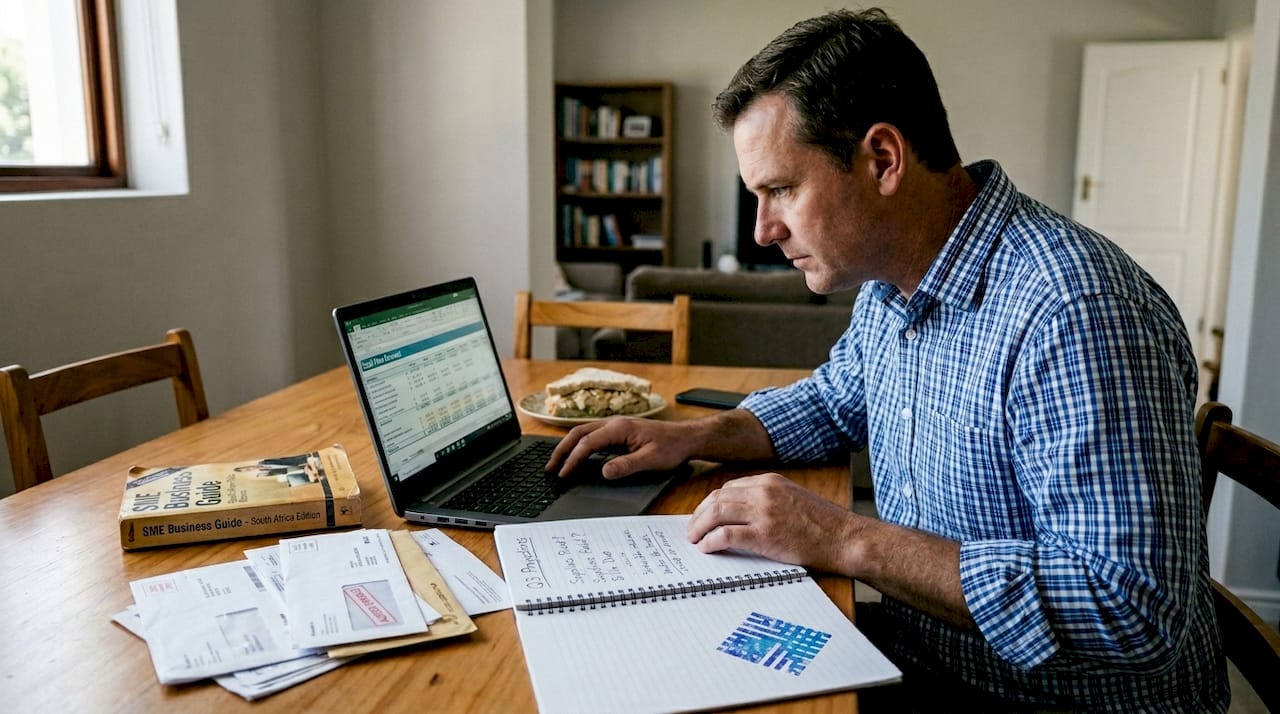
Executing your scaling plan: Step-by-step strategies for sustainable growth
Preparation sets the stage. Execution is where the real work happens. This is also where many business owners lose momentum because they try to do everything at once. Scaling works best as a sequenced, deliberate process.
Here is a proven execution sequence for South African SMEs:
- Automate your financial operations first. Before you scale anything else, get your numbers under control. Cloud accounting is the single highest-leverage move most SMEs can make.
- Standardise your service or product delivery. Growth exposes inconsistency. Document your processes so quality does not depend on any single person.
- Build your lead generation system. Marketing that relies on referrals alone cannot scale. Invest in repeatable, trackable channels.
- Hire for capacity, not just skills. The right hire at the right time accelerates growth. The wrong hire at the wrong time drains cash and morale.
- Review and adjust monthly. Scaling is not a set-and-forget exercise. Monthly reviews keep you responsive to what is actually happening.
Digital transformation drives efficiency for scaling businesses, while lack of systems is one of the top reasons marketing scale fails. This is not abstract advice. It means that if your back-end cannot handle the volume your marketing generates, you will disappoint customers and waste spend.
The digital transformation overview for accounting specifically shows how moving from manual to cloud-based systems reduces errors, speeds up reporting, and frees up owner time for strategic decisions. The cloud accounting benefits for small businesses include real-time visibility, automated reconciliations, and easier collaboration with your accountant.
Key areas to focus on during execution:
- Cash flow management: Weekly cash flow reviews, not monthly.
- Customer retention: It costs five times more to acquire a new customer than to keep an existing one.
- Team capacity: Scale your team slightly ahead of demand, not reactively.
- Technology stack: Invest in tools that integrate with each other to avoid data silos.
Pro Tip: When implementing digital transformation, start with one system, not five. Get your accounting software right first. Everything else flows from clean financial data.
Monitoring progress: Measuring results and avoiding common mistakes
Execution without measurement is guesswork. The businesses that scale successfully are the ones that track the right numbers, catch problems early, and adjust without ego.
The metrics that matter most during scaling:
- Gross profit margin: Are you actually making money as you grow, or just turning over more revenue?
- Cash conversion cycle: How long does it take from spending money to receiving it back?
- Customer acquisition cost vs. lifetime value: Is your growth profitable?
- Employee productivity: Are your people becoming more or less effective as the team grows?
- Debtor days: How long are clients taking to pay you?
Common mistakes that derail scaling efforts include poor bookkeeping, missed tax deadlines, and system gaps that let errors accumulate unnoticed. Avoiding bookkeeping mistakes is not just about accuracy. It protects your ability to make confident decisions based on real data. Similarly, avoiding tax compliance mistakes is critical because SARS penalties can destabilise a growing business overnight.
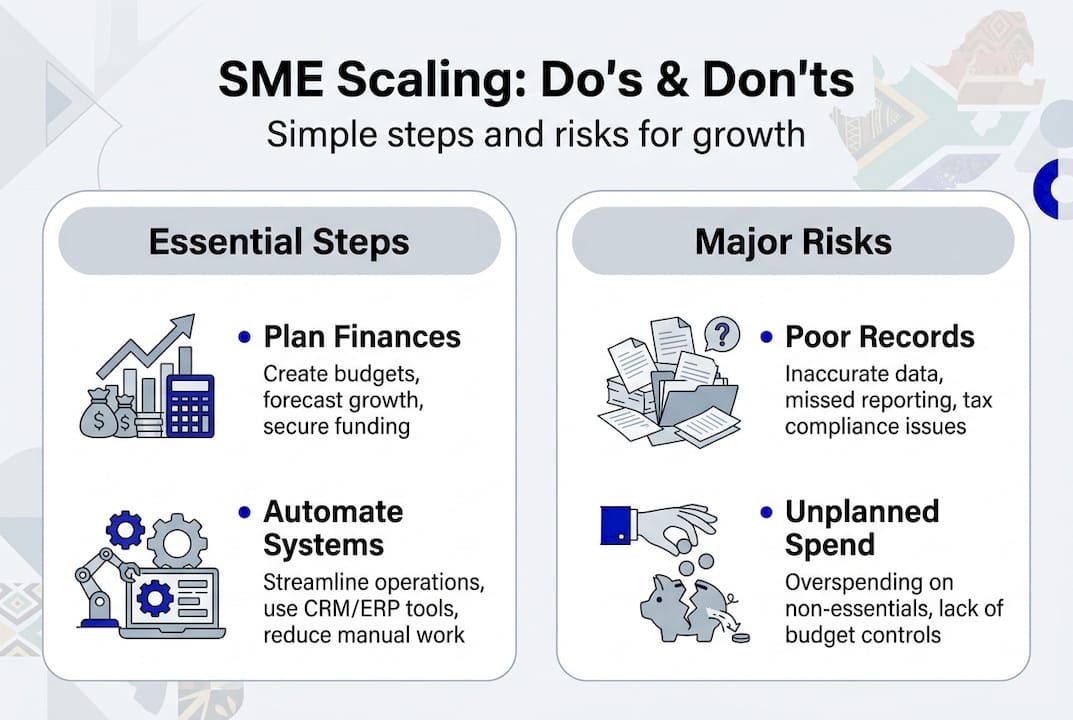
Knowing how to interpret your numbers is just as important as having them. Reading financial statements correctly allows you to spot trends before they become crises.
Pro Tip: Set up a simple monthly scorecard with five to seven key metrics. Review it on the same day each month. Consistency in monitoring is more valuable than complexity in measurement.
Statistic to remember: 70-80% of SMEs fail within five years, primarily because of cash flow and systems failures. Monitoring is not optional. It is the mechanism that keeps you in the surviving minority.
Feedback loops matter too. Talk to your customers, your team, and your accountant regularly. The information you need to course-correct is usually already available. The question is whether you are listening for it.
What most scaling advice misses: Sustainable success in the South African context
Most scaling guides are written for businesses operating in stable economies with easy access to capital and reliable infrastructure. South Africa is a different environment, and that demands a different mindset.
The uncomfortable truth is that many South African SME owners are trying to scale using frameworks designed for markets that do not look anything like ours. Chasing VC-style growth metrics in a constrained local market often leads to over-extension and collapse. A funding mismatch is a common pitfall, and the solution is not just finding more money. It is matching the right type of funding to your actual business needs, making realistic asks, and exploring diverse options beyond venture capital.
Constraints are not obstacles to growth. In our experience, they are often the catalyst for smarter, more resilient business models. When you cannot afford to hire ten people, you build better systems. When you cannot access cheap credit, you manage cash flow more carefully. These habits become competitive advantages.
Practical financial growth tips grounded in the South African context will always outperform generic advice. Sustainable scaling here means building a business that survives load shedding, currency shifts, and economic cycles. That is not a limitation. That is a strength.
Take the next step: How Ready Accounting supports your scaling journey
Scaling your business is achievable when you have the right financial systems and professional support behind you. At Ready Accounting, we work with South African SMEs to implement cloud accounting benefits that create real operational efficiency, from automated bookkeeping to real-time financial reporting. Our cloud accounting guide walks you through exactly how to make the transition without disrupting your business. We also offer tailored support in accounting automation, financial forecasting, and tax compliance so you can scale with confidence. Book a consultation with our team and let us help you build the financial foundation your growth deserves.
Frequently asked questions
What are the most common reasons South African SMEs fail to scale?
SMEs employ 60% of the workforce yet 70-80% fail within five years, primarily because of cash flow problems, weak operational systems, and mismatched funding options that create financial pressure at the worst possible time.
How can cloud accounting help my SME scale sustainably?
Cloud accounting drives efficiency for scaling businesses by providing real-time financial visibility, automating reconciliations, and simplifying reporting so you can make faster, better-informed decisions.
Which funding type is best for scaling my business in South Africa?
The best funding type matches your specific business need and growth stage. Diverse options beyond VC are essential for South African SMEs, including bank loans, government grants, and revenue-based financing, each suited to different situations.
What are the first steps before scaling operations?
Strategic pauses before big spends are essential. Start by strengthening your financial forecasting, building a realistic scaling budget, and upgrading your operational systems to handle increased volume before committing to growth investments.
Recommended
- How to create a budget for SA SMEs: step-by-step – Ready Accounting
- Grow your business with proven networking strategies – Ready Accounting
- Set financial goals for SME growth: a South African guide – Ready Accounting
- Goal setting for entrepreneurs: strategies to boost success – Ready Accounting
- How to improve Google rankings: proven SEO steps for SA SMEs