

How to restructure business finances for smes
Executive Summary
- Business financial restructuring involves reorganizing debt, expenses, and cash flow systems to restore profitability. Acting early when the debt service coverage ratio falls below 1.0 helps preserve creditworthiness and facilitates better lender negotiations. Operational reforms, combined with proactive creditor engagement, are essential for sustainable financial recovery.
Business financial restructuring is the process of reorganizing your company’s debt, expenses, and cash flow systems to restore profitability and prevent default. For South African SMEs, knowing how to restructure business finances is the difference between surviving a cash crisis and losing everything you have built. This guide covers the exact steps: from reading your Debt Service Coverage Ratio (DSCR) and building a 13-week cash flow forecast, to negotiating with creditors and fixing the operational leaks that quietly drain your revenue every month.
How to restructure business finances: know when to start
The right time to restructure is before you miss a payment, not after. Most business owners wait too long, and that delay costs them their negotiating power.
The clearest trigger is your DSCR falling below 1.0 for three consecutive months. A DSCR below 1.0 means your business generates less cash than it needs to cover its debt payments. That is not a warning sign. That is a structural problem requiring immediate action.
Other signals to watch:
- Negative free cash flow after operating expenses and debt payments for three or more months
- Suppliers tightening credit terms or demanding upfront payment
- Payroll funded by overdraft rather than operating revenue
- SARS debt accumulating because VAT or PAYE payments are being deferred
Early restructuring preserves creditworthiness and keeps your operations intact. Lenders have dedicated workout departments that handle distressed borrowers. Those departments exist to find solutions, not to foreclose immediately. But they respond far better to a business owner who calls them proactively with a plan than to one who has already defaulted.
Pro Tip: Contact your lender’s workout department before you miss a payment. Frame the conversation as a proactive update, not a distress call. Lenders reward transparency with better terms.
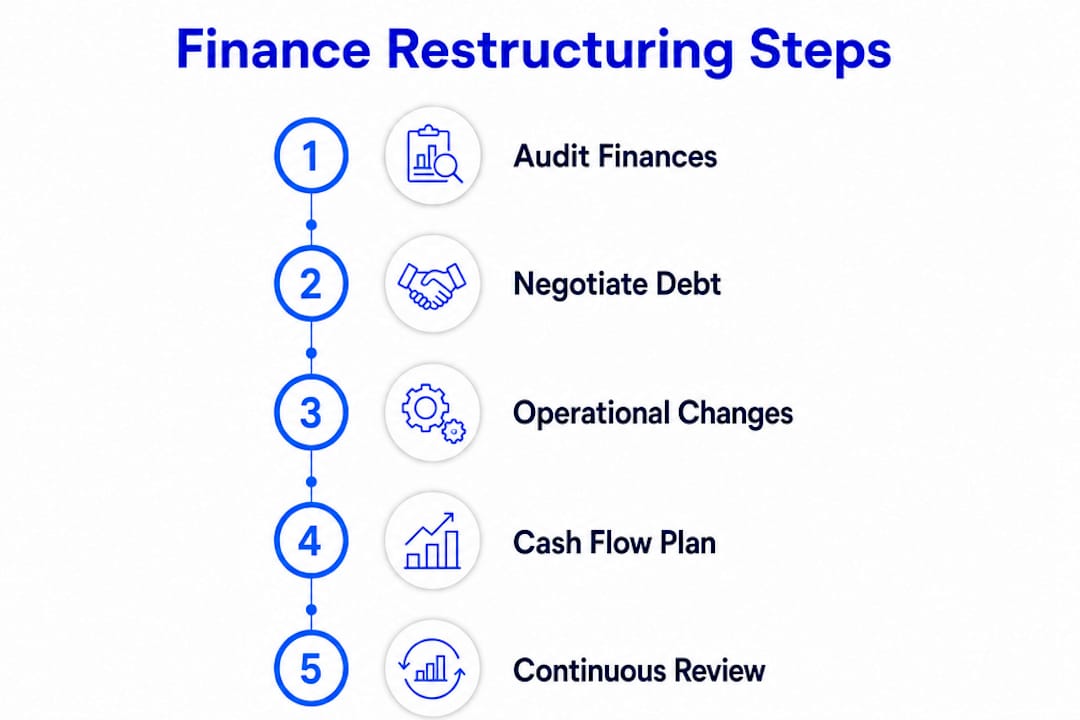
How do you audit your finances before restructuring?
A financial audit is the foundation of any restructuring plan. You cannot negotiate with creditors or cut costs intelligently without a clear picture of where your money goes.

Start by compiling a full debt profile. List every liability: bank loans, SARS debt, supplier credit, hire purchase agreements, and any director loans. Record the outstanding balance, interest rate, monthly payment, and maturity date for each. This single document will become your most important negotiating tool.
Next, separate personal and business finances completely. Mixed accounts damage lender trust and make it nearly impossible to produce credible financial statements. SAICA and SAIPA both flag this as one of the most common errors in SME accounting. Open a dedicated business account if you have not already done so.
Then build your 13-week rolling cash flow forecast. Here is what that looks like in practice:
| Week | Opening Balance | Expected Inflows | Expected Outflows | Closing Balance |
|---|---|---|---|---|
| 1 | R 45,000 | R 80,000 | R 95,000 | R 30,000 |
| 2 | R 30,000 | R 60,000 | R 75,000 | R 15,000 |
| 3 | R 15,000 | R 90,000 | R 70,000 | R 35,000 |
A 13-week rolling forecast is the most critical document lenders request during restructuring. It shows exactly when cash gaps will occur and demonstrates that you understand your own business. Readyaccounting’s guide on building a cash flow forecast walks through this process step by step for South African SMEs.
Pro Tip: Update your 13-week forecast every Monday morning. Stale forecasts mislead you and undermine creditor confidence. Treat it like a live dashboard, not a once-off document.
What are the best strategies for negotiating business debt?
Debt negotiation is a skill, and the business owners who approach it with a structured proposal get far better outcomes than those who simply ask for relief.
There are two paths: informal restructuring and formal restructuring. Informal restructuring covers payment term extensions, interest rate reductions, and temporary deferrals. Formal restructuring involves legal frameworks such as business rescue under the South African Companies Act. Start with informal options. They are faster, cheaper, and preserve your credit record.
Here is a practical sequence for informal debt negotiation:
- Prepare your proposal. Include a one-page summary of your cash flow shortfall, the specific modification you are requesting, and a realistic repayment forecast. Lenders prefer proposals that show a transparent shortfall, realistic forecasts, and specific term modification requests.
- Request a meeting with the lender’s workout department. Do not send an email and wait. Call and ask for a face-to-face or video meeting.
- Negotiate payment terms with suppliers. Extending Net-30 terms to Net-45 or Net-60 creates immediate cash flow relief without penalties or additional cost.
- Ask for an interest rate reduction or a payment deferral. Most lenders will agree to a 60 to 90 day deferral rather than risk a default.
- Document every agreement in writing. Verbal agreements are unenforceable. Get a signed addendum to your loan agreement for every change.
| Negotiation Option | Best For | Typical Outcome |
|---|---|---|
| Payment term extension | Supplier debt | 30–60 extra days of cash runway |
| Interest rate reduction | Bank loans | Lower monthly cash burden |
| Payment deferral | Short-term cash gaps | 60–90 day breathing room |
| Debt-for-equity swap | Significant insolvency risk | Lender takes equity stake |
For more detail on managing supplier and bank debt, Readyaccounting’s resource on reducing business debt covers the South African context specifically.
What operational changes improve cash flow fast?
Debt negotiation buys you time. Operational reform is what makes the restructuring permanent. The two must happen together.
Operational inefficiencies cause a 20–30% loss in potential top-line revenue for scaling companies. That is not a rounding error. For a business turning over R 2 million a year, that represents up to R 600,000 in recoverable revenue sitting in broken processes.
Focus on these four areas:
- Accelerate receivables. Sending invoices immediately after delivery and offering a 2% early payment discount dramatically improves cash velocity without borrowing more capital. The fastest way to improve your finances is accelerating receivables, not acquiring additional financing.
- Audit your customer base. High-maintenance customers who pay late, demand excessive support, and generate thin margins hurt profitability. Identify your bottom 20% by profit contribution and renegotiate or exit those contracts.
- Optimize inventory. Excess stock ties up cash. Run a monthly stock count and set reorder points based on actual sales velocity rather than gut feel.
- Cut fixed costs with a 90-day review. Go through every debit order and recurring expense. Cancel subscriptions you are not using. Renegotiate office leases. Reduce non-essential travel.
Pro Tip: Run a customer profitability analysis using your accounting software before cutting any client. Some clients who feel difficult are actually your most profitable. Numbers, not feelings, should drive that decision.
South African SMEs also have a specific lever that many overlook: VAT cash flow timing. If you are on the invoice basis for VAT, switching to the payments basis (for businesses under the SARS threshold) means you only pay VAT when your customer pays you. That single change can free up significant cash during a restructuring period. Speak to a SARS-registered tax practitioner before making that switch.
Understanding your cash flow problems at a structural level is what separates businesses that survive restructuring from those that cycle through the same crisis every 18 months.
Key takeaways
Restructuring business finances requires a combination of honest financial auditing, creditor negotiation, and operational reform executed in the right sequence.
| Point | Details |
|---|---|
| Act before default | Restructure when DSCR falls below 1.0 for three months, not after missing payments. |
| Build a 13-week forecast | This document is your most credible tool with lenders and your clearest internal planning guide. |
| Separate finances first | Mixed personal and business accounts destroy lender credibility and obstruct restructuring progress. |
| Negotiate with a proposal | Lenders respond to specific, data-backed requests, not vague appeals for help. |
| Fix operations, not just debt | Recovering the 20–30% revenue lost to inefficiencies makes restructuring sustainable long-term. |
The uncomfortable truth about financial restructuring
Most business owners I work with come to restructuring six months too late. They have been managing the symptoms: shuffling payments, dipping into personal savings, delaying VAT submissions to SARS. By the time they ask for help, their options have narrowed considerably.
Financial restructuring is not a failure. It is a mature management decision that lenders actually respect when handled transparently. The businesses I have seen recover fastest are the ones where the owner called the bank before the bank called them.
The other pattern I see consistently is the damage caused by mixed personal and business finances. It is not just an accounting inconvenience. When a lender reviews your books and cannot tell where the business ends and the owner begins, they assume the worst. Clean books are not a nice-to-have during restructuring. They are the price of admission to a credible negotiation.
My honest advice: treat your 13-week cash flow forecast as a non-negotiable weekly discipline, not a document you produce when things go wrong. The businesses that maintain real-time financial visibility rarely end up in crisis. And if they do, they recover faster because they already have the data their lenders need.
Restructuring is also not a one-time event. The operational reforms, the tighter receivables management, the customer profitability reviews — these become permanent habits. That is what turns a restructuring from a rescue into a genuine competitive advantage.
— Johan
How Readyaccounting supports your financial restructuring
Readyaccounting works with South African SMEs and startups to replace manual bookkeeping with cloud-based financial infrastructure that gives you real-time visibility into your cash position. If you are working through a restructuring, that visibility is not optional. It is what makes every negotiation and operational decision credible.
From SARS compliance and VAT management to building the cash flow forecasts your lenders require, Readyaccounting acts as your Fractional CFO. Explore how accounting automation improves cash flow and removes the administrative friction that slows down your recovery. You can also review the ultimate guide to accounting automation to see exactly how South African SMEs are using technology to manage their finances more effectively in 2026.
FAQ
What is business financial restructuring?
Business financial restructuring is the process of reorganizing a company’s debt, expenses, and cash flow systems to restore liquidity and profitability. It includes informal steps like renegotiating payment terms and formal options like business rescue under the South African Companies Act.
When should a small business start restructuring finances?
Start restructuring when your DSCR falls below 1.0 for three consecutive months or when you experience negative free cash flow after operating expenses and debt payments. Acting early preserves your creditworthiness and negotiating options.
What do lenders want to see in a restructuring proposal?
Lenders want a transparent explanation of your cash flow shortfall, a realistic 13-week forecast, and a specific request such as a payment deferral, interest rate reduction, or covenant relief. Vague requests without supporting data are rarely approved.
How do i improve cash flow without taking on more debt?
The fastest method is accelerating receivables: invoice immediately after delivery and offer early payment discounts. Auditing your customer base to exit unprofitable contracts and extending supplier payment terms from Net-30 to Net-60 also improve cash flow without new borrowing.
Does restructuring affect my SARS compliance?
Restructuring does not automatically affect your SARS obligations, but it creates an opportunity to address any outstanding VAT or PAYE debt. SARS offers payment arrangements for compliant taxpayers. Engage a registered tax practitioner early to avoid penalties and protect your compliance record during the process.