
Execution Framework: reduce tax liability for South African Scaling Companies
Executive Summary
- Proper tax planning and record-keeping help South African SMEs legitimately reduce their tax liability.
- Claiming all eligible deductions and taking advantage of government incentives directly lowers taxes owed.
- Regular review and professional advice ensure compliance, maximize savings, and prevent costly penalties.
Every rand of unnecessary tax paid is a rand that never grows your business. Many South African SMEs overpay simply because they react to tax season instead of planning for it. The good news is that reducing your tax liability is completely legal, structured, and within reach for any business owner willing to take a few deliberate steps. This guide walks you through the core strategies: understanding what you owe and why, claiming every legitimate deduction, leveraging government incentives, avoiding costly mistakes, and verifying your results year after year.
Table of Contents
- Understanding your tax liability: What you must know first
- Claiming all legitimate deductions: The fastest route to savings
- Taking advantage of special incentives and accelerated depreciation
- Avoiding common pitfalls: Compliance, edge cases, and when to get help
- Verifying your results: Tools, timelines, and ongoing strategies
- A smarter approach: Why proactive tax reduction pays off every year
- Ready to reduce your tax liability? Get expert help or explore more guides
- Frequently asked questions
Key Takeaways
| Point | Details |
|---|---|
| Know your tax types | Understanding all business taxes helps SMEs avoid overlooked liabilities and find the biggest saving opportunities. |
| Maximize deductions | Claiming all legitimate expenses and maintaining documentation can directly reduce taxable income. |
| Use incentives and depreciation | Government incentives and asset depreciation rules offer major upfront savings if used correctly. |
| Stay compliant | Good records and timely reviews prevent lost deductions and costly penalties for South African businesses. |
| Get expert support | Consulting a tax specialist improves compliance and reliably increases after-tax profits every year. |
Understanding your tax liability: What you must know first
Your tax liability is the total amount of tax your business legally owes to SARS (South African Revenue Service) for a given period. It is not a fixed number. It shifts based on your income, expenses, structure, and how well you manage your records. Understanding it is the first step toward reducing it.
South African SMEs face several types of taxes. Each one has its own rules, deadlines, and consequences for non-compliance.
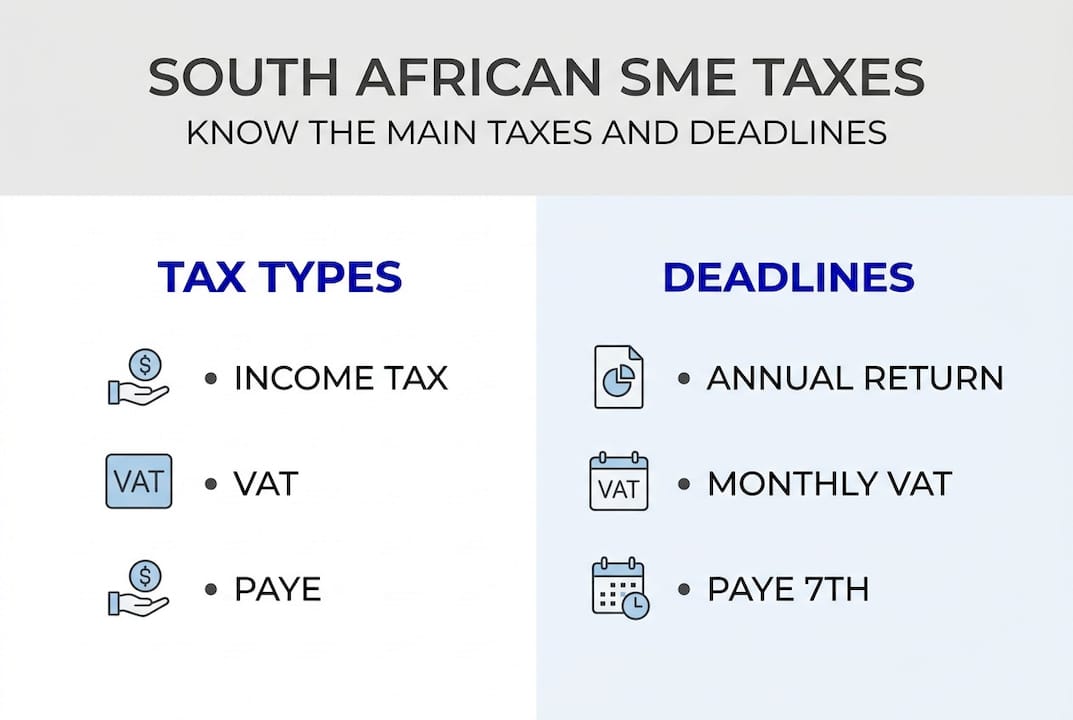
| Tax type | Who it applies to | Key deadline |
|---|---|---|
| Income tax | All registered businesses | Annual return |
| VAT | Turnover above R1 million | Monthly or bi-monthly |
| PAYE and UIF | Businesses with employees | Monthly |
| Capital gains tax | On disposal of business assets | Annual return |
Understanding tax compliance for SMBs means knowing which of these apply to you and staying current on each. Many business owners only think about income tax and miss obligations like PAYE or provisional tax, which creates penalties before the year even ends.
The most common pitfalls that inflate your liability include:
- Missing provisional tax deadlines (February and August)
- Failing to register for VAT once turnover crosses the threshold
- Mixing personal and business expenses in one account
- Not keeping invoices or bank statements to support claims
Poor records lead to reversed deductions and monthly penalties that compound quickly. A solid grasp of small business tax essentials and a working knowledge of the types of business taxes you face will save you money before you even touch a deduction.
Pro Tip: Open a dedicated business bank account if you have not already. It is the single fastest way to clean up your records and make tax time far less stressful.
Claiming all legitimate deductions: The fastest route to savings
Deductions reduce your taxable income, which directly lowers the tax you owe. Yet many SME owners either miss deductions entirely or claim them incorrectly and have them reversed. The rule is simple: an expense must be incurred in the production of income, it must be documented, and it must not be capital, personal, or a fine.

According to a complete 2025 checklist of deductible business expenses, you can claim rent and utilities, marketing costs, employee salaries plus UIF and PAYE contributions, professional fees, bad debts, bank and merchant fees, staff training, and a proportional share of home office costs. That is a wide net, and most businesses are not casting it fully.
Here is a practical comparison to help you distinguish what qualifies:
| Deductible | Not deductible |
|---|---|
| Office rent | Home mortgage capital |
| Business vehicle fuel (with logbook) | Personal travel |
| Staff salaries and bonuses | Owner drawings |
| Accounting and legal fees | Fines and penalties |
| Marketing and advertising | Personal entertainment |
To claim deductions correctly, follow these steps:
- Separate every business expense into its own category from day one.
- Keep the original invoice or receipt for every transaction.
- For vehicle use, maintain a logbook with date, destination, purpose, and kilometres.
- For home office claims, calculate the percentage of your home used exclusively for business.
- Submit claims with supporting documentation attached to your tax return.
Exploring deductible business expenses in detail will show you categories you may have overlooked. And if you want to go further, smart tax-saving strategies can help you build a full-year plan around your spending patterns.
Pro Tip: Use cloud accounting software to tag expenses by category in real time. Waiting until year-end to sort receipts is where most deductions get lost or rejected.
Taking advantage of special incentives and accelerated depreciation
Beyond standard deductions, the South African government offers targeted incentives that can dramatically reduce your tax bill. Most SMEs do not claim them, either because they do not know they exist or assume they do not qualify.
Accelerated depreciation is one of the most powerful tools available. Normally, a business asset is written off over several years. But for qualifying Small Business Corporations (SBCs), 100% first-year write-off applies to manufacturing assets and qualifying plant or machinery. Renewable energy assets qualify for a 125% deduction, and any asset under R7,000 can be written off immediately. On a R200,000 piece of equipment, that first-year deduction could save tens of thousands in tax.
| Asset type | Standard write-off | Accelerated write-off |
|---|---|---|
| Manufacturing machinery | Over 5 years | 100% year one (SBC) |
| Renewable energy assets | Over 3 years | 125% year one |
| Assets under R7,000 | Over useful life | Immediate |
Beyond depreciation, other incentives include:
- Section 11D: R&D 150% deduction for qualifying research and development spend.
- ETI (Employment Tax Incentive): Reduces PAYE liability when you employ young workers aged 18 to 29.
- Section 12B: Energy efficiency investments qualify for accelerated write-offs.
- SEZ rate: Businesses operating in Special Economic Zones pay a reduced 15% corporate tax rate.
These incentives require careful structuring. Reviewing tax efficient structures and aligning your year-end planning for SMEs with available incentives can make a material difference to your bottom line.
Pro Tip: SARS updates qualifying criteria annually. Set a reminder each March to review new incentives with your accountant before the financial year closes.
Avoiding common pitfalls: Compliance, edge cases, and when to get help
Taking action on incentives is powerful, but only if you avoid key risks. Many businesses claim deductions and incentives they are not actually entitled to, which triggers audits, penalties, and reversed savings.
Some of the most common ways businesses lose deductions include:
- Claiming vehicle costs without a logbook
- Mixing personal and business expenses
- Failing to meet the SBC definition due to investment income or personal service rules
- Missing submission deadlines and triggering automatic penalties
Edge cases catch many owners off guard. SBC disqualification occurs if more than 20% of income comes from investments, or if the business provides personal services without employing at least three unconnected employees. If you do not qualify as an SBC, you lose access to the preferential tax rates and accelerated depreciation that make the incentives so valuable.
Warning signs that you need professional help immediately:
- You have received a letter from SARS requesting supporting documents.
- Your provisional tax payments are consistently late or incorrect.
- You are unsure whether your business qualifies as an SBC.
- You have changed your business structure in the past year.
Poor records lead to reversed deductions and penalties ranging from R250 to R16,000 per month. A single missed document can wipe out an entire year of careful planning.
Knowing how to avoid tax penalties is as important as knowing how to claim savings. And if you have burning questions, reviewing common tax questions from other SME owners can surface issues you have not thought to ask yet.
Verifying your results: Tools, timelines, and ongoing strategies
With common risks in mind, let’s ensure those strategies actually deliver the results. Applying a deduction or incentive is only half the job. Verifying that it was applied correctly and will hold up under scrutiny is the other half.
Use this checklist to confirm your claims are solid:
- All deductions are supported by original invoices or bank statements
- Vehicle logbook is complete for the full tax year
- Home office percentage is calculated and documented
- SBC qualification criteria are confirmed with your accountant
- All incentive claims reference the correct SARS section
For tools, cloud accounting platforms like Xero or Sage allow you to tag transactions, generate expense reports, and flag anomalies before submission. These tools reduce human error and give you a live view of your tax position throughout the year.
Timelines matter too. Here is a simple review rhythm that works:
- Monthly: Reconcile accounts, confirm all expenses are categorised, and check PAYE submissions.
- Quarterly: Review year-to-date income and expenses with your accountant to adjust provisional tax estimates.
- Year-end: Run a full deduction and incentive checklist before submission, and confirm all documentation is filed.
Poor record-keeping can lead to reversed deductions and monthly penalties from R250 to R16,000, so the verification step is not optional. A tax year-end review should be a fixed event in your business calendar, not a last-minute scramble.
Pro Tip: Schedule a 30-minute quarterly check-in with your accountant. It costs far less than fixing a penalty or a missed claim after submission.
A smarter approach: Why proactive tax reduction pays off every year
Here is the uncomfortable truth most tax articles skip: the strategies in this guide are not secrets. SARS publishes them. Accountants explain them. Yet the majority of South African SME owners still overpay every year. The reason is not ignorance. It is timing.
Most business owners engage with tax once a year, under pressure, with incomplete records and no time to think strategically. That reactive pattern guarantees you will miss deductions, misapply incentives, and pay more than you should. Worse, it creates the false belief that paying more is somehow safer or more honest.
Proactive tax reduction is not aggressive or risky. It is what the tax code was designed to support. The incentives for R&D, renewable energy, and youth employment exist because government wants businesses to invest in those areas. Claiming them is not bending rules. It is participating in the system as intended.
The trusted SME tax guide we recommend makes this clear: businesses that build tax planning into their monthly operations consistently outperform those that treat it as an annual chore. A good accountant or tax consultant does not just file your return. They change how you make decisions throughout the year, and that shift pays for itself many times over.
Ready to reduce your tax liability? Get expert help or explore more guides
If saving more on tax and avoiding stress sounds right for you, here is how Ready Accounting makes the next steps simple. We work with South African SMEs to identify every legal saving available, from deductions and depreciation to incentives and structural planning. Our tax consulting services are built specifically for businesses like yours, where every rand matters and compliance cannot be left to chance. We also help you modernise how you manage finances through cloud accounting for SMEs, which makes record-keeping effortless and tax season far less painful. Explore our cloud accounting guide to see how the right tools and the right team work together to protect your profits.
Frequently asked questions
What expenses can I deduct to reduce tax liability?
You can deduct business expenses like rent, utilities, marketing, salaries, bank fees, training, and a proportional share of home office costs, provided each expense is documented and directly supports income production.
How does accelerated depreciation help South African SMEs?
Accelerated depreciation allows qualifying businesses to write off 100% of manufacturing assets in the first year, reducing taxable income far faster than the standard multi-year schedule.
When should a business owner consult a tax professional?
Consult a tax professional when you are unsure about deductions, compliance, or business structure, or when facing an audit, since mistakes trigger penalties and lost savings that far outweigh the cost of professional advice.
What is the biggest mistake businesses make with tax?
Poor record-keeping is the most costly mistake, as reversed deductions and penalties can reach R16,000 per month and undo an entire year of careful tax planning.