

How to maximize tax deductions for South African SMEs
Executive Summary
- South African SMEs can pay less tax by understanding and applying SARS rules for deductions and incentives. Proper documentation and year-round expense tracking help ensure deductions are accepted during audits. Leveraging incentives like ETI and Section 12E provides additional cash flow advantages.
Maximizing tax deductions is defined as the process of identifying every allowable business expense, applying the correct SARS rules, and maintaining proof that survives audit scrutiny. South African SMEs that do this well pay significantly less tax than those that don’t, not because they bend the rules, but because they know them. The South African Revenue Service (SARS) provides a clear framework under the Income Tax Act, and the business owners who benefit most are the ones who treat deduction planning as a year-round discipline, not a February scramble. This guide covers the key deductible categories, documentation requirements, and SARS incentives that matter most in 2026.
What business expenses qualify as tax deductions under South African law?
Every deductible expense must pass the Section 11(a) general deduction formula: it must be incurred in the production of income and not be capital in nature. That single test eliminates most personal expenses and forces business owners to think clearly about what they are actually claiming. Proof is as important as the expense itself.
The most common qualifying categories include:
- Operating expenses: Rent, utilities, marketing costs, professional fees (legal, accounting, consulting), and bank charges all qualify when incurred for business purposes.
- Capital allowances: Laptops, machinery, and office equipment depreciate over time. SARS allows wear and tear deductions under Section 11(e), typically over three to five years depending on the asset class.
- Home office expenses: Home office deductions require exclusive and regular use of a dedicated space. The deductible amount is calculated as the percentage of floor area used for business, applied to costs like rent, rates, electricity, water, insurance, and cleaning. A spare bedroom used occasionally does not qualify.
- Vehicle expenses: Fuel, maintenance, insurance, and wear and tear are deductible in proportion to business use. SARS requires a detailed logbook recording dates, kilometres, and business purpose for every trip. Without a compliant logbook, vehicle expense claims are routinely rejected.
- Bad debts: Under Section 11(i), irrecoverable debts are deductible. You need proof of the debt and evidence of recovery attempts, including emails, demand letters, and credit reviews. Bad debt write-offs do not require court proceedings, but they do require a paper trail.
- Training costs: Skills development expenses are deductible when directly related to current business operations. Personal courses unrelated to your trade do not qualify.
Pro Tip: Review your bank statements monthly and flag every expense that could have a business purpose. You will find deductions you missed simply because no one was looking.
The most overlooked deductions in South African SMEs are bad debts, learnership allowances, and training costs. These are legitimate, well-documented deductions that most business owners never claim because they are not visible in standard bookkeeping workflows.

How to document and organize records to ensure SARS accepts your deductions
Organized records are the single biggest factor in whether SARS accepts or rejects your claims. Digital archiving of invoices and receipts is not optional. Common audit failures come from missing proof of purchase, not from incorrect calculations.
Follow this process to build an audit-proof record system:
- Separate business and personal accounts. Use a dedicated business bank account and business credit card. Mixing personal and business transactions is the fastest way to lose deductions and trigger SARS queries.
- Capture every expense at the point of transaction. Photograph receipts immediately. Cloud accounting platforms sync directly with your bank and categorize transactions in real time, removing the end-of-year reconstruction problem.
- Maintain a vehicle logbook every trip. Record the date, starting point, destination, kilometres, and business purpose. SARS will not accept estimates or reconstructed logs.
- Document home office use with photographs and a floor plan. Exclusive use claims require physical evidence. A photograph of a dedicated office space and a floor plan showing the percentage of total area used for business will support your claim in an audit.
- Run a monthly expense review. Set aside 30 minutes at the end of each month to reconcile transactions, confirm categorization, and flag anything that needs additional documentation before the memory fades.
Pro Tip: Create a shared folder in Google Drive or a similar cloud service with subfolders for each expense category. Name every file with the date and supplier. When SARS sends a verification request, you retrieve documents in minutes instead of days.
The goal is to make your records so organized that a SARS auditor can verify every claim without asking you a single follow-up question. That level of preparation also gives you confidence to claim everything you are entitled to, because you know you can prove it.
What special SARS incentives can South African SMEs leverage?
SARS offers several incentives that go well beyond standard operating deductions. Most SMEs claim none of them. The ones that do gain a meaningful cash flow advantage.
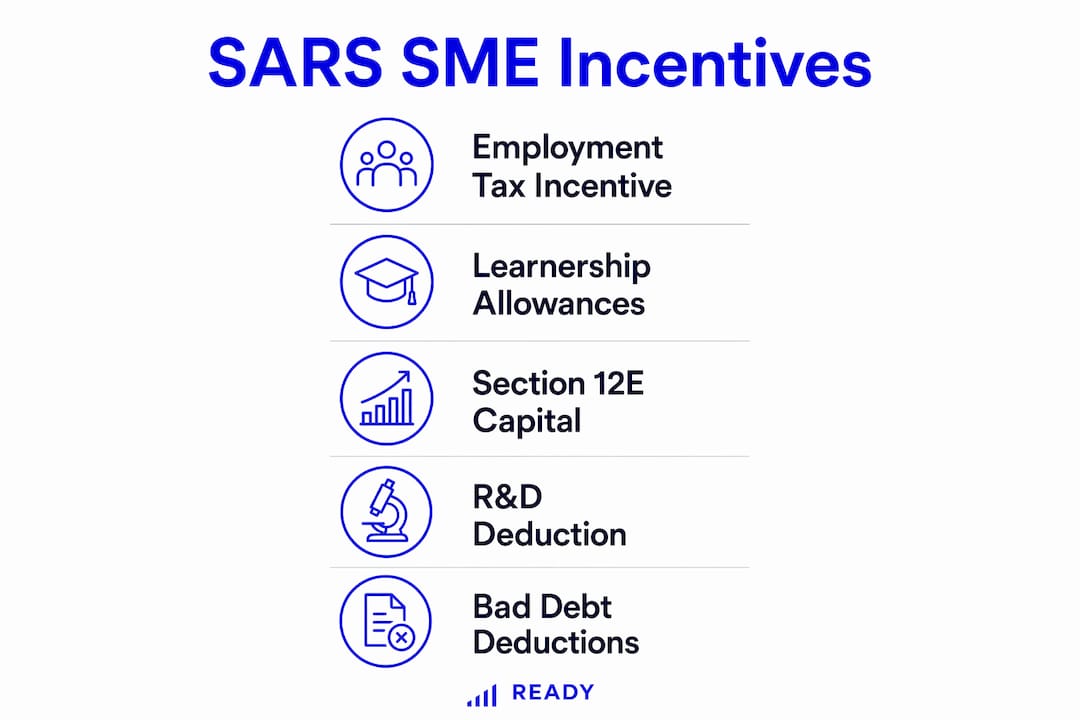
Employment Tax Incentive (ETI)
The ETI allows qualifying employers to reduce PAYE liability by up to R1,500 per month per qualifying young employee. The employee must be between 18 and 29 years old, earn within the qualifying wage band, and be employed in a qualifying role. This is a direct reduction in tax payable, not just a deduction from income.
Learnership and skills development allowances
Employers registered for the Skills Development Levy can claim learnership allowances ranging from R40,000 to R60,000 per learner per year, depending on whether the learner has a disability. Submitting a workplace skills plan through your Sector Education and Training Authority (SETA) may also recover part of your training spend through grants. Training and skills development expenses are separately deductible when directly related to your business.
Section 12E accelerated capital allowances
Section 12E enables a 100% immediate deduction for qualifying plant and machinery owned by Small Business Corporations (SBCs) used directly in manufacturing. Leased equipment does not qualify. This is particularly powerful in the early years of a manufacturing business, where capital expenditure is high and cash flow is tight.
Research and Development deduction
The R&D deduction allows a 150% deduction on qualifying research and development expenditure. Pre-approval from the Department of Science and Innovation is required before claiming. This incentive suits tech-focused SMEs and product developers who are already spending on innovation.
| Incentive | Benefit | Key requirement |
|---|---|---|
| Employment Tax Incentive (ETI) | Up to R1,500/month per employee | Employee aged 18–29, qualifying wage |
| Learnership allowance | R40,000–R60,000 per learner | SETA registration, qualifying NQF learnership |
| Section 12E allowance | 100% immediate write-off | SBC status, owned manufacturing assets |
| R&D deduction | 150% of qualifying spend | Pre-approval from Department of Science and Innovation |
Step-by-step process to maximize your deductions throughout the tax year
Maximizing tax savings is a year-round process. Business owners who wait until submission time leave money on the table every year.
- Map your deductible expenses at the start of the financial year. List every recurring cost and categorize it as fully deductible, partially deductible, or personal. This creates a baseline and highlights gaps in your current claiming strategy. The tax planning guide for South African SMEs from Readyaccounting covers the 2026 incentive landscape in detail.
- Implement monthly expense tracking. Reconcile your accounts monthly. Categorize every transaction and attach supporting documents before the month closes. This prevents the year-end scramble that causes missed deductions.
- Review your vehicle logbook quarterly. Check that every business trip is recorded. If you use your vehicle for less than 50% business purposes, a travel allowance structure may produce a better tax outcome than a full vehicle expense claim.
- Check ETI and learnership eligibility before hiring. If you are planning to hire, structure the role to qualify for ETI or a learnership allowance before the contract is signed. Retroactive qualification is not possible.
- Submit claims before SARS deadlines. Provisional tax deadlines fall in august and february for most SMEs. Late submissions attract penalties and interest that erode the value of your deductions.
- Get professional advice on complex claims. R&D deductions, Section 12E allowances, and ETI calculations have specific conditions. A qualified tax practitioner registered with SAIPA or SAICA will identify claims you would miss and structure them correctly.
The most common reason SARS disallows deductions is not fraud. It is poor documentation. Business owners who claim correctly but cannot prove it lose the same amount as those who overclaim. The top deductions every SA business should claim are well-established. The gap is always in the proof.
How to handle SARS audits and deduction disputes
SARS audits are triggered by patterns, not random selection. Knowing the red flags lets you prepare before a query arrives.
- Excessive home office claims are a primary audit trigger. Claims exceeding 40% of residence area attract scrutiny. If your home office genuinely occupies that proportion, document it thoroughly with photographs, a floor plan, and a lease or rates account showing the property address.
- Unsupported bad debt write-offs without demand letters or credit review records are frequently reversed on audit. Keep the full communication trail for every debt you write off.
- Missing Section 18A donation certificates for charitable contributions will result in those deductions being disallowed. Request the certificate at the time of donation, not after the fact.
- Inconsistent income and expense ratios compared to prior years or industry norms can trigger a desk audit. If your expenses spike in a particular year, document the reason clearly.
When SARS does send a verification request, respond within the stated timeframe with organized, labeled documents. A tax practitioner registered with SAIPA or SAICA can manage the response process and present your evidence in the format SARS expects. For guidance on avoiding compliance failures, the cost of professional representation is almost always lower than the cost of a disallowed deduction plus penalties.
Key takeaways
South African SMEs that maximize tax deductions do so by combining correct expense categorization, audit-proof documentation, and active use of SARS incentives like ETI and Section 12E allowances.
| Point | Details |
|---|---|
| Section 11(a) is the baseline test | Every deduction must be incurred in income production and supported by proof. |
| Documentation wins audits | Logbooks, photographs, invoices, and digital records determine whether SARS accepts your claims. |
| ETI delivers direct tax savings | Qualifying employers reduce PAYE by up to R1,500 per month per young employee. |
| Section 12E benefits manufacturing SMEs | A 100% immediate write-off on owned plant and machinery improves early-year cash flow. |
| Year-round tracking beats year-end recovery | Monthly reconciliation prevents missed deductions and reduces audit risk. |
What I have learned about tax deductions after years of working with South African SMEs
The conventional advice is to “keep your receipts.” That is true, but it misses the real problem. Most business owners I work with do keep receipts. They just keep them in a shoebox, a WhatsApp folder, or a Gmail inbox with no labels. When SARS sends a verification request, the receipts exist but cannot be found or presented in a usable format. The deduction gets disallowed not because the expense was illegitimate, but because the proof was inaccessible.
The second thing I have seen consistently is that business owners underestimate what they can claim. They know about rent and salaries. They do not know about bad debts, learnership allowances, or the ETI. These are not obscure loopholes. They are published SARS incentives that most SMEs simply never investigate. The practical strategies for South African SMEs that actually move the needle are the ones that combine standard deductions with these targeted incentives.
My honest view is that aggressive tax planning and SARS compliance are not in tension. The business owners who claim the most are usually the ones with the best records, because they had to build the systems to support the claims. Discipline in documentation is not a burden. It is the mechanism that makes every legitimate deduction stick.
— Johan
How Readyaccounting helps South African SMEs reduce their tax liability
Readyaccounting works with South African SMEs to identify every deductible expense, apply the correct SARS incentives, and maintain documentation that holds up under audit. The firm replaces manual bookkeeping with cloud infrastructure that captures transactions in real time, categorizes expenses automatically, and flags missing documents before they become a problem. For business owners who want to reduce tax liability without spending hours on administration, Readyaccounting acts as a Fractional CFO, turning your finance function into a tax defense asset. The firm’s accounting automation approach also improves cash flow visibility, so you always know where you stand before provisional tax deadlines arrive.
FAQ
What is the Section 11(a) general deduction formula?
Section 11(a) of the Income Tax Act allows a deduction for any expense incurred in the production of income, provided it is not capital in nature. Every business expense claim must satisfy this test before SARS will accept it.
How do I claim a home office deduction from SARS?
The space must be used exclusively and regularly for business. You calculate the deductible amount as the percentage of total floor area used for business, applied to qualifying costs like rent, rates, electricity, and insurance. Photographs and a floor plan are required to support the claim.
What is the Employment Tax Incentive and who qualifies?
The ETI reduces your monthly PAYE liability by up to R1,500 per qualifying employee aged 18 to 29 who earns within the qualifying wage band. The employee must be employed in a qualifying role and the employer must be registered for PAYE with SARS.
Can I deduct bad debts without going to court?
Yes. SARS allows bad debt deductions under Section 11(i) without legal proceedings. You need documentation showing the debt is irrecoverable, including emails, demand letters, and a credit review or board resolution confirming the write-off.
What triggers a SARS audit on tax deductions?
Common triggers include home office claims exceeding 40% of residence area, unsupported bad debt write-offs, missing Section 18A donation certificates, and expense ratios that differ significantly from prior years or industry norms. Organized records and compliant documentation reduce audit risk substantially.