

How to manage payroll compliantly in SA: 2026 guide
Executive Summary
- Proper payroll compliance in South Africa involves timely registration for PAYE, UIF, SDL, and COID, along with accurate calculation and submission of declarations.
- Using automated cloud payroll software ensures adherence to SARS regulations, simplifies filings, and reduces costly errors for SMEs.
Compliant payroll management in South Africa is defined as the accurate calculation of employee remuneration, statutory deductions, and timely submissions to SARS under the Income Tax Act, the Unemployment Insurance Act, and the Skills Development Levies Act. For South African SMEs, this means registering correctly for PAYE, UIF, and SDL, processing payroll with current tax tables, and meeting every EMP201 and EMP501 deadline without exception. Knowing how to manage payroll compliantly SA is not optional. SARS penalties, interest charges, and reputational damage follow non-compliance quickly. The good news is that with the right structure, software, and a payroll compliance checklist, this process is entirely manageable for any SME owner.
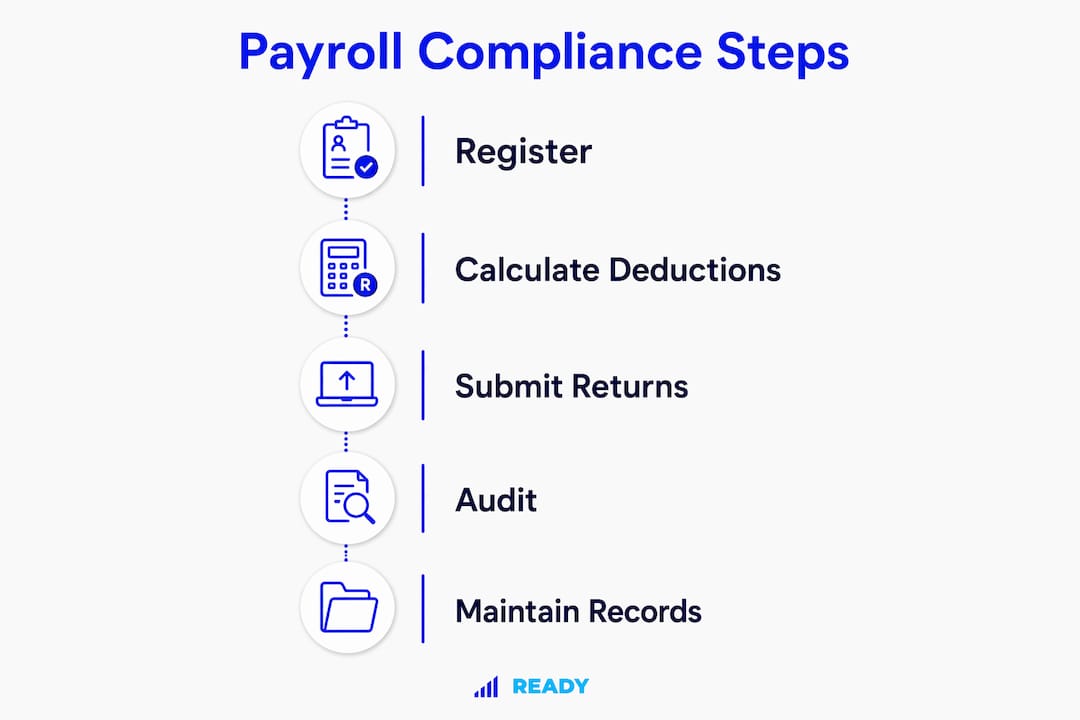
What are the mandatory registrations required for payroll compliance in SA?
Payroll compliance is an ongoing monthly discipline that begins before you process your first payslip. Every employer in South Africa must register with SARS for the correct statutory obligations, and the deadlines are strict.
The four core registrations every employer needs:
- PAYE registration: Required when any employee earns above R8,250 per month. Registration must happen within 21 days of hiring your first qualifying employee. Missing this window triggers penalties before you have even processed a single payslip.
- UIF registration: Compulsory for almost all employees regardless of hours worked or salary level. Both the employer and employee contribute 1% each of the employee’s gross remuneration.
- SDL registration: Applies when your total annual payroll exceeds R500,000. The levy funds the Sector Education and Training Authorities (SETAs) and is calculated at 1% of your total payroll.
- COID registration: Required with the Compensation Fund. You must renew your Letter of Good Standing annually. Lapsed COID cover exposes your business to significant liability if an employee is injured on duty.
Late registration does not just attract a fine. SARS can back-date your liability to the date you should have registered, meaning you owe contributions, penalties, and interest simultaneously.
Pro Tip: Register for all four obligations at the same time, even if your payroll is currently below the SDL threshold. Growth can push you over R500,000 in annual payroll faster than most SME owners expect, and retroactive SDL assessments are painful.
How to calculate and process payroll deductions accurately
Accurate payroll calculation starts with correctly identifying gross pay. Gross remuneration includes basic salary, overtime, bonuses, commission, travel allowances, and any taxable fringe benefits. Each component is treated differently under the Fourth Schedule of the Income Tax Act, so getting this right from the start prevents cascading errors downstream.
A structured payroll calculation follows these steps:
- Calculate gross remuneration by adding all salary components, including taxable allowances and fringe benefits.
- Apply PAYE using the current SARS tax tables and annual rebates. The primary rebate for the 2026/2027 tax year applies to all taxpayers. PAYE is calculated on an annualised basis and divided by the number of pay periods.
- Deduct employee UIF at 1% of gross remuneration. UIF is capped at R17,712 monthly for the 2026/2027 tax year, meaning the maximum employee deduction is R177.12 per month.
- Calculate employer UIF at the same 1% rate, matched to the employee contribution. This is a cost to the business, not a deduction from the employee’s pay.
- Calculate SDL at 1% of total payroll if your annual payroll exceeds R500,000. SDL is an employer cost only.
- Apply any other deductions such as pension fund contributions, medical aid, or garnishee orders, ensuring each is correctly classified as pre-tax or post-tax.
| Deduction | Rate | Who pays | Monthly cap |
|---|---|---|---|
| PAYE | Progressive (SARS tables) | Employee | No cap |
| Employee UIF | 1% of gross | Employee | R177.12 |
| Employer UIF | 1% of gross | Employer | R177.12 |
| SDL | 1% of total payroll | Employer | No cap |
A common and costly mistake is forgetting the employer UIF contribution entirely. It does not appear on the employee’s payslip, so it is easy to overlook when building your payroll model. Outdated payslip templates are another frequent problem. Every time SARS updates tax thresholds or rebates, your payslip calculations must reflect those changes immediately.
Pro Tip: Download the SARS tax tables at the start of every tax year (March) and update your payroll model before processing the first payroll run of the new year. Set a calendar reminder for the last week of February.
What are the monthly and biannual SARS submission requirements?
SARS requires two types of payroll submissions from every registered employer. Missing either one triggers automatic penalties.
Monthly EMP201 declarations must be submitted and paid by the 7th of the month following the payroll period. The EMP201 declares your total PAYE, UIF, and SDL for that month. Late EMP201 returns attract a 10% penalty plus interest on the outstanding amount. That 10% compounds quickly if you miss multiple months.
Biannual EMP501 reconciliations are submitted twice a year: at interim (covering March to August) and at year-end (covering March to February). The EMP501 reconciles all your monthly EMP201 declarations against the IRP5 tax certificates you issue to employees. Discrepancies between your EMP201 totals and your IRP5 certificates are a direct audit trigger.
Best practices for staying on top of SARS submissions:
- Use a compliance calendar that marks every EMP201 due date and both EMP501 windows. A payroll compliance calendar is the single most effective tool for avoiding missed deadlines.
- Reconcile your payroll ledger monthly, not just at EMP501 time. Errors caught monthly take minutes to fix. Errors discovered at year-end can take days.
- Issue accurate IRP5 certificates to every employee annually. Employees use these to file their personal income tax returns. Incorrect IRP5s create problems for your employees and attract SARS scrutiny back to your business.
- Retain all payroll records for a minimum of five years. SARS can audit any period within that window.
Pro Tip: Set your internal payroll processing deadline to the 3rd of each month, not the 7th. This gives you a four-day buffer to resolve any payment or submission errors before the SARS deadline.
How can SMEs use software to maintain compliant payroll practices?
Manual payroll management carries risks that grow with every statutory change SARS introduces. Cloud payroll software with real-time tax updates removes the human error risk from PAYE, UIF, and SDL calculations and keeps your payslips compliant automatically.

| Feature | Manual payroll | Cloud payroll software |
|---|---|---|
| Tax table updates | Manual, error-prone | Automatic with each SARS change |
| EMP201 preparation | Spreadsheet-based | Auto-generated from payroll data |
| Audit trail | Paper-based or fragmented | Digital, timestamped, searchable |
| IRP5 generation | Manual compilation | Automated at year-end |
| Compliance alerts | None | Built-in deadline reminders |
Registered payroll software automates PAYE, UIF, and SDL calculations and simplifies filing EMP201 and EMP501 returns directly to SARS. This matters because the statutory trio changes regularly. A software solution that updates automatically means you are never running payroll on last year’s rates.
When selecting payroll software for your South African SME, look for SARS-recognised solutions, built-in Employment Tax Incentive (ETI) management, and exception reporting that flags anomalies before submission. You can find a practical breakdown of best payroll management strategies that covers software selection criteria in detail.
Pro Tip: Before committing to any payroll software, confirm it is listed on the SARS recognised payroll software register. Unrecognised software may not generate compliant EMP201 or IRP5 files.
What are the most common payroll compliance mistakes SA SMEs make?
Most payroll penalties in South African SMEs trace back to a small set of recurring errors. Knowing them in advance is the most direct way to avoid them.
- Misclassifying workers as independent contractors when they meet the criteria for employees under the Labour Relations Act. Contractors do not attract PAYE, UIF, or SDL. Misclassification creates backdated liability.
- Skipping employer UIF contributions because they do not appear on the payslip. Both the employer and employee portions must be declared on the EMP201.
- Missing SDL registration when payroll crosses R500,000 annually. Many SMEs grow past this threshold mid-year and only discover the obligation during a SARS audit.
- Using outdated tax tables after the annual SARS budget changes. This is the leading cause of incorrect PAYE deductions.
- Late or missing SARS returns triggering the automatic 10% penalty plus interest.
- Failing to issue IRP5 certificates on time, which delays employee tax returns and draws SARS attention to your submissions.
Common payroll mistakes including skipping employer UIF and missing SDL registration cause costly penalties that proactive internal audits and payroll software can prevent entirely.
“Payroll compliance is not a year-end task. It is a monthly operational discipline that protects your business, your employees, and your relationship with SARS.”
Pro Tip: Schedule a quarterly internal payroll audit. Pull three months of payslips, cross-check them against your EMP201 submissions, and verify that your tax tables match the current SARS rates. Thirty minutes per quarter prevents hours of remediation.
Key takeaways
Compliant payroll management in South Africa requires correct registrations, accurate monthly calculations, and on-time SARS submissions every single month without exception.
| Point | Details |
|---|---|
| Register before you pay | PAYE, UIF, SDL, and COID registrations must be in place within 21 days of your first employee. |
| Cap your UIF correctly | UIF contributions are capped at R17,712 monthly; always apply the current SARS threshold. |
| Meet every EMP201 deadline | Submit and pay by the 7th of each month to avoid the automatic 10% penalty plus interest. |
| Automate statutory updates | Cloud payroll software eliminates outdated tax table errors and generates compliant IRP5 certificates. |
| Audit quarterly | A quarterly payroll review catches errors before they compound into SARS penalties or audit triggers. |
Payroll compliance is a discipline, not a deadline
I have worked with dozens of South African SME owners who treat payroll as something to sort out once a year when the EMP501 is due. That approach is expensive. By the time the reconciliation reveals a problem, you are looking at months of incorrect deductions, potential penalties, and the stress of correcting IRP5 certificates that employees have already used to file their tax returns.
The businesses that handle payroll well share one habit: they treat it as monthly operational hygiene, the same way they treat bank reconciliations. They do not wait for SARS to flag an issue. They run their own checks first.
The other pattern I see consistently is that SME owners who invest in proper payroll software early save far more than the software costs. The time saved on manual calculations, the penalties avoided, and the audit confidence that comes from a clean digital trail are worth multiples of any monthly subscription fee.
My honest advice: do not wait until your payroll is complex to get it right. Start with the correct registrations, use a compliance calendar, and get software that updates automatically with SARS changes. If you are unsure whether your current payroll setup is compliant, a payroll compliance review is a far cheaper exercise than a SARS audit.
— Johan
Let Readyaccounting handle your payroll compliance
Readyaccounting builds cloud payroll infrastructure for South African SMEs that removes the manual risk from PAYE, UIF, and SDL calculations entirely. Our systems automate monthly EMP201 preparation, generate compliant IRP5 certificates at year-end, and flag statutory changes before they affect your next payroll run. You get a clean audit trail, deadline alerts, and expert support without adding headcount. If you want to understand how payroll automation improves cash flow and reduces your SARS exposure, we can show you exactly what that looks like for your business. Contact Readyaccounting to schedule a payroll compliance review.
FAQ
What registrations does an employer need for payroll compliance in SA?
Every South African employer must register for PAYE (if any employee earns above R8,250 per month), UIF (for almost all employees), SDL (if annual payroll exceeds R500,000), and COID with the Compensation Fund. Registration must happen within 21 days of hiring your first employee.
When must EMP201 returns be submitted to SARS?
EMP201 declarations must be submitted and paid by the 7th of the month following each payroll period. Late submissions attract an automatic 10% penalty plus interest on the outstanding amount.
What is the UIF contribution rate and cap for 2026?
UIF is deducted at 1% from the employee’s gross salary and matched by the employer at 1%. Both contributions are capped at a monthly remuneration of R17,712 for the 2026/2027 tax year.
How does cloud payroll software reduce compliance risk?
Cloud payroll software applies current SARS tax tables automatically, generates EMP201 and IRP5 files in compliant formats, and provides built-in deadline alerts. This removes the human error risk that makes manual payroll management unreliable after every SARS budget update.
How long must payroll records be retained in South Africa?
SARS requires employers to retain all payroll records, including payslips, EMP201 submissions, and IRP5 certificates, for a minimum of five years. Records must be available for inspection during any SARS audit within that period.
Recommended
- Payroll Management Made Simple: A Complete Protocol for South African Employers | Ready Accounting
- Steps to implement payroll services for your employees | Ready Accounting
- Payroll compliance checklist: Easy steps for SA SMEs | Ready Accounting
- Payroll best practices for South African SMEs in 2026 | Ready Accounting