

How to handle petty cash: A guide for business owners
If you’re wondering how to handle petty cash properly, the short answer is this: fix a float amount, put one named person in charge of it, require a numbered voucher and a receipt for every rand spent, and reconcile the box on a set schedule. That’s the whole system. Everything else is detail.
Here’s the same idea as a checklist you can act on before lunch:
- Set a fixed float. Decide the total amount the fund will hold and never let it drift up or down without a documented top-up.
- Appoint one custodian. One named person controls the cash box. Nobody else touches it.
- Use numbered vouchers. Every payout gets a sequential voucher number, no exceptions.
- Attach a receipt to every voucher. No receipt, no reimbursement, full stop.
- Reconcile on schedule. Weekly for a busy office, monthly if the fund barely moves.
- Restore the float only after reconciling. Never top up an unreconciled box.
The moment your petty cash spend starts climbing past a few thousand rand a month, or you find yourself chasing three different people for receipts, that’s your signal to stop fighting paper and shift the workflow onto a digital expense tool instead.
Key Takeaways
Handling petty cash correctly comes down to one fixed float, one named custodian, numbered vouchers with receipts, and a reconciliation schedule you never skip.
| Point | Details |
|---|---|
| Fix the float and the custodian | Set one imprest amount and appoint a single named person accountable for the box. |
| Require a voucher and receipt every time | No receipt means no reimbursement, and every voucher gets a sequential number. |
| Reconcile on a real schedule | Count cash plus receipts against the float weekly for busy offices, monthly for low-volume ones. |
| Separate custody from approval | The person handling cash should never also authorise replenishment unsupervised. |
| Digitise once volume grows | Move to expense apps or cards once cash requests happen several times a week or exceed a few hundred dollars monthly. |
| Get expert help when it slips | Readyaccounting can set up your petty cash policy or automate the whole workflow through its cloud accounting and Fractional CFO services. |
Table of Contents
- What is petty cash, and what should it actually pay for?
- Why do businesses still bother with petty cash?
- How do you set up a petty cash system correctly?
- How should you disburse cash and record each transaction?
- When and how should you replenish the float?
- How often should you reconcile, and what controls actually stop fraud?
- What should petty cash cover, and what are reasonable spending limits?
- When should you replace physical cash with a digital workflow?
- What mistakes trip up most small businesses, and how does automation fix them?
- Why strict petty cash controls matter more than owners think
- How Readyaccounting helps you get petty cash under control
- Sources
What is petty cash, and what should it actually pay for?
Petty cash is a small, fixed amount of physical cash kept on hand to cover minor, infrequent business expenses that are impractical to pay by EFT or card. It runs on what accountants call the imprest system: you start with a set amount, spend from it, and top it back up to that exact same starting figure once you’ve accounted for what left the box.
In a typical small office, that means things like stationery top-ups, postage stamps, a courier fee for an urgent document, tea and coffee for the staff room, parking for a client meeting, or emergency taxi fare when someone’s stranded without cash. These are the transactions too small and too irregular to justify a purchase order or a bank transfer.
What petty cash should never touch: salaries, supplier invoices, recurring subscriptions, or anything that should leave a paper trail through your normal accounts payable process. The moment a “petty” expense becomes regular or gets above your per-item limit, it belongs in your main bookkeeping workflow, not the cash box. Mixing the two is one of the fastest ways to lose track of where money actually went, something we cover in more detail in our piece on common bookkeeping mistakes.
Why do businesses still bother with petty cash?
Cash still wins on speed. Nobody wants to wait two days for an EFT to clear so the office can buy a roll of packing tape.
The upside is real:
- It settles small, immediate needs without banking delays or transfer fees.
- It avoids the administrative overhead of raising a purchase order for a $5 expense.
- Staff don’t need company card access or reimbursement paperwork for tiny, one-off costs.
The downside is just as real:
- Cash is the easiest asset in a business to lose track of, quietly or otherwise.
- Missing receipts and undocumented “loans” from the box are common, and they compound fast.
- Reconciliation drifts when nobody owns the process, and by month three, nobody can explain a $200 shortfall.
The imprest method exists specifically to contain that risk. Reconcile more often if your team spends from the box daily.
A simple decision rule works here: keep physical cash for low-frequency, low-value needs where speed genuinely matters. If your team is requesting reimbursements more than a few times a week, or amounts are creeping above $500 (or your local equivalent), it’s time to look at a card program or a digital expense app instead of expanding the cash float.
How do you set up a petty cash system correctly?
Getting the setup right the first time saves you months of cleanup later. Follow these steps in order:
- Decide the float size. Base it on roughly a month of expected small expenses. Vendor guidance commonly suggests a modest float for a small office, and you should adjust that to your local currency and actual spend volume.
- Appoint a single custodian. Pick one person, name them in writing, and hold them accountable for the box. This isn’t about trust, it’s about traceability.
- Choose secure storage. A lockable cash box or small safe, kept somewhere that isn’t a shared drawer everyone has a key to.
- Set per-item limits. Cap individual payouts (say, $25 to $50 or your local equivalent) so anything larger automatically routes through normal payment channels.
- Write a one-page policy. Cover authorised uses, the single-custodian rule, the no-personal-use rule, mandatory receipt attachment, and voucher numbering.
- Pick a replenishment cadence. Weekly, fortnightly, or monthly, matched to how fast the fund actually depletes.
- Number your vouchers sequentially and file receipts as you go. A gap in the sequence is the first thing an auditor will notice, and it’s the easiest thing to prevent.
If you’re running a South African business, keep SARS record-keeping requirements in mind from day one. Petty cash vouchers and receipts count as source documents, and SARS expects supporting records to be retained for VAT and income tax purposes just like any other expense.
Pro Tip: Number your vouchers as a printed pad, not loose slips of paper. A missing voucher number is far more obvious than a missing receipt, and it forces whoever broke the sequence to explain why, before small problems become recurring habits.
How should you disburse cash and record each transaction?
The moment someone asks for petty cash is where most control failures start, so the process needs to be automatic, not improvised. Here’s the flow that actually holds up:
- Employee requests funds and states the purpose and estimated amount.
- Custodian approves the request against the policy (is it an allowed expense category, is it under the per-item limit?).
- A voucher is completed before cash changes hands, and the voucher should record the date, voucher number, amount, purpose, payee name, and a signature.
- Cash is handed over and the employee goes and makes the purchase.
- The receipt is attached to the voucher the same day, not “sometime this week.”
- The custodian logs the entry in the petty cash book or the petty cash module of your accounting software, referencing the voucher number.
On the bookkeeping side, each disbursement debits the relevant expense account (stationery, postage, refreshments) and credits petty cash. When the fund is replenished from the bank, that transaction debits petty cash and credits the bank account. It’s a simple entry, but it only stays simple if every voucher is captured the day it happens rather than reconstructed from memory at month-end.
One rule matters more than any other here: the custodian who hands out cash should never also be the person who authorises the replenishment or records the journal entries unsupervised. Separating those roles is the single most effective fraud deterrent available to a small office, according to guidance on petty cash management. If you’re a two-person office and can’t fully separate those duties, at minimum have a second person review and initial the reconciliation before any top-up is approved.

When and how should you replenish the float?
Replenishment follows a deceptively simple equation: opening float = cash remaining + total value of receipts on hand. If those two numbers don’t add up to your original float, you have a discrepancy to investigate before you top up, not after.
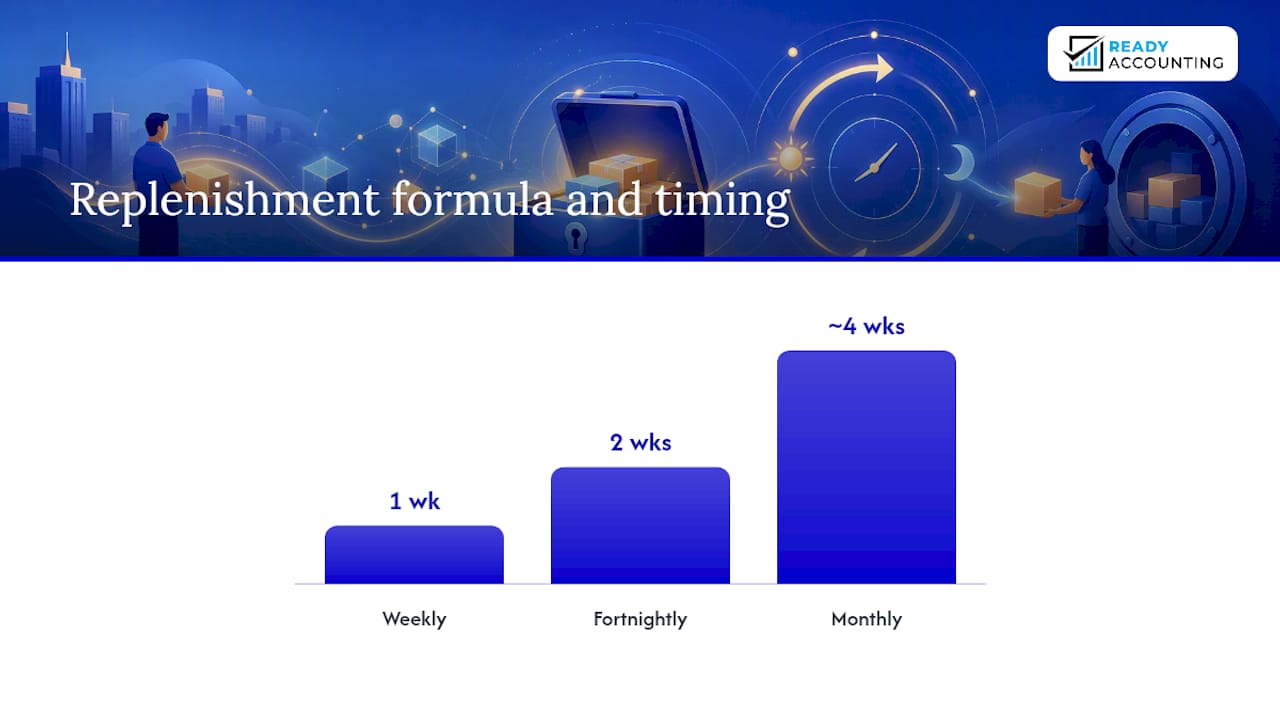
Two common triggers work well for deciding when to replenish. The first is a fixed schedule, weekly, fortnightly, or monthly, chosen to match how quickly the fund actually empties.
When you do replenish, withdraw exactly enough to restore the fund to its original imprest amount, no more and no less. Allocate the withdrawal across the correct expense accounts based on the vouchers submitted, and where VAT applies to a purchase (a valid tax invoice for stationery or courier services, for example), capture the input VAT correctly rather than lumping it into the gross expense figure. That distinction matters at tax time.
Whoever signs off on the replenishment request should not be the custodian who spent the cash. Require the full stack of vouchers and receipts as the supporting documentation attached to that sign-off, not a verbal summary of “roughly what we spent this week.”
How often should you reconcile, and what controls actually stop fraud?
Reconciliation is where most petty cash systems either prove themselves or fall apart, and it needs to happen on a schedule you actually keep, not “whenever someone remembers.” A weekly count suits a busy office where the fund turns over fast; monthly is enough for a low-volume operation where the box barely moves between top-ups.
Run through this checklist every time you reconcile:
- Count the physical cash remaining in the box.
- Total the value of all receipts and vouchers since the last reconciliation.
- Add cash plus receipts and compare the total to the fixed float amount.
- Investigate any variance immediately, even a small one, rather than writing it off as “close enough.”
- Sign off the reconciliation with both the custodian’s and a second person’s initials.
Watch for a few recurring red flags: receipts that go missing repeatedly, suspiciously round numbers on vouchers (a $50 “stationery” claim with no itemised slip), a persistent small shortage that never quite balances, or a voucher pad with skipped numbers. Any one of these on its own might be an honest mistake. A pattern of them is a control failure.
The controls that actually prevent this, according to guidance on month-end bank and petty cash cycles, are unglamorous but effective: a locked box with a limited number of keyholders, occasional surprise counts nobody warns the custodian about in advance, strict segregation of duties, pre-numbered vouchers, and a signed reconciliation every single cycle. None of these require software or budget. They just require discipline.
Pro Tip: Do a surprise count once a quarter, at minimum, even in a tiny office. The predictability of “we always reconcile on the last Friday of the month” is exactly what lets a small, ongoing shortfall hide for months.
What should petty cash cover, and what are reasonable spending limits?
Petty cash should stay narrow. Widen the categories it covers and you dilute the whole point of having tight limits in the first place.
Reasonable uses:
- Office supplies and stationery top-ups
- Postage and small courier fees
- Staff reimbursements under a defined per-item cap
- Parking, toll fees, or emergency taxi fares
- Tea, coffee, and small refreshment purchases for the office
What to keep out of the box:
- Supplier invoices of any size, these belong in accounts payable
- Equipment purchases, even small ones
- Payroll or wage advances
- Recurring subscriptions or services
Per-item caps commonly sit somewhere between $25 and $50 (or the local equivalent), a range that lets the fund cover genuine small expenses without becoming a shadow payment channel for larger, uncontrolled spending, per Xero’s petty cash guidance.
Treat these as a starting point, not a rule. Localise the currency to whatever your business trades in, and adjust the float up or down based on how often you’re actually dipping into it. A float that sits untouched for three weeks is oversized; a float that runs dry every second day is undersized.
When should you replace physical cash with a digital workflow?
Physical cash makes sense until it doesn’t, and for a lot of small businesses that tipping point arrives faster than expected. Several digital alternatives can absorb the same spending without the box, the keys, or the monthly count.
The main options worth considering:
- Prepaid or corporate cards issued to specific staff with preset spending limits
- Employee expense apps that capture a receipt photo at the point of purchase and route it for approval instantly
- Petty cash modules built into cloud accounting software, which auto-post transactions to the correct ledger accounts
- Mobile receipt capture, even as a standalone habit, which eliminates the “I lost the slip” problem entirely
A sensible way to migrate is to pilot the new workflow with one team before rolling it out company-wide. Require a receipt photo at the moment of purchase, not at month-end reconstruction, and connect the tool to your accounting software so approved expenses auto-create journal entries rather than requiring manual capture later. For a deeper look at what to automate first, our guide on cloud accounting benefits walks through the practical starting points. On the pure expense-tracking side, this breakdown of tracking steps covers habits worth building regardless of which tool you choose.
Digital tools don’t remove the need for policy or approval limits, they just make the audit trail tamper-proof and the reconciliation near-instant. Decide to decommission physical cash entirely once your digital pilot has run cleanly for a full quarter with no reconciliation gaps.
What mistakes trip up most small businesses, and how does automation fix them?
The same handful of mistakes show up in almost every petty cash cleanup we’ve seen, and they’re worth naming plainly. Missing receipts top the list, usually because someone paid cash for a genuine business expense and never got a slip, or lost it before month-end. Infrequent reconciliation is close behind: a box that only gets counted once a quarter accumulates errors nobody can trace back to a specific date. Poor segregation of duties is the third, where one person requests, approves, and records the same transaction with no second set of eyes anywhere in the chain.

Each of these looks minor in isolation. At month-end or during an audit, they compound into hours of reconstruction work and, occasionally, an unexplained variance that nobody can resolve.
A simple automated workflow closes most of these gaps at once: an employee submits a request through an app, a manager approves it digitally, the receipt is photographed at the point of purchase, the entry auto-posts to the ledger, and the fund tops up on a scheduled trigger rather than an ad hoc request. Read more in our guide to tasks worth automating first.
Pro Tip: Automation should remove the manual data entry and the lost paperwork, not the human judgment calls. Keep surprise counts and reimbursement sign-offs as manual steps even after you digitise everything else.
The return on this kind of setup is rarely dramatic, but it’s consistent: a few hours of bookkeeping time saved every month, and a measurably lower chance that a small, recurring shortfall goes unnoticed for half a year.
Why strict petty cash controls matter more than owners think
Small business owners tend to treat petty cash as the least important line item in their books, right up until an auditor flags a gap in the voucher sequence or a SARS query asks for supporting documentation that was never filed. The businesses that avoid that conversation are almost always the ones that treated a $10 tea fund with the same discipline as their bank account.
The pattern we see repeatedly is straightforward: a business sets up petty cash informally, with no named custodian and no voucher system, and it runs fine for a year or two. Then growth hits, more staff start dipping into the box, and suddenly nobody can explain three months of drift between what should be in the fund and what’s actually there. The fix is never complicated. It’s a named custodian, numbered vouchers, and a reconciliation date on the calendar that actually gets kept. Businesses that make that change almost always report cleaner month-ends and far fewer awkward questions when the annual financial statements get compiled.
.
How Readyaccounting helps you get petty cash under control
If reading through voucher numbering, imprest maths, and reconciliation schedules made you realise your current setup is a shoebox and good intentions, you’re not alone, and you don’t have to fix it by hand. Readyaccounting builds the cloud accounting infrastructure and automation that turns a manual petty cash process into a system that reconciles itself, flags variances before they become month-end surprises, and keeps every voucher and receipt filed the way SARS expects.
Whether you need a one-off policy setup and voucher template, a pilot automation of your expense capture, or ongoing bookkeeping oversight as a Fractional CFO service, Readyaccounting scopes engagements to match. Read our full breakdown of how automation improves cash flow, or get in touch for a short review of your current petty cash workflow and a practical plan to tighten it, cash-based or fully digital.
Sources
A handful of sources cover petty cash policy and procedure better than most, and each is worth bookmarking for a specific purpose.
- Petty cash: what it is and how to manage it properly | Xero ZA
- Petty Cash: A Complete Guide for South African Businesses
- Petty Cash and Cash Drawers - Division of Financial Services
If you’d rather have a professional set this up properly the first time, Readyaccounting can review your current process or design a policy from scratch. Visit Readyaccounting to get started.