

Forecast cash flow for your South African SME

Running a business without a cash flow forecast is like driving at night with no headlights. You might know the road, but you will not see the pothole until it is too late. A cash flow forecast is a projection of every rand you expect to receive and every rand you expect to pay out over a defined period, typically a rolling 12-month horizon. It tells you, in advance, whether you will have enough cash to pay salaries, settle your VAT, and keep the lights on.
Every reliable forecast is built on four core elements:
- Opening balance: the exact cash in your bank at the start of each period
- Cash inflows: revenue from settled invoices, cash sales, loans, grants, and asset sales
- Cash outflows: payroll, rent, supplier payments, PAYE/UIF, VAT, and provisional tax
- Closing balance: what remains after inflows minus outflows, which becomes next month’s opening balance
South African SMEs carry an extra layer of complexity here. SARS deadlines are fixed and non-negotiable, so PAYE, UIF, VAT, and provisional tax must appear in your forecast as hard line items, not afterthoughts. Miss them and you face penalties that compound fast.
How to forecast cash flow: a step-by-step process
Building a forecast from scratch feels daunting, but it follows a clear sequence. Work through these steps in order and you will have a usable projection within a few hours.
-
Define your forecast period. Most businesses run a 12-month rolling forecast updated monthly. If your cash position is tight, run a weekly 13-week view alongside it to catch short-term gaps before they become crises.
-
Record your opening balance. Pull the actual bank balance for the first day of your forecast period. This is your baseline. Everything else flows from it.
-
Map all expected cash inflows. List every source: customer receipts (adjusted for your actual debtor days, not your invoice terms), cash sales, loan drawdowns, grants, and any asset disposals. If a client typically pays in 60 days, put the cash in month two, not month one.
-
Apply collection probabilities to your debtors. Current invoices carry a high collection probability; invoices over 90 days old carry a much lower one. Weighting your receivables this way keeps your inflow estimates honest.
-
List all expected cash outflows. Include rent, salaries, supplier payments, loan repayments, and every statutory obligation. SARS requires PAYE and UIF by the 7th of each month, VAT by the 25th of every second month, and provisional tax twice a year. These dates go into your forecast as fixed commitments.
-
Build in your assumptions explicitly. Write down every assumption: debtor days, creditor terms, expected sales growth, and seasonal fluctuations. Lenders and investors will scrutinise these, and documenting them forces you to be realistic rather than optimistic.
-
Compile the forecast period by period. Calculate net cash flow (inflows minus outflows) for each month, add it to the opening balance, and carry the result forward as the next period’s opening balance. A negative closing balance in any month is a warning you now have time to act on.
-
Run “what if” scenarios. Test what happens if sales drop by 10% or a major client pays 30 days late. Scenario planning converts your forecast from a static document into a decision-making tool.
Understanding the three types of cash flow activities
Not all cash movements are the same, and grouping them correctly gives you a much clearer picture of where your money actually comes from and where it goes.
Operating cash flows cover the day-to-day engine of your business:
- Revenue collected from customers (not invoiced, collected)
- Payroll and related costs including PAYE and UIF contributions
- Supplier payments for stock and services
- Rent, utilities, and general operating expenses
Investing cash flows reflect decisions about your asset base:
- Purchases of equipment, vehicles, or property
- Proceeds from selling assets
- Capital expenditure on technology or infrastructure upgrades
Financing cash flows show how you fund the business and service that funding:
- Loan drawdowns and repayments
- Interest payments
- Equity injections from shareholders
- Dividend payments
Tracking these three categories separately matters because a business can show strong operating cash flow while bleeding cash through poor financing decisions, or vice versa. A Johannesburg-based manufacturer with a healthy order book can still run out of cash if it funds a new machine purchase entirely from working capital while sitting on a 60-day debtor cycle.
Tips for keeping your forecast accurate and useful
A forecast you build once and never touch again is worse than no forecast. It gives you false confidence. These practices keep yours sharp:
- Update it monthly at minimum. Drop the completed month, add a new month at the far end, and reconcile every line against actual bank movements. Variance analysis, comparing what you forecast against what actually happened, is where the real learning occurs.
- Use conservative assumptions. Assume customers pay slower than your terms allow, because in South Africa, they often do. Build your forecast on realistic historic payment patterns, not contractual ones.
- Incorporate seasonality. A retail business in December looks nothing like the same business in February. Adjusting for seasonal cycles prevents the over-optimistic mid-year forecasts that catch owners off guard.
- Never assume supplier flexibility. Extended payment terms with suppliers are a negotiated agreement, not a right. Build your forecast on confirmed terms only.
- Use cloud accounting software. Platforms that connect directly to your bank feed give you real-time data, which makes updating your forecast faster and more accurate. Readyaccounting’s cloud accounting guide explains how this works in practice for South African businesses.
- Build a cash buffer. Financial experts recommend three to six months of operating expenses held in reserve. This is not idle cash; it is insurance against the unexpected supplier price hike or broken equipment that would otherwise force you into expensive emergency debt.
Pro Tip: Set a recurring calendar reminder on the first working day of each month to update your forecast and compare actuals. Businesses that do this consistently spot cash shortfalls six to eight weeks before they hit, which is exactly enough time to act.
South African SME cash flow challenges and compliance

South African SMEs face a specific set of pressures that generic forecasting guides simply do not address. Corporate clients routinely stretch payment terms to up to 150 days, and government invoices frequently sit unpaid well beyond the standard 30-day window. This is not a cash flow management failure on your part; it is a structural feature of the South African market that your forecast must account for explicitly.
A staggering 70% to 80% of South African SMEs fail within their first five years, primarily due to poor cash flow management rather than lack of demand or poor products. A forecast does not guarantee survival, but the absence of one is a reliable predictor of failure.
Statistic to know: South African SMEs face a 70% to 80% failure rate within five years, with poor cash flow management cited as the primary cause, not weak sales.
Compliance is where many SMEs get blindsided. Your forecast must treat statutory payments as fixed, non-negotiable outflows. PAYE and UIF fall due by the 7th of each month. VAT returns and payments are due by the 25th of every second month. Provisional tax falls twice a year. Miss any of these and SARS penalties compound quickly. The tax planning guide from Readyaccounting maps out these deadlines in detail.
When your forecast reveals a shortfall caused by a delayed government payment or a slow-paying corporate client, bridging finance through fintech lenders like Bridgement or GroWise Capital can convert outstanding receivables into immediate cash. These platforms integrate directly with your accounting software and move faster than traditional bank facilities.

Pro Tip: Register as a Small Business Corporation (SBC) with SARS if you qualify. For the 2025/2026 tax year, SBCs pay 0% tax on the first R99,000 of taxable income and only 7% on income between R99,001 and R365,000. That tax saving belongs in your forecast as a real cash benefit.
What to do next: putting your forecast to work
Accurate cash flow forecasting is not a once-off exercise. It is a discipline, and like any discipline, the value compounds over time as your assumptions get sharper and your variance analysis gets tighter.
The practical steps to act on now:
- Build or update your 12-month rolling forecast this week, using actual bank data as your opening balance
- Add every SARS deadline as a fixed outflow with the correct due date
- Set a monthly review date and stick to it
- Run at least two scenarios: one where your biggest client pays 30 days late, and one where sales come in 10% below plan
- Consider accounting automation to reduce the manual effort of keeping your forecast current
Readyaccounting works with South African SMEs and VC-backed startups to build real-time cash flow dashboards, manage SARS compliance, and act as a Fractional CFO when you need financial leadership without the full-time cost. If your forecast is telling you something uncomfortable, that is exactly the right time to get expert eyes on it.
Key takeaways
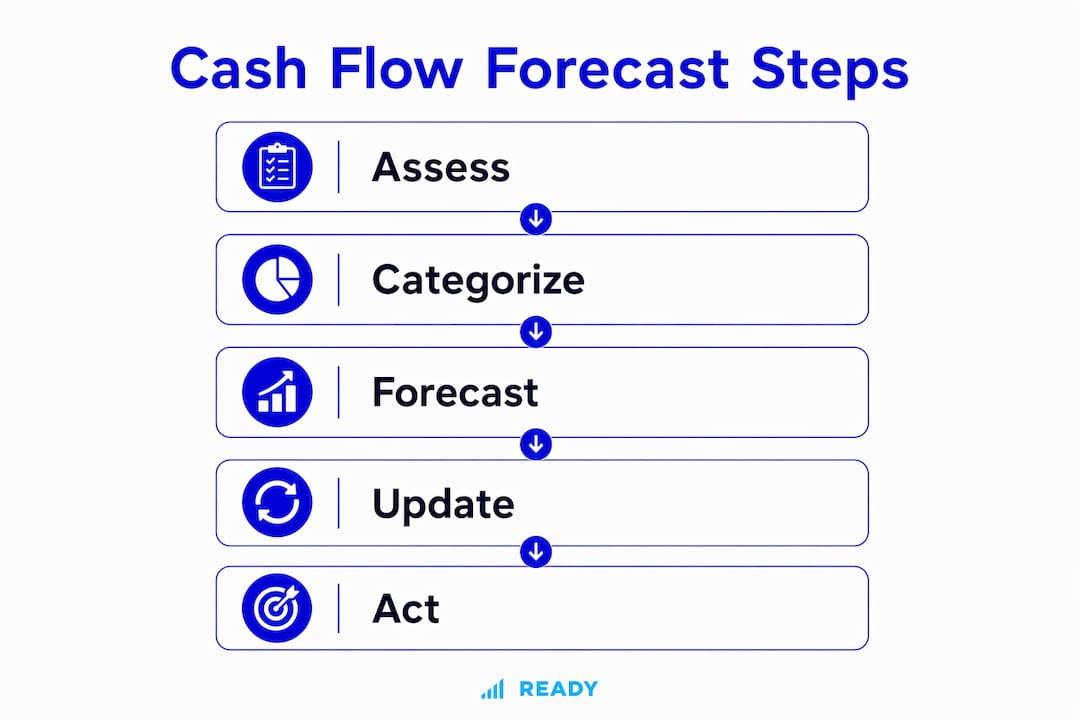
Accurate cash flow forecasting is the single most effective tool South African SMEs have to avoid the liquidity crises that drive the majority of early-stage business failures.
| Point | Details |
|---|---|
| Use a rolling 12-month forecast | Update it monthly, dropping the past period and adding a new one to maintain a forward view. |
| Fix statutory payments in your forecast | PAYE/UIF is due by the 7th, VAT by the 25th bi-monthly, and provisional tax twice yearly. |
| Account for slow payment cycles | South African corporate clients can stretch to 150 days; build your inflows around actual payment patterns. |
| Build a cash buffer | Aim for three to six months of operating expenses held in reserve to absorb shocks without emergency debt. |
| SME failure is largely preventable | The 70%–80% five-year failure rate among South African SMEs is driven primarily by poor cash flow management. |