

How to find a reliable tax consultant for your business
Executive Summary
- Finding a registered tax consultant affiliated with a Recognised Controlling Body ensures professional accountability and compliance.
- Building a shortlist through referrals, directories, and industry relevance helps select reliable candidates who can provide proactive tax planning.
Finding the right tax consultant can feel like one of the most consequential decisions you make as a small business owner in South Africa. Get it wrong and you are exposed to SARS penalties, missed deductions, and the kind of compliance gaps that surface at the worst possible moment. This guide walks you through exactly how to find a reliable tax consultant for my business owners often struggle to identify, covering credentials, research, vetting, and formalising the relationship so you hire with confidence rather than guesswork.
Table of Contents
- Key takeaways
- How to find a reliable tax consultant for your business in South Africa
- Researching and shortlisting potential candidates
- Questions to ask and red flags to watch for
- Formalising the appointment and building the relationship
- My honest take on what makes a tax consultant truly reliable
- How Readyaccounting supports South African SMEs with tax consulting
- FAQ
Key takeaways
| Point | Details |
|---|---|
| Verify SARS registration first | Confirm your consultant is registered with SARS and a Recognised Controlling Body before anything else. |
| Use structured shortlisting | Gather referrals, check online directories, and review industry experience before drawing up a candidate list. |
| Ask the right questions | Cover fees, cloud accounting tools, SARS compliance experience, and red flags in your first meeting. |
| Formalise everything in writing | A signed engagement letter and proper SARS representative appointment protect both parties. |
| Plan proactively, not reactively | The best consultants build tax strategies ahead of deadlines rather than just filing returns on time. |
How to find a reliable tax consultant for your business in South Africa
The foundation of this entire process is knowing what legitimate looks like before you start making calls. In South Africa, tax practitioners must register with both SARS and a Recognised Controlling Body (RCB) to practice legally. This is not optional and it is not bureaucratic box-ticking. It is the minimum bar.
The RCBs you will encounter most often are SAICA (South African Institute of Chartered Accountants), SAIPA (South African Institute of Professional Accountants), and CIBA (Chartered Institute of Business Accountants). Each body has its own membership standards and disciplinary processes. When a practitioner belongs to one of these organisations, they are operating under a dual oversight system where both SARS and the RCB can investigate complaints and enforce professional standards. That is a meaningful protection for your business.
Here is what makes this more urgent than most business owners realise. SARS has identified many practitioners falsely claiming RCB affiliations. Thousands of registrations carry incorrect or invalid RCB links in the SARS system. Hiring one of these people exposes you to advice that has no professional accountability behind it.
Every registered practitioner has a PR number. You can search the SARS practitioner lookup database on their website to verify that number and confirm the practitioner’s status is active and their RCB link is valid. This takes five minutes and it is non-negotiable.
- Confirm SARS tax practitioner registration and active PR number
- Verify RCB affiliation (SAICA, SAIPA, CIBA, or another approved body)
- Check that the RCB link in the SARS system is valid, not just claimed
- Confirm they hold professional indemnity insurance
- Ask for their registration number directly and cross-reference it yourself
Pro Tip: Do not accept a copy of a membership certificate as proof. Go directly to the SARS practitioner lookup tool and the RCB’s own member directory to verify independently.
Researching and shortlisting potential candidates
Once you understand what credentials to look for, the next step is building a shortlist worth interviewing. This part trips up a lot of business owners because they either go too narrow (only asking one contact) or too broad (scrolling through generic Google results without a filter). Neither approach gives you a quality pool to work from.
Here is a structured way to approach it:
-
Ask your business network first. Fellow business owners in your industry who are at a similar size and growth stage are your best source. They have already done the vetting, dealt with the relationship, and know whether the consultant actually delivers. A warm referral from a trusted peer carries more weight than any testimonial on a website.
-
Use professional directories. SAICA and SAIPA both maintain searchable member directories. Professional associations’ directories are a globally recognised resource for finding certified professionals, and the South African equivalents are the right place to start locally. Search by region and specialisation where possible.
-
Check online presence critically. A consultant’s website, LinkedIn profile, and Google reviews tell you something, but not everything. Look for specificity. A consultant who writes about VAT registration, provisional tax, and CIPC compliance for SMEs is likely more relevant to your situation than one with a generic “we handle all taxes” profile.
-
Consider industry fit. A tax consultant who works primarily with retail businesses may not have the depth of knowledge needed for a professional services firm or a tech startup with complex revenue recognition. Your understanding of business taxes should inform what specialist knowledge you need from a consultant.
-
Narrow to three or four candidates. A shortlist of more than five becomes unwieldy. Three to four gives you genuine comparison without exhausting the process.
The goal at this stage is to arrive at a small group of candidates who are verifiably credentialed, relevant to your industry, and accessible enough to actually meet with.
Questions to ask and red flags to watch for
This is where business owners lose the most ground. They schedule a meeting, feel reassured by a confident-sounding consultant, and sign an agreement without asking the questions that actually reveal capability and reliability.
Here are the questions worth asking in your first meeting:
- What RCB are you registered with, and can I verify your PR number directly?
- Have you worked with businesses in my industry? What are the most common tax issues you have resolved for them?
- How do you handle SARS compliance, VAT submissions, and CIPC registrations for your clients?
- Do you prepare or review Annual Financial Statements, and how do you coordinate with auditors?
- What accounting software do you use, and do you support cloud-based systems?
- How do you communicate with clients: email, phone, a client portal? How quickly do you respond?
- What are your fees, and how are they structured? Hourly, fixed monthly, or per service?
On fees, business tax preparation costs vary widely depending on complexity, structure, and the scope of services included. Get a written fee schedule before committing and ask specifically what is and is not included.
The red flags are just as telling as the answers. Walk away if a consultant cannot or will not provide their PR number for verification. Be cautious of anyone who promises guaranteed refunds or who dismisses the need for independent written tax opinions before filing returns. SARS now requires taxpayers to have documented professional opinions at the time of return submission to avoid understatement penalties. A consultant who does not know or care about this is behind the curve.

Pro Tip: Contact at least one reference from each shortlisted candidate. Ask specifically about responsiveness during tax season and whether the consultant proactively flagged issues or only responded when problems arose.
Formalising the appointment and building the relationship
Finding a good candidate is only half the process. Formalising the relationship correctly protects your business and sets the right expectations from day one.
Here is how to do it properly:
-
Sign a written engagement letter. This document should clearly define the scope of work, turnaround times, fee structure, and what happens if either party ends the relationship. Do not rely on verbal agreements.
-
Appoint your representative on SARS eFiling. Appointing a representative through SARS eFiling or via a Power of Attorney form gives your consultant the authority to act on your behalf with SARS. Without this, they cannot file returns, respond to queries, or access your tax account officially.
-
Define the scope of their SARS authority. You can limit a representative’s authority to specific tax types or transactions. For example, you might authorise them for VAT and income tax but not for PAYE if you handle payroll internally. Be deliberate about this.
-
Set communication expectations upfront. Agree on how often you will receive updates, what the turnaround is for queries, and who to contact if your primary consultant is unavailable.
-
Use cloud accounting to maintain shared visibility. Cloud accounting tools give both you and your consultant real-time access to the same financial data. This reduces errors, speeds up submissions, and makes the relationship considerably more efficient than emailing spreadsheets back and forth.
The table below summarises what you need to have in place before and after formally appointing your consultant:
| Step | What it involves | Why it matters |
|---|---|---|
| Engagement letter | Written agreement covering scope and fees | Creates accountability and clarity for both parties |
| SARS eFiling appointment | Adding representative via eFiling or POA | Authorises consultant to act on SARS matters legally |
| Authority scope definition | Limiting access to relevant tax types | Prevents unauthorised actions on your account |
| Communication protocol | Agreed channels and response times | Avoids delays and misunderstandings during filing periods |
| Cloud access setup | Shared login or view access to accounting software | Enables real-time collaboration and transparency |
My honest take on what makes a tax consultant truly reliable
I have seen businesses spend years with a consultant who files returns on time but never once suggested a smarter structure, a legitimate deduction, or a better approach to provisional tax. Technically compliant. Practically useless.
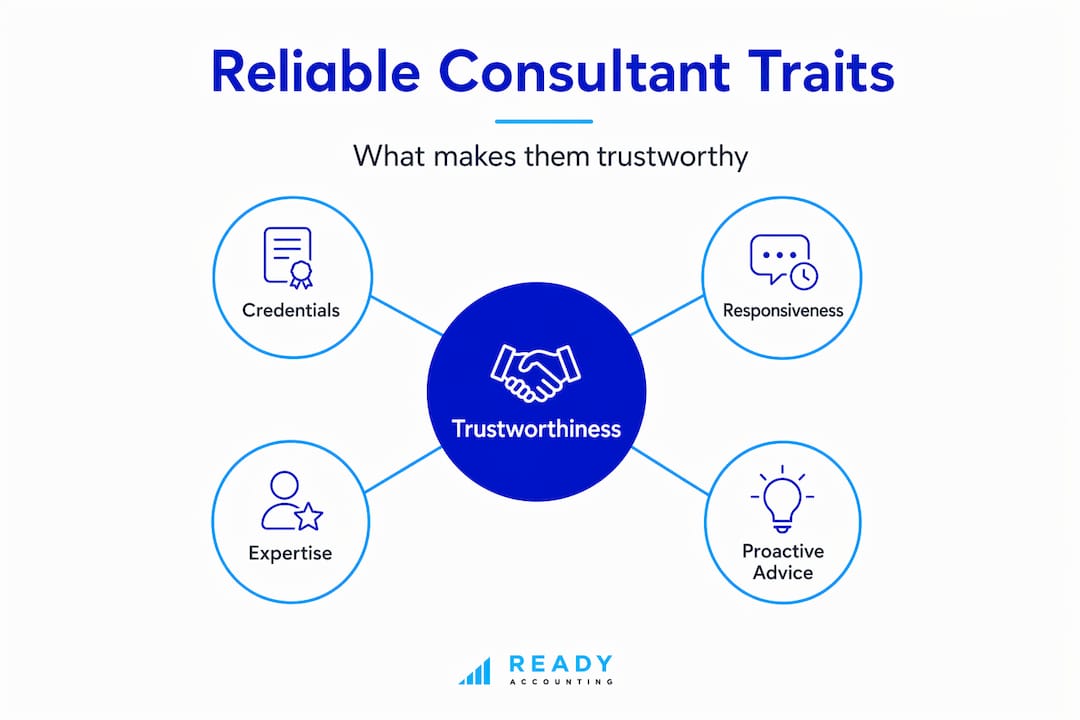
In my experience, the consultants who actually move the needle for South African SMEs are the ones who treat tax planning strategies as a year-round conversation rather than an annual event. They flag changes in SARS policy before those changes cost you money. They ask questions about your growth plans so they can advise on the right business structure before you are locked into one.
What I have learned is that credentials get you to the starting line. Character and communication are what determine whether the relationship actually serves your business. Ask yourself after that first meeting: did they listen more than they talked? Did they ask about your business before offering solutions? Did they explain things clearly without making you feel like an outsider? Those are the real indicators.
Build the relationship as a partnership, not a transaction. Review it annually. If your consultant is not proactively adding value, it is worth exploring your options with the same rigour you used to hire them.
— Johan
How Readyaccounting supports South African SMEs with tax consulting
At Readyaccounting, we work with scaling South African SMEs and startups that need more than a once-a-year tax filing service. We handle SARS compliance, VAT registration, CIPC submissions, and Annual Financial Statements, and we do it inside a cloud-based infrastructure that gives you real-time visibility into your financial position. If you are serious about reducing your tax liability while staying fully compliant, our team acts as your Fractional CFO, identifying opportunities most generalist consultants miss. Reach out to Readyaccounting for a consultation and find out what a properly structured tax relationship looks like for a business at your stage.
FAQ
What qualifications should a tax consultant have in South Africa?
A legitimate tax consultant in South Africa must be registered with SARS as a tax practitioner and affiliated with a Recognised Controlling Body such as SAICA, SAIPA, or CIBA. You can verify their PR number directly on the SARS website.
How do I verify a tax consultant’s registration with SARS?
Use the SARS practitioner lookup tool on the SARS website to search by PR number and confirm the practitioner’s status is active and their RCB link is valid. Do not rely solely on membership certificates provided by the consultant.
What should I include in a tax consultant engagement letter?
Your engagement letter should cover the scope of services, fee structure, communication expectations, turnaround times, and the process for ending the agreement. This written record protects both you and the consultant if disputes arise.
How many candidates should I shortlist before hiring a tax consultant?
Three to four candidates is the right range. It gives you a meaningful comparison without turning the process into a full-time job. Use referrals, professional directories, and direct SARS verification to get to this shortlist.
What are the biggest red flags when hiring a tax consultant?
Walk away if a consultant refuses to provide their PR number for SARS verification, promises guaranteed refunds, or cannot explain their approach to written tax opinions before filing. These gaps signal both a knowledge deficit and a potential compliance risk for your business.