

How to build a strong company culture that drives growth
Executive Summary
- Company culture is the invisible operating system that influences decision-making, employee treatment, and business growth.
- For South African SMEs and startups, embedding Ubuntu and cultural norms into daily routines reinforces engagement and reduces turnover.
Company culture is not a poster on the wall or a Friday pizza budget. It is the invisible operating system that determines how decisions get made, how people treat each other, and ultimately whether your business grows or stagnates. South African SMEs and VC-backed startups face a specific challenge here: many founders borrow culture playbooks from Silicon Valley or London without accounting for local labor law, workforce expectations, or the values of Ubuntu that shape South African professional life. Culture is built in the field, not in the mission statement, and the sooner your leadership team internalizes that, the sooner culture becomes a genuine competitive advantage.
Table of Contents
- Why company culture matters for South African SMEs and startups
- Core principles: How strong cultures are built and reinforced
- What works (and what doesn’t): Key culture strategies for SMEs and startups
- Integrating technology thoughtfully to support company culture
- What most guides miss: Culture is a daily management discipline, not a launch event
- Take the next step to reinforce culture with the right tools
- Frequently asked questions
Key Takeaways
| Point | Details |
|---|---|
| Culture drives business success | Strong culture boosts engagement, retention, and innovation overtime. |
| Local values matter | Incorporate Ubuntu, legal standards, and dignity principles to avoid disconnects. |
| Actions speak louder than perks | Daily leadership behavior and explicit standards make culture real. |
| Tech is a tool, not a cure-all | Automation or AI only improves culture if integrated with training and care. |
Why company culture matters for South African SMEs and startups
Think of culture as a management system. Every time a manager ignores a deadline slip without comment, every time a founder celebrates a win loudly but stays quiet about a failure, that system gets programmed. Culture is not what you say you value. It is what actually happens repeatedly without correction.
The business case is direct. High employee turnover in South African SMEs costs between 50% and 200% of an employee’s annual salary to replace, when you factor in recruitment, onboarding, and lost productivity. Weak culture is one of the top drivers of voluntary attrition. Global engagement levels remain stubbornly low, which tells us that surface-level perks like free snacks, trendy office furniture, and team-building days are not moving the needle. Culture change requires a management-system change, not a perks budget increase.
For South African businesses specifically, there is an additional layer of responsibility. Your workforce is diverse, your labor legislation is demanding, and the concept of Ubuntu (which broadly translates to “I am because we are”) is not just a feel-good idea. It is a deeply held value that shapes how South African employees expect to be treated in the workplace. Workplaces worth staying in actively integrate Ubuntu alongside legal commitments to dignity, equality, and fair procedure.
“Culture is not what is written on a wall. It is what leaders tolerate, celebrate, and ignore every single working day.”
Here is what a weak culture costs you in practical terms:
- Attrition spikes that drain institutional knowledge and inflate payroll costs
- Legal risk from poorly managed disciplinary processes and non-compliance with the Labour Relations Act
- Productivity loss from disengaged teams that do the minimum required
- Innovation stagnation because psychologically unsafe teams do not surface new ideas
Aligning your culture with ethical accounting practices is one concrete signal of organizational integrity. When employees see financial discipline and transparency modeled from the top, trust in leadership deepens. Similarly, designing thoughtful employee benefits for small businesses is not just an HR function. It communicates organizational values directly.
With the business importance clear, let us get into what actually building a culture means for your SME or startup.
Core principles: How strong cultures are built and reinforced
Here is the most important thing to understand about culture mechanics: culture equals what gets repeated, what gets sanctioned, and what gets celebrated. Nothing else. Not your values document. Not your brand story. Not your LinkedIn posts about psychological safety.

Strong cultures require explicit standards and consistent measurement. They are built through the daily accumulation of tiny decisions, not through quarterly all-hands meetings.
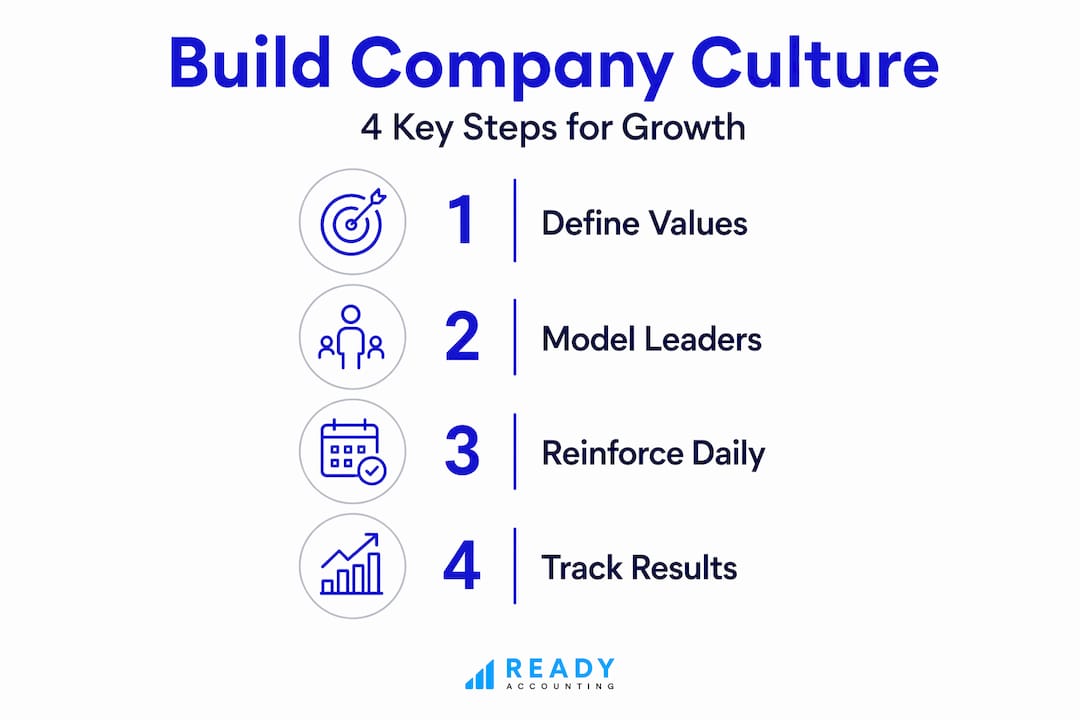
The four core mechanics that actually shape culture in practice are:
- Leader behavior — What leaders do under pressure is what gets copied. If a founder cuts corners when under financial stress, the team learns that standards are situational.
- Operating norms — These are the unwritten rules about how work actually gets done. Make them written. Explicit norms reduce ambiguity and conflict.
- Role clarity — Unclear roles breed politics. When people know exactly what they own and how performance is measured, engagement rises.
- Feedback discipline — Regular, honest, constructive feedback signals that growth is real and expected. Skipping feedback says mediocrity is acceptable.
| Culture element | What it looks like when working | What it looks like when broken |
|---|---|---|
| Leader behavior | Consistent, visible follow-through on commitments | Leaders exempt themselves from the rules |
| Operating norms | Documented, followed, and updated regularly | “That’s just how we do it here” |
| Role clarity | Employees know their KPIs and decision authority | Overlap, confusion, and blame culture |
| Feedback discipline | Scheduled 1-on-1s with honest conversation | Feedback only happens at annual reviews |
For South African teams, these mechanics need to be applied with cultural sensitivity. Ubuntu means that collective wellbeing matters, not just individual performance metrics. A useful practice is to pair individual accountability with team recognition, so that your system rewards both personal excellence and collaborative behavior.
Pro Tip: Introduce a fortnightly “culture check” in your team meeting. Ask two questions: “What behavior did we see that we want more of?” and “What got in the way of great work this week?” The habit of naming these things publicly is more powerful than any values poster.
Connecting culture to financial systems also matters more than most founders realize. Transparent payroll best practices and fair, timely employee expense management are daily touchpoints where employees experience your values in action. If your expense reimbursement process takes six weeks and involves chasing three managers, that is a culture statement whether you intended it or not.
With the core foundations clear, let us compare what works against what consistently fails.
What works (and what doesn’t): Key culture strategies for SMEs and startups
Let us be direct. The most common culture mistake South African SMEs make is investing in outputs (branded hoodies, office perks, culture decks) while neglecting inputs (operating standards, coaching conversations, disciplinary consistency).
Making culture explicit through repeated reinforcement and genuine measurement is what produces lasting engagement and alignment. Perks alone fail because they do not address the root causes of disengagement: unclear expectations, poor management, and a sense that the game is rigged.
| Approach | Why it works or fails | Effort required |
|---|---|---|
| Explicit operating norms | Reduces ambiguity, builds trust | Medium, ongoing |
| Structured onboarding | Sets expectations from day one | High upfront, low ongoing |
| Perks without standards | Doesn’t address root disengagement | Low effort, low impact |
| Consistent feedback culture | Drives growth and belonging | High, daily discipline |
| Culture slogans without follow-through | Erodes trust faster than no slogan | Near zero, negative ROI |
For startups specifically, early hiring decisions have outsized impact. The first ten employees do not just fill roles. They set behavioral precedents that ripple outward as the team scales. Hiring for cultural contribution, not just technical skill, is non-negotiable at this stage.
Here is what a practical, high-impact culture strategy looks like for a South African SME:
- Structured onboarding program covering company values, operating norms, role expectations, and local context (including Ubuntu-aligned team principles)
- 30-60-90 day check-ins for all new employees, with explicit feedback on culture fit alongside performance
- Public recognition rituals that call out behaviors (not just results), so the team knows exactly what “great” looks like
- Zero tolerance for high performance with low conduct — your best salesperson undermining colleagues is a culture tax everyone else pays
Pro Tip: Use your employee benefits opportunities strategically. Benefits that reduce financial stress (like medical aid contributions or EAP access) have a measurable effect on engagement because they signal that the business sees employees as full human beings, not just headcount.
Tracking culture improvement also requires the same rigor you apply to financial metrics. Your financial KPI examples should have a cultural equivalent. Employee Net Promoter Score (eNPS), voluntary attrition rate, and internal promotion rate are all measurable culture indicators. Companies that apply financial discipline to culture measurement tend to outperform those that treat it as a soft, unmeasurable area. SME profitability strategies consistently show that employee engagement is one of the highest-leverage inputs to bottom-line performance.
Building on these strategies, let us look at how technology fits into the picture.
Integrating technology thoughtfully to support company culture
Technology is neutral. It amplifies whatever culture already exists. If your culture is chaotic and unclear, adding an AI scheduling tool or an automated performance tracker will produce chaotic, unclear outputs faster. If your culture is disciplined and values-aligned, the right technology reduces administrative drag and frees people to do more meaningful work.
AI and automation tools can genuinely improve company culture by removing repetitive, low-value tasks that cause frustration and burnout. When an employee spends two hours a week manually chasing expense approvals or re-entering payroll data, that is two hours of engagement and innovation capacity lost. Automating those processes signals that the business respects people’s time.
Signs technology is supporting your culture:
- Employees spend less time on administrative tasks and more on creative or strategic work
- Tools are introduced with adequate training and explanation of why the change is happening
- New systems reduce friction in feedback, communication, or performance tracking
- People feel the tools make their jobs easier, not just more monitored
Signs technology is damaging your culture:
- Tools are introduced with no training or change management
- Surveillance software replaces trust-based accountability
- Automation creates new manual workarounds because integration is poor
- Employees feel tracked rather than supported
Statistic callout: Companies that introduce AI tools without a cultural change management plan report higher short-term disengagement, as employees fear job displacement rather than welcoming efficiency gains.
Pro Tip: Before rolling out any new tool, ask two questions. “Does this reduce friction for the employee or only for management?” and “Have we explained the business reason clearly?” The answers will predict whether the tool strengthens or weakens trust. Streamlining payroll is a strong starting point because it is high-frequency, high-stress, and immediately noticeable when it improves.
With the principles and risks mapped out, here is an editorial take that most culture guides will not give you.
What most guides miss: Culture is a daily management discipline, not a launch event
Most culture advice reads like a product launch playbook. Define your values, communicate them to the team, run a workshop, and ship it. The problem is that culture is not a product. It does not launch. It accumulates.
We work closely with South African SMEs and startups at every stage of growth, and the pattern is consistent: founders who treat culture as a one-off initiative watch it degrade the moment the business faces its first real stress test. Funding pressure, a key resignation, a difficult client. Those moments reveal what the culture actually is, not what it was declared to be.
The best cultures we observe show up in boring routines. A founder who never misses a 1-on-1. A finance lead who sends a consistent weekly update. A team lead who gives honest, kind feedback every single week rather than building up a list for the annual review. Culture is shaped daily by leaders staying close to real decisions and reinforcing expectations through action, not aspiration.
South African SMEs also need to resist the urge to copy American startup culture wholesale. Hustle culture without wellness infrastructure creates burnout. Radical transparency without relational safety creates anxiety. Ubuntu is not just a philosophical nice-to-have. It is a genuine competitive advantage when operationalized, because it builds the kind of team loyalty and mutual accountability that foreign templates miss entirely.
Culture also intersects directly with financial best practices in South Africa. A business with financial discipline communicates stability and seriousness. Employees in financially chaotic organizations disengage because uncertainty is exhausting. When your finance systems are clean, real-time, and transparent, it creates a psychological safety net that shows up in engagement data.
The actionable reframe: treat culture like a financial system. Set standards, measure outcomes, identify variances, and correct them promptly. That is the discipline that separates companies with genuine cultures from those with impressive slide decks.
Take the next step to reinforce culture with the right tools
Culture does not operate in isolation from your financial infrastructure. At Ready Accounting, we work with scaling South African SMEs and VC-backed startups to build the operational backbone that makes cultural values visible and sustainable. When payroll is automated, expenses are tracked in real time, and financial reporting is transparent, your team experiences the values of respect, accountability, and clarity in every touchpoint. Explore how automation improves cash flow and reduces the administrative stress that quietly erodes engagement. Or dig into our accounting automation guide to see how the right financial infrastructure frees your leadership to focus on building the culture your business deserves.
Frequently asked questions
What are the first steps to building a strong company culture in a South African SME?
Start by defining core operating standards, integrating Ubuntu values into team norms, and ensuring leadership consistently models the expected behaviors in daily interactions. Local workplace values like dignity and equality must be embedded in policy and practice, not just stated.
How can I measure if my company culture is improving?
Track employee engagement using structured tools and monitor voluntary attrition and internal promotion rates over time. Measuring engagement with structured survey tools like Gallup’s Q12 gives you data points to act on rather than opinions to argue about.
Does technology help build better company culture or cause problems?
Technology helps when introduced with proper training and a clear reason tied to employee benefit, but poor implementation causes friction and disengagement. AI in company culture works best when it removes friction rather than adding a new monitoring layer.
Why is consistency from leaders so important for company culture?
Consistent leadership behavior sets the real standard for what is valued, replacing ambiguity with trust and clarity. Daily field decisions made by leaders accumulate into the culture employees experience, regardless of what the values document says.