

Execution Framework: avoid tax penalties: protect your South African Corporate Asset
Tax penalties pose one of the greatest threats to small and medium businesses in South Africa, contributing significantly to the 90% failure rate among SMBs. Late submissions, incorrect filings, and poor record keeping trigger recurring monthly penalties that drain cash flow and block access to vital tax clearance certificates. This guide provides practical steps to maintain compliance, understand SARS requirements, and protect your business from costly penalties that threaten survival.
Table of Contents
- Key takeaways
- Understanding tax penalties for South African SMBs
- Preparing your business to meet tax compliance requirements
- Step by step guide to filing tax returns correctly and on time
- Common mistakes to avoid and how to verify your tax compliance
- How Ready Accounting can help your business avoid tax penalties
- Frequently asked questions about avoiding tax penalties
Key Takeaways
| Point | Details |
|---|---|
| Penalty scale by size | Penalties scale with taxable income and can continue for up to 35 months. |
| Timely filings prevent penalties | Missing deadlines or submitting late returns triggers automatic penalties and harms cash flow. |
| Robust record keeping | Organized digital records speed accurate filings and reduce errors that trigger penalties. |
| Cloud accounting helps compliance | Cloud storage and online tools improve backups, access, and deadline tracking to lower risk. |
| Professional support helps | Seeking professional guidance helps tailor compliance strategies and improve overall outcomes. |
Understanding tax penalties for South African SMBs
The South African Revenue Service enforces strict penalties for non compliance that can cripple small businesses. Section 210 of the TAA imposes penalties ranging from R250 to R16,000 monthly depending on your taxable income, recurring for up to 35 months. These administrative penalties apply automatically when you miss filing deadlines or fail to submit required returns.
The financial impact extends beyond direct penalty amounts. Without a valid tax clearance certificate, you cannot bid on government contracts, secure business financing, or prove compliance to potential partners. Banks and suppliers often require proof of good standing with SARS before extending credit facilities.
Penalty amounts scale dramatically with business size. A micro business with taxable income under R250,000 faces R250 monthly penalties, while a company earning over R50 million pays R16,000 per month for the same violation. Over 35 months, these penalties accumulate to amounts that exceed many SMBs’ annual profit margins.
Cash flow damage from penalties creates a vicious cycle. Money paid to SARS for penalties cannot fund operations, pay suppliers, or invest in growth. Many businesses then struggle to meet subsequent tax obligations, triggering additional penalties. This spiral contributes significantly to the high failure rate among South African small businesses.
Common penalty triggers for SMBs:
- Missing income tax return deadlines
- Late VAT return submissions
- Failure to submit employee tax (PAYE) returns
- Non submission of provisional tax returns
- Ignoring SARS correspondence and notices
| Income bracket | Monthly penalty | 35 month total |
|---|---|---|
| Under R250,000 | R250 | R8,750 |
| R250,000 to R500,000 | R500 | R17,500 |
| R500,000 to R1 million | R1,000 | R35,000 |
| R1 million to R5 million | R2,000 | R70,000 |
| R5 million to R10 million | R4,000 | R140,000 |
| R10 million to R50 million | R8,000 | R280,000 |
| Over R50 million | R16,000 | R560,000 |
Understanding these penalty structures motivates timely compliance and helps you appreciate the true cost of missing deadlines. The small business tax guide provides detailed information on all tax obligations relevant to your business size and structure.
Preparing your business to meet tax compliance requirements
Effective preparation forms the foundation of penalty avoidance. Tax compliance costs SMEs approximately R7,030 annually, but this investment prevents far costlier penalties and business failure. Start by establishing robust financial record keeping systems that capture every transaction accurately.
Organized records enable you to prepare returns quickly and correctly. Store invoices, receipts, bank statements, and expense documentation systematically. Digital filing systems work better than paper, allowing quick searches and automatic backups. Cloud storage protects records from physical damage while enabling access from anywhere.
SARS deadlines vary by tax type and business structure. Companies must submit income tax returns within 12 months of year end if using a registered tax practitioner, or within six months without professional assistance. VAT registered businesses file every two months. PAYE submissions occur monthly. Create a compliance calendar marking every deadline with buffer time for preparation.

Regular account reconciliation catches errors before they reach SARS. Match your accounting records against bank statements monthly. Investigate discrepancies immediately. This practice identifies missing transactions, duplicate entries, and categorization mistakes that could trigger audits or penalties.
Modern accounting software automates much compliance work. Cloud based solutions like Xero or QuickBooks track income and expenses, generate reports, and remind you of upcoming deadlines. These tools reduce manual errors and save time compared to spreadsheets or paper ledgers. The SARS record keeping rules specify retention periods and documentation requirements you must follow.
Essential compliance preparations:
- Implement proper bookkeeping software or cloud accounting
- Create a tax calendar with all filing and payment deadlines
- Establish document retention systems meeting SARS requirements
- Reconcile bank accounts with financial records monthly
- Review and update business registration details annually
- Maintain separate business and personal bank accounts
Understanding basic SARS regulations relevant to your business prevents accidental violations. Study the requirements for your entity type, whether sole proprietor, partnership, close corporation, or company. Each structure has different obligations and deadlines. The tax compliance essentials resource explains these differences clearly.
Pro Tip: Set internal deadlines one week before actual SARS due dates. This buffer absorbs unexpected delays from technical issues, missing documents, or calculation errors without triggering penalties.
Invest time learning SARS eFiling system navigation. Register for eFiling if you haven’t already, and familiarize yourself with the interface during non deadline periods. Practice navigating to different return types and understand where to find your compliance status. This preparation prevents last minute panic when deadlines approach.
Step by step guide to filing tax returns correctly and on time
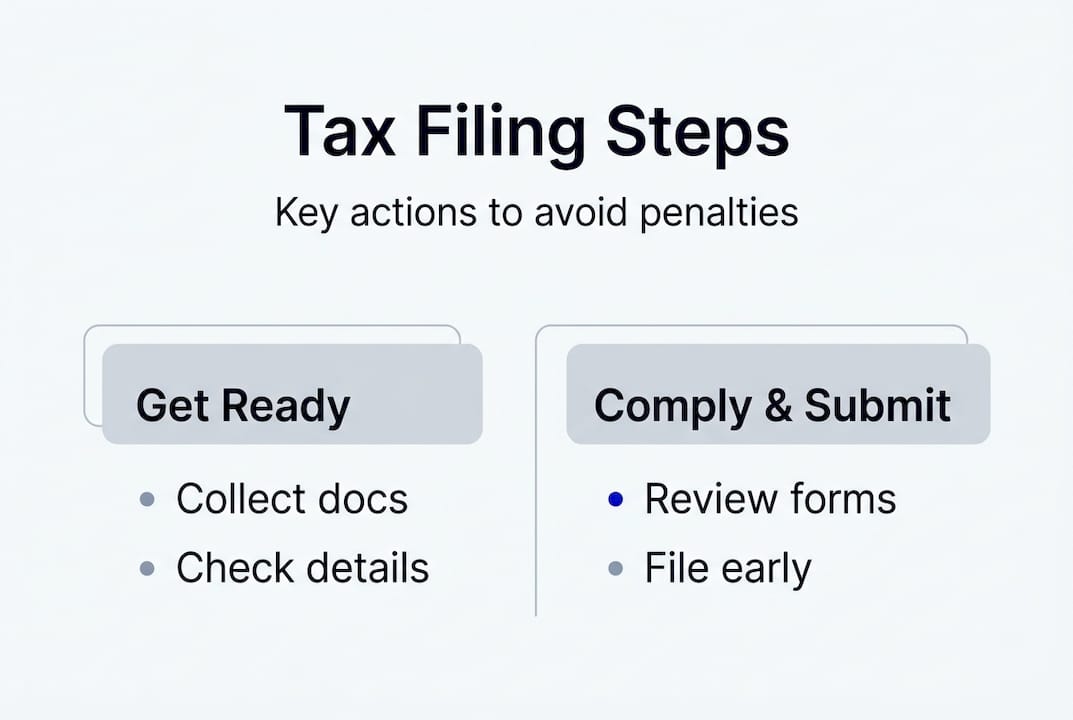
Successful tax filing follows a systematic process that ensures accuracy and timeliness. Monthly penalties recur up to 35 months for late submissions, making punctual filing critical to business survival. Follow these steps to maintain compliance and avoid costly mistakes.
Step 1: Gather and verify all financial documents
Collect bank statements, invoices, receipts, payroll records, and expense documentation for the filing period. Verify completeness by reconciling transactions against your accounting system. Missing documents create gaps that lead to incorrect returns and potential audits.
Step 2: Prepare accurate financial statements
Use reliable accounting software or engage a professional to compile income statements, balance sheets, and cash flow statements. These documents form the foundation of your tax calculations. Double check figures against source documents to catch data entry errors.
Step 3: Calculate tax obligations correctly
Apply current tax rates and allowable deductions to determine amounts owing. Use SARS tax tables and calculators to verify calculations. Incorrect computations trigger assessments and penalties even when filed on time. The year end tax planning guide helps optimize deductions legally.
Step 4: Review returns thoroughly before submission
Check every field for accuracy. Verify tax numbers, banking details, and contact information. Confirm amounts match supporting documents. Review calculations for mathematical errors. This quality control step prevents rejections and amendments that delay processing.
Step 5: Submit via SARS eFiling before deadlines
Log into eFiling and navigate to the appropriate return type. Complete all required fields and upload supporting schedules. Review the summary page carefully. Submit the return and save the confirmation reference number immediately.
Step 6: Make payment and retain proof
Pay any amounts owing through eFiling or approved payment channels before the payment deadline. Save payment confirmation receipts. Late payment triggers interest charges even when returns filed on time. Keep digital and physical copies of all submission and payment confirmations.
| Filing step | Timeline | Critical action |
|---|---|---|
| Document gathering | 30 days before deadline | Reconcile all accounts |
| Statement preparation | 21 days before deadline | Verify accuracy with source docs |
| Tax calculation | 14 days before deadline | Apply correct rates and deductions |
| Quality review | 7 days before deadline | Check every field and calculation |
| eFiling submission | 3 days before deadline | Submit and save confirmation |
| Payment processing | By payment deadline | Pay full amount and retain proof |
Regular status monitoring prevents surprises. Log into eFiling monthly to check for SARS correspondence, assessment notices, or compliance alerts. Respond to queries immediately. Ignoring SARS communication escalates minor issues into major penalties.
Pro Tip: Create submission checklists for each return type. Include every required document, calculation, and verification step. Following checklists prevents oversights that cause rejections or penalties.
Renew registrations proactively. VAT registration, PAYE employer numbers, and other tax registrations require periodic updates. Monitor expiry dates and submit renewal applications well before deadlines. Lapsed registrations can invalidate returns and trigger penalties. The tax return filing guide provides detailed submission instructions for different business types.
Common mistakes to avoid and how to verify your tax compliance
Preventing errors requires understanding where businesses typically fail. Poor compliance contributes significantly to cash flow strain that forces closure. Learning from others’ mistakes protects your business from similar fates.
Late submissions top the list of costly errors. Many business owners underestimate preparation time or forget deadlines entirely. Even one day late triggers full monthly penalties. Calendar reminders alone prove insufficient when unexpected issues arise. Build buffer time into your schedule.
Incorrect data entry causes assessment adjustments and potential audits. Transposed numbers, wrong account classifications, and mathematical errors signal carelessness to SARS. These mistakes invite scrutiny that extends beyond the specific return, potentially triggering comprehensive audits.
Poor record keeping prevents accurate return preparation. Missing receipts, lost invoices, and incomplete documentation force estimates that SARS may challenge. The bookkeeping mistakes to avoid guide highlights critical documentation practices.
Ignoring SARS notices escalates minor issues dramatically. Automated penalty notices, assessment letters, and audit requests demand immediate attention. Each ignored communication increases penalties and may trigger collection action including asset seizure.
Failing to obtain tax clearance certificates blocks business opportunities. Many owners only discover compliance issues when bidding on contracts or applying for financing. By then, resolving outstanding matters takes weeks or months, costing valuable opportunities.
Frequent compliance mistakes:
- Missing filing deadlines due to poor calendar management
- Submitting returns with calculation errors or data entry mistakes
- Failing to maintain complete financial records
- Ignoring SARS correspondence and penalty notices
Common mistake Consequence Best practice Late submission Monthly recurring penalties File one week before deadline Incorrect data Assessments and audits Implement quality review process Poor records Inability to substantiate claims Use cloud accounting with backups Ignored notices Escalating penalties and collection Respond within 21 days to all SARS communication No tax clearance Lost contracts and financing Verify compliance status monthly
Verifying compliance status regularly prevents unpleasant surprises. Log into SARS eFiling and check your tax compliance status certificate. This document shows whether you have outstanding returns or payments. Green status indicates good standing, while red flags compliance issues requiring immediate attention.
Use SARS online tools to confirm your registration details remain current. Verify your business address, banking information, and contact details. Outdated information causes correspondence to go astray, leading to missed deadlines and penalties.
Implement internal compliance checklists covering all tax types. Review monthly whether you’ve filed required returns, made necessary payments, and responded to SARS communications. This systematic approach catches oversights before they become penalties.
Understand penalty appeal processes for situations where penalties seem unjustified. SARS allows requests for remission when you can demonstrate reasonable cause for non compliance. Valid reasons include serious illness, natural disasters, or SARS system failures. Document circumstances thoroughly and submit appeals promptly. The SARS penalties and fines resource explains appeal procedures.
Schedule periodic compliance reviews with accounting professionals. External experts identify risks you might overlook and ensure you’re applying current regulations correctly. These reviews cost far less than penalties and provide peace of mind. The SARS compliance verification guide offers verification frameworks.
How Ready Accounting can help your business avoid tax penalties
Navigating South African tax compliance alone creates unnecessary risk and stress. Ready Accounting’s cloud based accounting solutions automate critical compliance tasks while providing expert guidance tailored to your business needs. Our team ensures accurate, timely submissions that keep you penalty free.
We handle complete tax filing services including income tax, VAT, PAYE, and provisional tax returns. Our systematic processes catch errors before submission and ensure you claim all eligible deductions. Real time bookkeeping through our cloud accounting platform gives you constant visibility into your financial position and upcoming obligations.
Our compliance advisory services help you understand changing regulations and optimize your tax strategy legally. We monitor SARS communications on your behalf and respond promptly to queries. This proactive approach prevents small issues from escalating into costly penalties. Learn more about comprehensive tax support in our small business tax guide.
Frequently asked questions about avoiding tax penalties
What are the main reasons SMBs get tax penalties in South Africa?
The primary causes include missing filing deadlines, submitting incomplete or incorrect returns, and failing to maintain proper financial records. Many businesses also ignore SARS correspondence, which escalates penalties. Poor cash flow management prevents timely payments even when returns are filed correctly.
How can I check if my business has outstanding tax penalties?
Log into your SARS eFiling profile and navigate to the tax compliance status section. This shows all outstanding returns, payments, and penalties. You can also request a tax clearance certificate, which will indicate any compliance issues preventing issuance. Check your statement of account for penalty line items.
When is the best time to file tax returns to avoid penalties?
File at least one week before the official deadline to absorb unexpected delays. Companies using registered tax practitioners have 12 months from year end, while those without professional help must file within six months. VAT returns are due by the 25th of the month following the tax period. For detailed guidance, visit our top tax questions for SMBs resource.
Can I appeal SARS penalties if I believe they are unfair?
Yes, you can request penalty remission through eFiling by providing evidence of reasonable cause for non compliance. Valid reasons include serious illness, natural disasters, or proven SARS system failures. Submit appeals within 21 days of receiving the penalty notice with comprehensive supporting documentation. SARS reviews each case individually.
What bookkeeping practices help ensure tax compliance?
Maintain complete records of all income and expenses with supporting documentation. Reconcile bank accounts monthly against your accounting system. Use cloud accounting software that automates calculations and generates compliant reports. Separate business and personal finances completely. Retain all records for five years as required by SARS regulations.
Recommended
- How to save tax in South Africa: smart strategies for SMEs in 2026 – Ready Accounting
- Year-End Tax Planning Guide for Small Businesses – Ready Accounting
- Small business tax in South Africa: essential 2026 guide – Ready Accounting
- Top Tax Questions Small Business Owners Ask in 2025 – Ready Accounting
- Deductible items for landlords in South Africa 2026 – Rental Income Insurance