

Avoid SARS Penalties: Freelance Cloud Bookkeeping for SA Startups
Avoid SARS Penalties: Freelance Cloud Bookkeeping for SA Startups
Outsourced, cloud-first freelance bookkeeping is the right call for most scaling South African SMEs and VC-backed startups that need dependable numbers and clean SARS compliance without hiring a full finance team. Done well, it combines automation, API integration and fractional CFO insight into one service. There are firms operating in exactly this space. If cash flow visibility or tax risk is keeping you up at night, the next step is simple: request a books audit or a pricing conversation before your next filing deadline.
Executive Summary
- Outsourced bookkeeping that focuses on automation and API integration helps South African startups maintain real-time cash flow visibility and SARS compliance.
- Implementing cloud-first services includes daily bank feeds, management packs highlighting burn and runway, and proactive compliance handling with VAT and PAYE.
- Choosing a provider requires evidence of SARS eFiling experience, demonstrated automation capabilities, and references from similar-sized startups or SMEs.
- Firms specializing in automation and tax defense offer strategic dashboards and infrastructure that reduce manual reconciliation and improve growth readiness.
- Prioritizing tax compliance and eFiling profile management is crucial, as these foundations enable effective reporting and reduce risk before optimizing management insights.
Table of Contents
- What outsourced bookkeeping delivers: cash flow, compliance and faster decisions
- What a cloud-first outsourced bookkeeping engagement actually includes
- How to choose the right outsourced bookkeeping partner: questions, pricing and red flags
- South African compliance checklist bookkeepers must handle
- Some firms position themselves as Financial Automation and Tax Defense providers rather than traditional bookkeeping shops. The distinction matters: the goal isn’t just recording transactions, it’s building cloud infrastructure, real-time runway dashboards and API bridges that remove administrative friction before it becomes a compliance problem.
- Why most founders get bookkeeping advice backwards
- Ready to fix your books before your next SARS deadline?
- Sources
What outsourced bookkeeping delivers: cash flow, compliance and faster decisions
Founders don’t hire outsourced bookkeeping because it sounds efficient. They hire it because late-night spreadsheet reconciliation is a terrible use of a CEO’s time, and because investors ask questions your gut feel can’t answer.
The measurable outcomes look like this:
- Faster, accurate management accounts — runway, burn rate and cash conversion figures ready when your board wants them, not two weeks later.
- Lower compliance risk and a stronger Tax Compliance Status profile, which matters for tenders, loans and investor due diligence.
- Reduced admin cost through automated bank feeds and API integrations instead of manual data entry.
- Forensic cleanups that catch reconciliation errors before an auditor or lender does.
- Fractional CFO input that turns your bookkeeping into a decision-making tool, not a filing cabinet.
Here’s the number that should get your attention: SARS itself now pushes hard on digital compliance tools, from eFiling to the MobiApp to TCS verification, because manual, paper-based bookkeeping simply cannot keep pace with how quickly SARS now cross-references data. A business running on spreadsheets is playing catch-up against a system built for automation. One that runs on integrated cloud accounting is playing the same game SARS is.
What a cloud-first outsourced bookkeeping engagement actually includes
A proper proposal from a cloud-based bookkeeping partner should read like a build spec, not a vague retainer letter. Expect these deliverables, in roughly this order:
- Automated bank feeds and reconciliations running daily or weekly, not once a month when someone remembers.
- API bridging between your point-of-sale, payroll, invoicing and accounting systems so numbers move without a human retyping them.
- Monthly management packs with the KPIs that actually matter to a startup: burn, runway, gross margin, debtor days.
- Compliance handling: VAT returns, PAYE reconciliations, provisional tax support, and Tax Compliance Status maintenance.
- Cleanup and year-end handover, including the documentation your accountant needs to finalise Annual Financial Statements.
Pro Tip: Ask any prospective provider to show you a sample monthly pack before you sign anything. If it’s a wall of numbers with no runway or burn-rate line, it wasn’t built for a startup, it was built for a corner shop.
If you’re still doing your own bookkeeping setup, the leap from spreadsheet to API bridging is bigger than it looks. It’s not just faster data entry, it’s the difference between reacting to last month’s numbers and watching this week’s cash position in real time.
How to choose the right outsourced bookkeeping partner: questions, pricing and red flags
Not all outsourced bookkeeping looks the same, and the gap between a good provider and a mediocre one shows up fastest in a crisis, exactly when you can least afford it.
What to look for before you sign anything:
- Demonstrated cloud and API experience, not just familiarity with a single accounting package.
- Direct SARS eFiling integration and comfort managing Tax Compliance Status requests.
- Fractional CFO capability, meaning someone who can interpret the numbers, not just produce them.
- References from startups or SMEs at a similar stage, not just retail clients.
Questions worth asking in the first meeting:
- Can you show me a sample management pack from a client in my industry?
- What’s your turnaround time on monthly reconciliations and reports?
- Who owns the data if we part ways, and how quickly can we get it?
- What’s your onboarding process, and how long until we’re fully live?
Pricing typically follows one of three shapes: a flat monthly retainer, a transaction-volume model, or a hybrid with a one-off automation setup fee. Setup fees cover the actual engineering work, connecting your bank feeds, payroll and invoicing systems, so expect a higher first-month cost that tapers into a lower ongoing retainer once the automation build is done.
Watch for red flags: manual-only workflows with no automation roadmap, no stated SARS eFiling experience, deliverables described in vague terms like “monthly bookkeeping” with no sample report attached, and an unwillingness to name a single reference client. If a provider can’t show you a dashboard, walk away. For a broader view of hiring signals, Ready Accounting’s guide on when to hire a bookkeeper covers the tipping point most owners miss until it’s already a problem, and businesses weighing an in-house hire against outsourcing should also check general remote hiring practices in South Africa before committing to either path.

South African compliance checklist bookkeepers must handle
This is where most DIY bookkeeping quietly falls apart, not because owners are careless, but because SARS deadlines don’t wait for a quiet month.
Registration and record retention. SARS requires businesses to register within the required SARS deadline of 21 business days of becoming liable for a tax type, and to keep supporting records, invoices, bank slips, receipts, for a minimum retention period as required by SARS. Miss the registration window and you’re already behind before your first return is due.
Turnover Tax and VAT decisions. Businesses with an annual turnover of R2.3 million or less can elect into Turnover Tax, a simplified tax system that replaces various other tax types for qualifying small businesses. Whether that election makes sense depends on your margins and growth trajectory, which is exactly the kind of modelling a bookkeeper should run before you commit either way.
Tax Compliance Status. A valid TCS PIN depends on a merged eFiling profile showing a complete My Compliance Profile across all your tax types. If your VAT and PAYE accounts were registered separately and never merged, expect delays exactly when you’re chasing a tender deadline or a funding round.
Monthly discipline that actually matters:
- VAT schedules reconciled against invoices, not estimated at year-end.
- PAYE reconciliations run monthly, not scrambled together in February.
- Provisional tax estimates updated as revenue shifts, not left on last year’s numbers.
- Supporting documents uploaded and ready before SARS asks, not after.
Detailed record-keeping requirements are worth a proper read if you’ve never had your document trail tested by an actual SARS enquiry.
Some firms position themselves as Financial Automation and Tax Defense providers rather than traditional bookkeeping shops. The distinction matters: the goal isn’t just recording transactions, it’s building cloud infrastructure, real-time runway dashboards and API bridges that remove administrative friction before it becomes a compliance problem.
That means published pricing guides and cleanup pricing rather than vague quotes, automation case studies showing how a client’s dashboard came together, and an onboarding process built around getting a startup’s finance stack talking to itself, bank feeds, payroll and invoicing, without months of manual patchwork. Author Johan brings direct experience advising SA SMEs and startups through exactly this kind of transition, and client outcomes typically move from reactive, month-end bookkeeping to a real-time view of cash position and compliance status within one onboarding cycle.
Why most founders get bookkeeping advice backwards
The conventional advice tells founders to hire a bookkeeper “when things get busy.” That’s backwards. The businesses that get into real trouble with SARS aren’t the busy ones, they’re the ones whose books were never structured to scale in the first place, so growth just exposes the gaps faster.
What’s overrated: shopping purely on monthly retainer price. A cheaper provider running manual reconciliations will cost you more in cleanup fees and compliance risk than the automation-first option ever would.
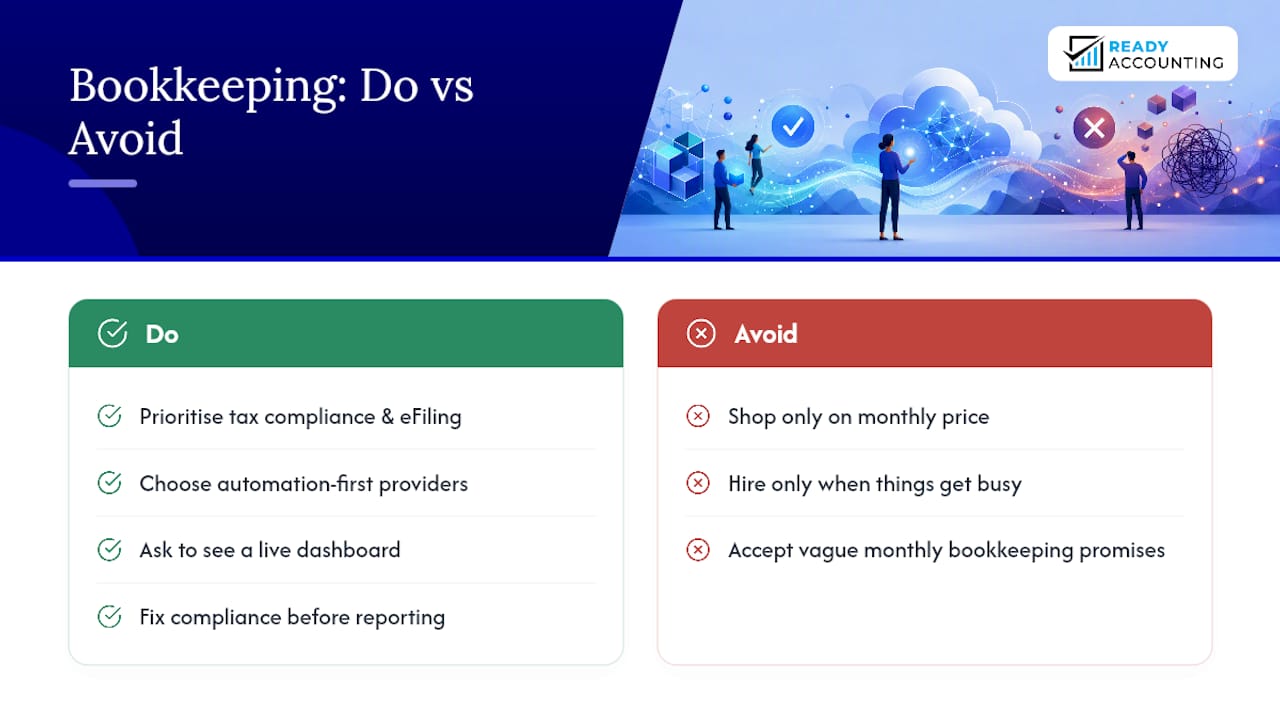
What’s underrated: asking to see a live dashboard before signing anything. Most owners judge a bookkeeping proposal on the sales call, not on the actual deliverable, and that’s exactly how vague “monthly bookkeeping” services survive in this market.
If you take one thing from this, prioritise your Tax Compliance Status and eFiling profile first. Everything else, management packs, KPI dashboards, fractional CFO input, works better once your compliance foundation is actually solid. Fix the foundation before you optimise the reporting.
— Johan
Ready to fix your books before your next SARS deadline?
If you’re a growing SME or a VC-backed startup drowning in reconciliations, chasing provisional tax deadlines, or unsure whether your Tax Compliance Status will survive a funding round’s due diligence, finding the right professional service provider is crucial. Some providers replace manual bookkeeping with cloud infrastructure, API-connected systems and real-time dashboards, enabling a more current view of cash position.
Book a books audit or a pricing conversation, and the first meeting covers a scope review of your current systems, a look at sample management packs, realistic onboarding timelines, and a transparent automation pricing guide so you know the cost before you commit. Start with a conversation about how automation actually improves cash flow for a business at your stage.
This article is general information, not a substitute for advice from a qualified financial advisor. Consult a qualified financial professional about your own circumstances before acting on anything here.