

Financial forecasting: why it matters for SA Scaling Companies
Executive Summary
- Most South African SMEs fail within 3 to 4 years due to poor cash flow management. Financial forecasting helps small businesses anticipate cash shortages and make informed decisions. Using rolling forecasts, scenario planning, and real-time data improves resilience in volatile economic conditions.
72% of small South African businesses fail within 3 to 4 years, most due to poor financial performance and cash flow management. Yet many SME owners still believe financial forecasting is something reserved for large corporations with dedicated finance teams. That belief is costing businesses their survival. Financial forecasting is not about complex spreadsheets or MBA-level analysis. It is about knowing where your money is going before it disappears. This article breaks down exactly why forecasting matters for South African SMEs, which methods work best in our volatile economy, and how you can start building better financial visibility today.
Table of Contents
- Why financial forecasting is vital for South African SMEs
- Core methods and approaches to financial forecasting
- Avoiding common pitfalls and making forecasting work
- Practical steps to improve your SME’s financial forecasting
- What most advice misses about forecasting for SA SMEs
- How Ready Accounting supports smarter forecasting
- Frequently asked questions
Key Takeaways
| Point | Details |
|---|---|
| Cash flow is critical | Robust financial forecasting is key to preventing cash crunches and business failure. |
| Rolling forecasts work best | Update forecasts often and use scenario planning to stay agile during uncertainty. |
| Avoid common mistakes | Don’t rely on static budgets or ignore forecast variance; use real data and practical tools. |
| Accessible to all SMEs | Even with limited resources, free templates and expert advice can make a difference. |
Why financial forecasting is vital for South African SMEs
Financial forecasting is the process of estimating your future revenues, expenses, and cash flows based on historical data, market trends, and known business drivers. Think of it as your business’s early warning system. Instead of reacting to a cash shortfall after it happens, you see it coming weeks or months in advance and can act accordingly.
The benefits are direct and measurable. Forecasting helps businesses mitigate risks, set realistic goals, access funding, inform decision-making, and manage cash flow amid economic volatility. For South African SMEs, these benefits are not optional extras. They are survival tools.
Here is why forecasting matters specifically in the South African context:
- Risk reduction: Anticipate cash gaps before they become crises, especially during slow trading periods.
- Cash flow management: Know exactly when money comes in and goes out so you can plan payments and avoid overdrafts.
- Investor and funder confidence: Banks and investors want to see forecasts before approving funding. A solid forecast signals that you understand your business.
- Better planning: Whether you are hiring, expanding, or cutting costs, forecasting gives you the data to make confident decisions.
- Resilience against local shocks: Load-shedding, rand volatility, fuel price hikes, and supply chain disruptions are facts of South African business life. Forecasting lets you stress-test your numbers against these realities.
The South African economic environment adds layers of complexity that businesses in more stable markets simply do not face. Inflation has remained persistently elevated, energy costs have surged, and consumer spending patterns shift unpredictably. A business owner who is also setting SME growth goals without a financial forecast is essentially navigating without a map.
“A forecast is not a prediction of the future. It is a tool that helps you shape it.”
The businesses that survive and grow in South Africa are not necessarily the ones with the best products. They are the ones that understand their numbers well enough to adapt quickly when conditions change.
Core methods and approaches to financial forecasting
Not all forecasting methods are created equal, and not all of them suit the realities of running a small or medium business in South Africa. Understanding your options helps you choose the approach that actually fits your situation.
Driver-based and scenario-based rolling forecasts outperform static annual budgets for SMEs in unpredictable environments. Here is a breakdown of the main methods:
| Method | How it works | Best for SA SMEs? |
|---|---|---|
| Trend extrapolation | Projects future figures based on historical patterns | Useful in stable sectors, limited in volatile markets |
| Driver-based forecasting | Links forecasts to specific business drivers like sales volume or headcount | Strong fit, especially for cost-heavy businesses |
| Scenario planning | Models best, worst, and base-case outcomes | Excellent for load-shedding and rand volatility planning |
| Rolling forecasts | Updates continuously, typically every month or quarter | Best overall fit for most South African SMEs |
Rolling forecasts are particularly valuable because they replace the outdated annual budget model. Instead of locking in numbers for 12 months and hoping for the best, you update your forecast every quarter based on what is actually happening. This keeps your financial picture current and your decisions grounded in reality.
Scenario planning works hand in hand with rolling forecasts. You build three versions of your financial future: one where things go well, one where they go as expected, and one where conditions deteriorate. When load-shedding escalates or a key client delays payment, you already have a plan.
For context on what your forecasts should be built on, reviewing financial statement examples gives you a clear picture of the underlying data you need. Pairing that with a solid SME budget creation process ensures your forecast has a realistic foundation.
Pro Tip: The most common forecasting mistake SME owners make is over-optimism. Revenue projections tend to be too high and expense estimates too low. Build your base-case forecast conservatively, then work upward. Also account for seasonality. A retail business in South Africa that ignores the December spike and January slump will always be caught off guard.
Avoiding common pitfalls and making forecasting work
Knowing the right methods is essential, but avoiding hidden traps and embedding best practices is what separates useful forecasts from mere guesswork.

SMEs with formal forecasting have 20% fewer liquidity crises and better overall cash management. That gap is significant. It means businesses that take forecasting seriously are materially less likely to run out of cash. Yet most SME owners either skip forecasting entirely or create a once-off annual budget and never look at it again.
Here are the most common mistakes and how to fix them:
- Using a static annual budget: A budget set in January is outdated by March. Replace it with a rolling quarterly forecast that updates as your business evolves.
- Ignoring variance analysis: Variance analysis means comparing your forecast to your actual results. If you projected R80,000 in revenue and only achieved R60,000, you need to understand why and adjust future forecasts accordingly.
- Neglecting local risk factors: Load-shedding, municipal service disruptions, and supply chain delays are not edge cases in South Africa. They are regular occurrences. Build them into your scenarios.
- Relying only on gut feel: Intuition has its place, but it cannot replace data. Even basic historical figures give you a stronger foundation than guesswork.
- Forecasting in isolation: Your forecast should connect to your sales pipeline, your payroll schedule, your supplier payment terms, and your tax obligations.
To build resilience, track variance between forecast and actual, integrate real-time data, and stress-test for local uncertainties like load-shedding and supply issues. This is not a once-a-year exercise. It is an ongoing discipline that compounds in value over time.
Pro Tip: Build your rolling forecast around real events and known drivers. Tax payment dates, school holidays, supplier price reviews, and seasonal demand shifts are all foreseeable. Anchor your numbers to these events and your forecast becomes far more reliable.
For businesses focused on long-term SME growth, embedding these habits early is one of the highest-return investments you can make in your business infrastructure.
Practical steps to improve your SME’s financial forecasting
With an understanding of what to avoid, it is time to get practical. Here is how you can start building better forecasts for your business, step by step.
SME owners should prioritise cash flow, use 13-week rolling views, leverage templates, upskill in financial literacy, and engage advisors for complex needs. That is a solid roadmap. Let us unpack it.
Start by gathering your key financial data:
- Revenue: Monthly sales figures for the past 12 to 24 months, broken down by product or service line if possible.
- Fixed costs: Rent, salaries, insurance, subscriptions. These do not change much month to month.
- Variable costs: Stock, fuel, freelancers, utilities. These fluctuate and need careful tracking.
- Cash inflows and outflows: When does money actually arrive in your account, and when do payments leave?
Once you have this data, a 13-week rolling cash flow view gives you a practical short-term forecast. Here is a simplified structure:
| Week | Opening balance | Expected inflows | Expected outflows | Closing balance |
|---|---|---|---|---|
| Week 1 | R50,000 | R30,000 | R25,000 | R55,000 |
| Week 2 | R55,000 | R20,000 | R30,000 | R45,000 |
| Week 3 | R45,000 | R35,000 | R20,000 | R60,000 |
This table format makes cash gaps visible before they become emergencies. You can build this in a basic spreadsheet or use tools like Xero, Sage, or QuickBooks, which are widely used by South African SMEs.
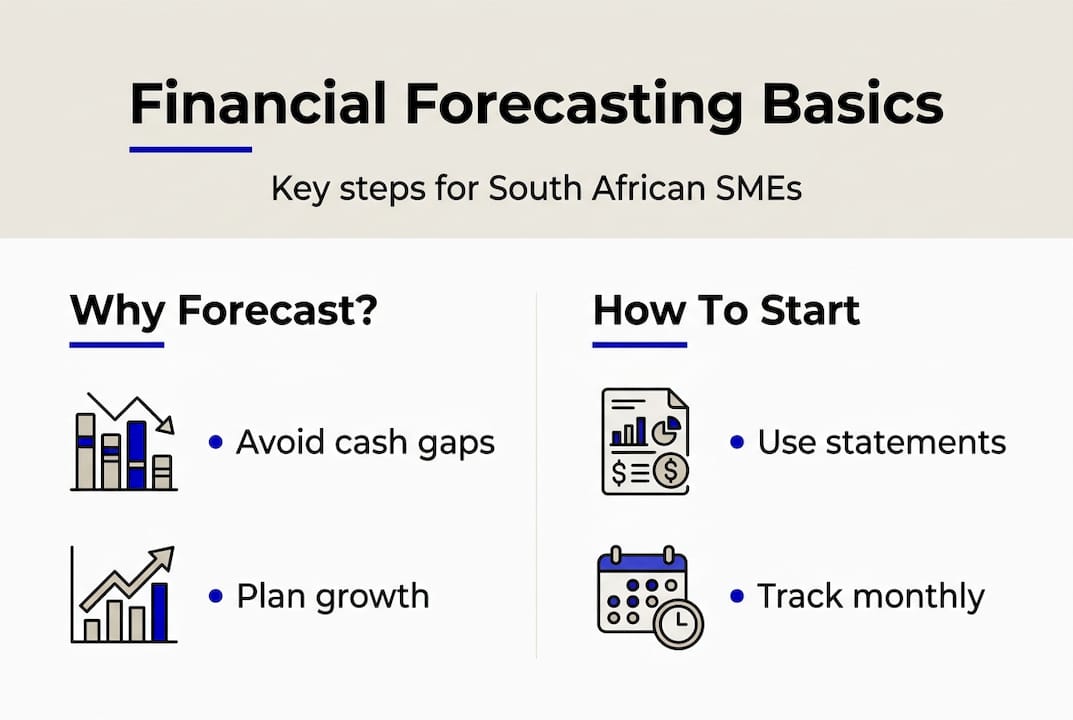
Understanding your financial statements guide is a natural starting point, and pairing that with a clear view of why financial planning matters helps you connect forecasting to your broader business strategy. For those still getting comfortable with the numbers, understanding SME financials at a foundational level makes the forecasting process far less intimidating.
What most advice misses about forecasting for SA SMEs
Here is the uncomfortable truth: most forecasting guides focus on profit projections, not cash survival. They talk about EBITDA (earnings before interest, taxes, depreciation, and amortisation) and net margins as if those are what keep your business alive. They are not. Cash is.
We have seen profitable businesses close in South Africa because they ran out of cash while waiting on invoice payments. A business can show a healthy profit on paper and still be unable to pay salaries on Friday. That is the gap that forecasting must close.
The real value of forecasting for a South African SME is not about producing a polished document for your bank. It is about building a habit of cash visibility. Knowing your cash position 13 weeks out changes how you negotiate with suppliers, when you chase debtors, and whether you take on that new contract.
Flexibility matters more than precision here. A forecast that gets updated every month and reflects real conditions is worth far more than a perfect annual model built in January and forgotten by April. If you want a deeper dive on SME financial planning that connects forecasting to real business outcomes, that is where the real leverage lies.
How Ready Accounting supports smarter forecasting
Building a reliable forecasting process takes the right tools, the right data, and often the right support. Ready Accounting works with South African SMEs to put all three in place. Our cloud-based approach means your financial data is always current, always accessible, and always ready to inform your next decision. Understanding the cloud accounting benefits for small businesses shows just how much automation and real-time reporting can improve your forecasting accuracy. Our cloud-based accounting guide walks you through how to get set up, and our advisory team is ready to help you build forecasting habits that actually stick. Explore our SMB financial planning services to take the next step.
Frequently asked questions
What is the difference between budgeting and financial forecasting?
Budgeting sets a fixed financial plan for a period, while forecasting continuously updates expected results based on real data and changing conditions. Rolling forecasts outperform annual budgets and should be reviewed regularly rather than set once a year.
How often should an SME update its financial forecast?
An SME should update its forecast at least quarterly, and more frequently during periods of economic uncertainty or rapid business change. Regular scenario-based rolling forecasts are specifically recommended for South African SMEs given local market volatility.
What are the risks of not doing financial forecasting for my business?
Without forecasting, businesses face cash shortages, missed funding opportunities, and potential closure. 72% of SA SMEs fail within 3 to 4 years, largely because of poor financial management and cash flow visibility.
How can I improve my forecasting if I have limited financial skills or tools?
Start with basic cash flow templates and focus on tracking money in and money out each week. Leverage free tools and templates while building your financial literacy, and consider engaging an advisor for more complex forecasting needs.