

Effective Client Communication: 6 Documented Habits Accountants Use
Effective Client Communication: 6 Documented Habits Accountants Use

Effective client communication comes down to one shift: make it proactive, documented, and tailored to how each client actually wants to hear from you. That single change closes the gap where misunderstandings breed. It also builds the paper trail that protects your practice when SARS queries a return or a client disputes what was agreed months ago. Trust follows naturally once clients stop having to chase you for answers.
Executive Summary
- Clearly define response times for each channel, such as under 30 minutes for urgent WhatsApp messages and two hours for emails, to build client trust.
- Use shared inboxes, client portals, and written policies to centralize communication and prevent information leaks that erode client confidence.
- Confirm scope, deadlines, and responsible contacts in writing within 48 hours of onboarding to set clear expectations for at least the first year of engagement.
- Document all interactions, meeting notes, and scope changes promptly to create a reliable trail that reduces legal and professional risk.
- When communication breakdowns occur, acknowledge the issue immediately, set a clear fix with a deadline, and request client feedback to prevent future loss of trust.
Table of Contents
- Practical techniques that improve client communication today
- Which channels should you use, and where should records live?
- How do you set expectations during onboarding?
- Why documentation is a risk-management tool, not paperwork
- Building trust across different client personalities
- Setting response-time targets and measuring what matters
- What to do when communication has already broken down
- How Ready Accounting handles this in practice
- A managed alternative if you’d rather not build this yourself
- Sources
- FAQ
Practical techniques that improve client communication today
Most communication breakdowns in accounting practices trace back to six fixable habits. Fix them in order and the friction drops fast.
- Active listening with confirm-back. After a client explains a problem, repeat it in your own words before responding: “So you’re saying the VAT number never arrived from SARS, and that’s holding up your first invoice run, correct?” This single habit stops half the “that’s not what I meant” emails before they get sent.
- Translate jargon into client-facing summaries. A line like “your VAT201 is due on the 25th and here’s what we need from you by the 20th” lands better than “please prepare your VAT return.” SAICA’s competency framework treats this translation skill as a core professional competency, not a soft extra.
- Publish response-time expectations. Tell clients upfront: “We reply to emails within two business hours and WhatsApp messages within 30 minutes during business hours.” Write it into your engagement letter so nobody has to guess.
- Send short, frequent status updates. “Your AFS draft is with our reviewer, next update Thursday” beats silence every time, even when there’s no real news to share.
- Automate value-add touchpoints during decision windows. A Day 2 and Day 7 follow-up after sending a proposal or a compliance notice keeps momentum without needing a person to remember to send it.
- Use templates for recurring information requests. A standard “documents we need for your annual financial statement” checklist means you never ask the same client for their bank statements three separate times.
Pro Tip: Build one canned response per recurring question (VAT registration status, AFS turnaround time, payroll deadlines) and store them in your shared inbox. It cuts response time without making replies feel robotic, because you still personalise the opening line.
Which channels should you use, and where should records live?
Match the channel to the message, not to habit. Email suits anything with a deadline, a number, or a decision attached. Phone calls work for sensitive conversations, like a bigger-than-expected tax bill. WhatsApp is fine for quick logistics but risky for anything that matters later.
That risk is not hypothetical. WhatsApp has overtaken email in South African workplace communication, which sounds convenient until you realize how much of that traffic lives on one employee’s personal phone with no backup and no audit trail. If that person leaves, the history of who approved what goes with them.
The fix is centralising everything that matters into a shared hub:
- A shared inbox or CRM that logs every client interaction in one place, not scattered across four apps
- A client portal for document exchange, so nothing critical sits in a WhatsApp thread
- A written policy: instructions affecting deadlines or deliverables get confirmed in writing before anyone acts on them
- Regular audits of your own communication touchpoints to catch where information is quietly leaking
Practices that skip this step lose what one African SME guide calls the ‘invisible leak’: small, unrecorded gaps in communication that erode client trust long before anyone complains out loud.
How do you set expectations during onboarding?
The first week of any engagement decides how the next twelve months feel. A rushed onboarding call, followed by silence, sets a bad precedent that’s hard to undo later.
- Confirm scope in writing within 48 hours. State exactly what’s included (bookkeeping, VAT submissions, payroll) and what isn’t.
- Set the reporting cadence explicitly. “Monthly management accounts by the 10th, AFS draft within 60 days of year end” removes ambiguity.
- Name the responsible contact on both sides. Clients should know exactly who to email, and you should know who signs off on their end.
- Send a three-part welcome sequence. A welcome note, a list of what you need from them, and a note on what to expect in the first month keeps early momentum alive.
- Put the mandate in writing before touching a single number. This isn’t bureaucracy for its own sake. It’s the single cheapest insurance policy against a dispute six months from now.
Guiding a new client through VAT registration is a good test case: confirm deadlines, required documents, and who’s responsible for what, all before the first submission goes anywhere near SARS.
Why documentation is a risk-management tool, not paperwork
Written records aren’t busywork. They’re the thing standing between your practice and a professional indemnity claim when a client insists they never agreed to a deadline extension. Proactive, documented communication reduces both regulatory and PI risk by creating a clear trail across the entire engagement, from the first onboarding email to the closing letter.
In practice, that means:
- Logging meeting notes within 24 hours, while details are still fresh
- Sending a short closing letter at the end of every engagement summarising what was delivered and what remains outstanding
- Attaching every material email, SARS notice, and signed document to the client’s file, not just leaving it in someone’s personal inbox
- Confirming any change to scope, fees, or deadlines in writing before proceeding
For SARS and VAT workflows specifically, this record becomes your defense if a submission is ever queried months after the fact. Practices that skip this step tend to discover its value only after something goes wrong. Client experience research backs this up: the small, unglamorous moments between meetings, not the big advisory calls, are what clients actually remember.
Building trust across different client personalities
An SME owner running a five-person shop and a VC-backed startup founder burning through runway need entirely different communication styles, even if the underlying accounting work is identical. The SME owner usually wants plain language and reassurance. The startup founder wants numbers fast and doesn’t want to be managed.
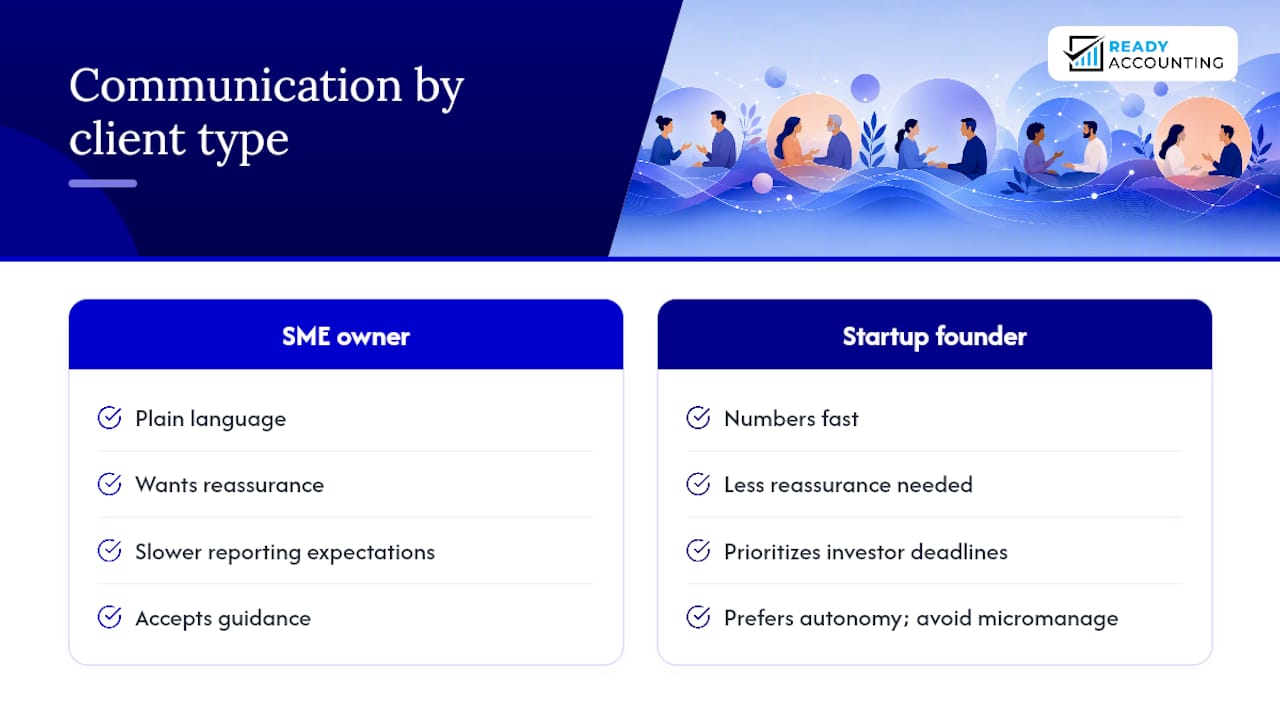
Ask open questions early to surface what a client actually cares about: “What’s the one thing that would make this engagement a success for you?” Then confirm your understanding back to them. That single question often reveals priorities that never show up in the engagement letter, like a founder who’s more worried about investor reporting deadlines than the AFS itself.
Adjust tone and pace accordingly, but don’t overcorrect into flattery. If a deadline genuinely can’t be met, say so plainly and early. Clients forgive a delay they hear about in advance far more easily than one they discover on their own.
Setting response-time targets and measuring what matters
Vague promises like “we’ll get back to you soon” erode trust faster than a slightly slower but honest timeline. Set concrete targets and hold to them.
| Channel | Message type | Target response time |
|---|---|---|
| Urgent, time-sensitive | Under 30 minutes (business hours) | |
| Non-urgent, standard queries | Under 2 business hours | |
| Client portal | Document requests, submissions | Same business day |
Track these targets inside whatever CRM or shared inbox you’re already using; most flag overdue replies automatically. Layer in a lightweight feedback loop: a quarterly pulse check with key clients, plus a single one-question satisfaction rating after milestones like an AFS sign-off or a VAT registration completion. Fast, consistent responses build measurable trust, and small practices often win clients on this alone, before advisory quality even enters the conversation.
What to do when communication has already broken down
Every practice eventually drops the ball. What separates a minor hiccup from a lost client is how fast you recover.
- Acknowledge the failure directly. Don’t soften it into “there may have been a slight delay.” Say what happened.
- Document the agreed fix in writing, even if the conversation happened by phone.
- Set one clear next action with a date attached, not a vague promise to “follow up soon.”
- Ask for feedback once the issue closes. Unresolved frustration tends to resurface at renewal time if you never asked about it directly.
Pro Tip: The most common failure isn’t a mistake. It’s silence after sending a quote or a compliance notice. A single automated check-in on day three catches most of these before they turn into lost clients.
How Ready Accounting handles this in practice
Every client relationship should run through a centralised hub rather than scattered inboxes and phone threads. Handovers between tax, payroll, and advisory teams should be documented, not verbally passed along, so nothing depends on one person’s memory. Automated check-ins during compliance windows, like VAT deadlines and AFS submissions, mean clients hear from us before they need to ask.
The result has been fewer repeat follow-up emails and faster turnaround on compliance filings, because the information a client already gave us doesn’t need asking for twice. If you want a copy of the onboarding checklist or engagement letter templates referenced above, get in touch and we’ll share what we use internally.
— Johan
A managed alternative if you’d rather not build this yourself
Everything above works, and any practice can implement it with a shared inbox, a CRM, and some discipline. But building and maintaining that infrastructure takes time most business owners don’t have to spare. A managed service can remove the admin layer entirely by using cloud accounting infrastructure that connects client portals, API bridges, and real-time dashboards so communication about VAT status, payroll runs, or AFS progress happens automatically, without clients or bookkeepers chasing updates by hand.
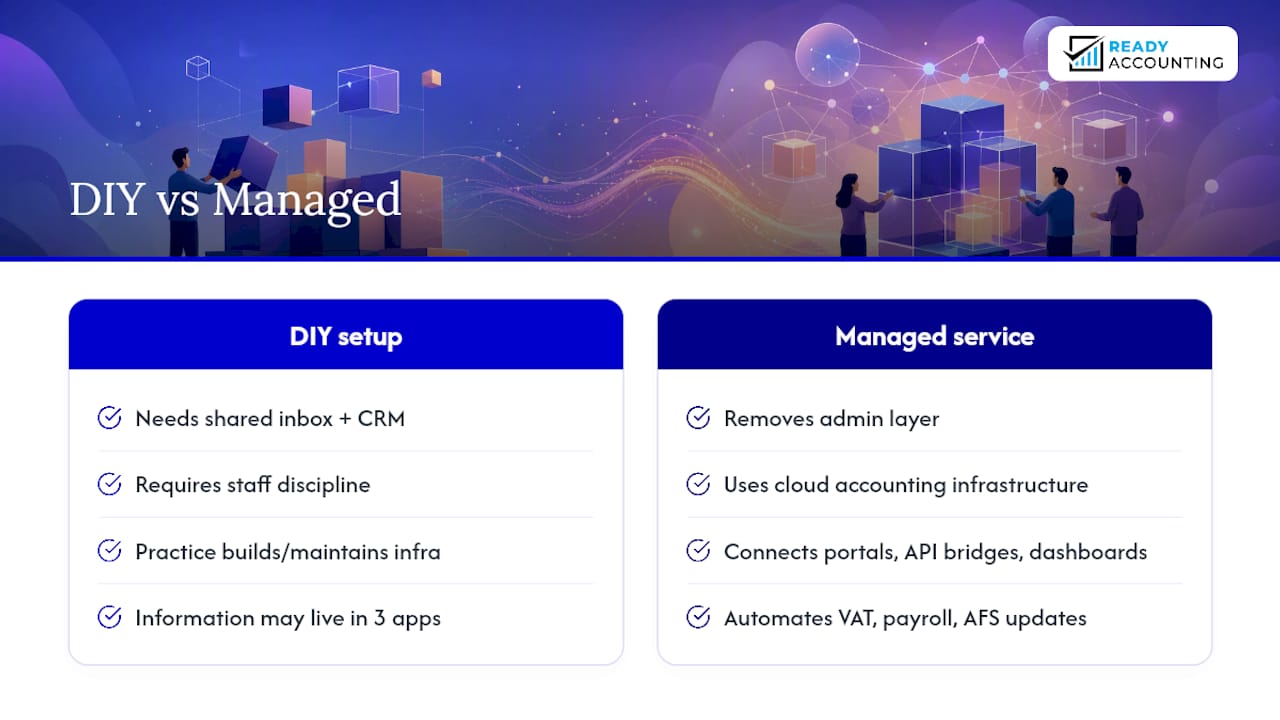
If your current setup already runs on solid documentation and response-time discipline, keep doing what works. If you’re tired of information living in three different apps and want a system that centralises it for you, see how automation improves cash flow visibility and cuts administrative friction for South African SMEs, and reach out to discuss what a managed setup would look like for your business.
Sources
- SAICA competency framework
- Proactive communication as a risk management tool - De Rebus
- The ‘Invisible Leak’ That’s Costing You Clients: A Guide for African SMEs
- WhatsApp overtakes email in South African work communications — IOL
FAQ
How Do You Effectively Communicate With Clients?
Set clear response-time expectations, confirm understanding before acting on instructions, and put every material decision in writing. Practices that centralise this into a shared CRM, the way Readyaccounting structures client accounts, see fewer repeat queries and faster turnaround.
What Are the Five Pillars of Client Communication?
Definitions vary across frameworks, but a common version includes clarity, responsiveness, empathy, consistency, and documentation. All five show up directly in SAICA’s professional competency guidance for accountants.
What Are the Five P’s of Effective Communication?
There’s no single agreed industry standard for “the five P’s” specific to client communication in accounting. Rather than force a definition that doesn’t hold up, focus on the practices proven to work: proactive updates, plain language, published response times, personalised tone, and paper trails.
How Often Should You Update Clients During an Engagement?
Send a short status update at least weekly during active work, even when there’s no major development to report. Silence, not slow progress, is what usually erodes client trust.
Is WhatsApp Safe for Client Communication?
WhatsApp works for quick logistics but shouldn’t carry instructions affecting deadlines or deliverables, since it lacks the audit trail a written record provides. Move anything material into a client portal or CRM instead.