

Digital transformation in SMEs: a practical guide for South Africa
Digital transformation in SMEs: a practical guide for South Africa
Executive Summary
- South African SMEs see technology as essential to stay competitive amid challenges like load shedding and rising costs.
- A phased approach involving auditing, foundation building, and integration helps SMEs implement digital tools effectively.
Digital transformation in SMEs is the process of using technology to improve business operations, customer experience, and decision-making so your business stays competitive. For South African SME owners, this is not a luxury. 64% of South African SMEs report that technology has positively impacted their business, and 55% point to AI and machine learning as key drivers. The pressure is real: load shedding, rising costs, and ICT leadership gaps make manual operations increasingly expensive. The good news is that effective digital change in SMEs does not require a Silicon Valley budget. It requires a clear plan, the right tools, and a trusted partner.
What practical steps should South African SMEs take to start digital transformation?
The biggest mistake SMEs make is buying software before understanding their problems. Purchasing tools based on price or features without first mapping your business pain points leads to “shelfware.” That is software sitting unused while your admin burden grows. The fix starts with an honest audit.
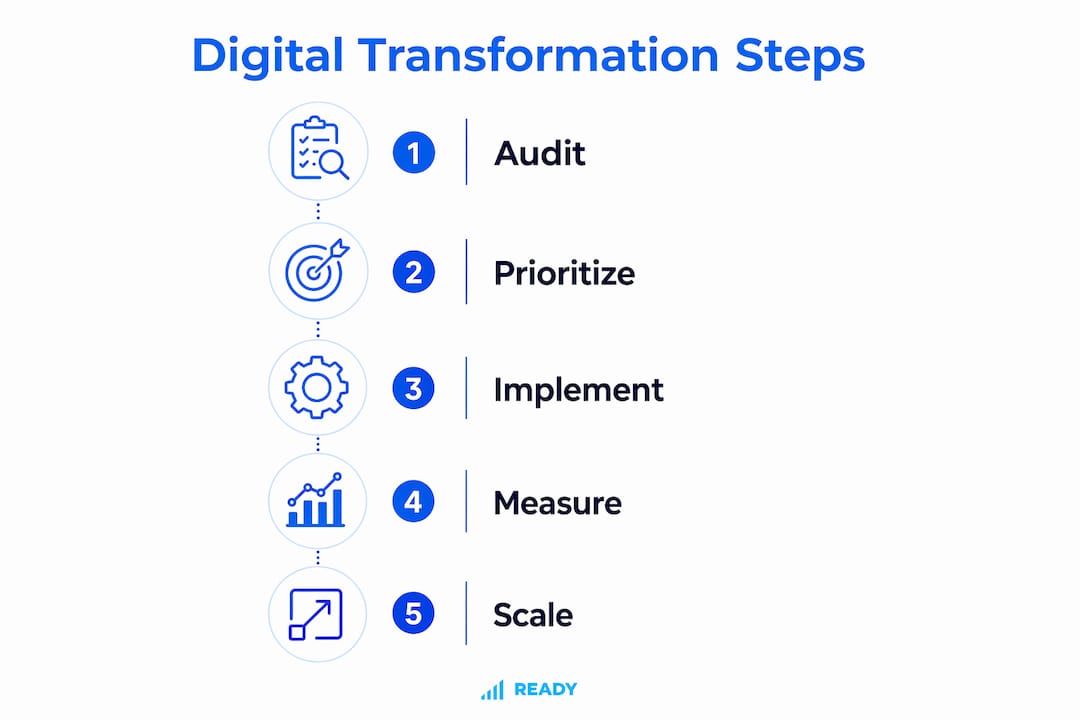
A proven approach follows a 6-month phased framework:
- Weeks 1–2: Audit your pain points. Walk through every key process. Where does work slow down? Where do errors happen? Where do you lose time chasing paper or spreadsheets? Document these bottlenecks before you look at a single product demo.
- Months 1–2: Build your foundation. Pick one or two tools that directly solve your top pain points. Cloud accounting is the most common starting point for South African SMEs because it gives you real-time financial visibility and supports SARS compliance without manual reconciliation.
- Months 3–6: Integrate and expand. Connect your tools so data flows between them automatically. Add a CRM, automate invoicing, or set up a reporting dashboard. Each step should build on the last.
This phased approach works because it forces you to prove value at each stage before spending more. You avoid the trap of over-investing in technology that does not fit your actual workflow.
Pro Tip: Start with the process that costs you the most time each week. Fix that one first. Your team will see the benefit immediately, and that early win builds momentum for the next phase.

The phased model also protects you from a common failure pattern: automating a broken process only makes the problem faster and more expensive. Audit first, automate second.
Which digital tools and technologies most benefit SMEs in South Africa?
A practical digital strategy focuses on doing what you already do, but better. That means automating repetitive tasks, creating real-time dashboards, and giving your team accurate data to make faster decisions. The tools that deliver this fall into four clear categories:
- Cloud accounting and financial automation. Cloud accounting gives you live cash flow data, automated VAT calculations, and SARS-ready reports without manual data entry. Readyaccounting builds custom cloud infrastructure for South African SMEs that connects directly to SARS workflows. The cloud accounting benefits for growing businesses go well beyond basic bookkeeping.
- Customer relationship management (CRM). A CRM tracks every customer interaction in one place. This eliminates the “who spoke to this client last?” problem and gives your sales team a clear view of the pipeline.
- Digital payment systems. Accepting EFT, card, and mobile payments reduces late payments and improves cash flow. Integrating payment data with your accounting system removes double-entry and reduces errors.
- Cybersecurity fundamentals. Strong passwords, two-factor authentication, and regular backups do not require a large investment. These basics protect your business data and support continuity during load shedding or a cyberattack.
The shift that separates successful SMEs from struggling ones is moving away from isolated tools toward integrated systems. SMEs that prioritize integration over standalone apps reduce complexity and increase productivity. When your accounting, CRM, and payments talk to each other, you spend less time on admin and more time on growth. Understanding how digital tools drive finance efficiency is a useful starting point for identifying where integration pays off fastest.
Pro Tip: Before evaluating any tool, write down the specific business problem it must solve. If a vendor cannot show you exactly how their product fixes that problem, move on.
How can SMEs manage change and skills for successful digital adoption?
Technology alone does not transform a business. People do. 70% of small businesses in South Africa lack a dedicated ICT lead, which means the risk of poor integration and failed adoption is high. Managing the human side of digital change is as important as choosing the right tools.
The most effective approach involves four actions:
- Appoint an internal digital champion. This person does not need to be a tech expert. They need to believe in the change, understand the business, and support their colleagues through the transition. Identifying a digital champion within your team is the single most effective change management step you can take.
- Involve your team early. Staff who feel excluded from decisions resist new tools. Staff who help choose and test tools become advocates. Run a pilot with a small group before rolling out company-wide.
- Address shadow IT directly. Shadow IT happens when employees use unauthorized apps because official tools are too slow or complicated. Involving teams early and providing proper training reduces this risk significantly.
- Use external digital partners where skills are missing. If your business lacks ICT leadership, a trusted external partner fills that gap. They provide ongoing integration support, training, and strategic guidance without the cost of a full-time hire.
Leadership clarity matters here. Your team takes their cue from you. If you treat digital adoption as optional or low priority, your staff will too. Communicate the “why” behind each change clearly and consistently.
How do South African SMEs measure and scale digital transformation success?
Measurement is where most SME digital strategies fall apart. Owners invest in tools, see some improvement, and then stop tracking progress. Without clear metrics, you cannot tell what is working or where to invest next.
The foundation of good measurement is a single source of truth. This means integrating your systems so all your business data flows into one dashboard. Fragmented data across spreadsheets, email threads, and disconnected apps slows decisions and hides problems. A unified dashboard gives you real-time visibility into cash flow, sales, and operations simultaneously.
| KPI | What it measures | Expected benefit |
|---|---|---|
| Invoice processing time | Hours spent creating and sending invoices | Reduction of 60–80% with automation |
| Debtor days | Average time to collect payment | Faster collection improves cash flow |
| Reporting turnaround | Time to produce monthly management accounts | From days to hours with cloud accounting |
| Customer response time | Speed of handling queries and orders | Improved satisfaction and retention |
| Error rate in financial data | Frequency of manual data entry mistakes | Near-zero with integrated systems |
Once your baseline metrics are in place, scaling becomes systematic. Automate the next most time-consuming process. Improve your customer-facing digital experience. Use your dashboard data to spot new bottlenecks before they become expensive. The goal is continuous improvement, not a single big-bang project. Readyaccounting builds real-time financial reporting systems that give South African SME owners exactly this kind of ongoing visibility.
Key takeaways
Effective digital transformation in SMEs starts with auditing existing processes, adopting integrated tools in phases, and measuring outcomes with a single source of truth dashboard.
| Point | Details |
|---|---|
| Audit before you buy | Map your bottlenecks before selecting any tool to avoid costly shelfware. |
| Use a phased approach | Follow a 6-month framework: audit, build foundation, then integrate and expand. |
| Prioritize integration | Connected systems outperform isolated apps by eliminating data fragmentation. |
| Appoint a digital champion | An internal advocate drives adoption and reduces staff resistance to change. |
| Measure with a dashboard | Track invoice time, debtor days, and error rates to prove and sustain ROI. |
What I have learned from watching South African SMEs go digital
The pattern I see most often is this: an owner attends a tech event, gets excited about a new platform, buys it, and six months later it is barely used. The problem was never the tool. The problem was skipping the audit.
The SMEs I have seen succeed share one habit. They spend more time understanding their broken processes than they spend evaluating software. They ask “what is actually slowing us down?” before they ask “what should we buy?” That discipline is rare, and it is the difference between a tool that transforms a business and one that collects dust.
Cybersecurity is the other area where I see dangerous shortcuts. Owners assume that because they are small, they are not targets. They are wrong. A single ransomware attack on an unprotected system can shut down a South African SME for weeks. Two-factor authentication and daily backups cost almost nothing and protect everything.
The final lesson: cheap tools are expensive. A low-cost, poorly integrated system creates more admin work than it removes. Trusted digital partners, including firms like Readyaccounting that understand accounting automation deeply, deliver better long-term outcomes than a collection of disconnected apps ever will. Build for integration from day one, and you will not have to rebuild from scratch in two years.
— Johan
How Readyaccounting supports South African SMEs going digital
Readyaccounting works with South African SMEs and VC-backed startups to replace manual financial processes with cloud infrastructure and real-time dashboards. If your business is still reconciling accounts in spreadsheets or chasing debtors manually, there is a faster way. The firm’s approach to improving cash flow through automation gives you live financial visibility without the overhead of a full finance department. Readyaccounting acts as your Fractional CFO, handling SARS compliance, VAT, and financial reporting so you can focus on running your business. Contact Readyaccounting to discuss a tailored solution for your SME.
FAQ
What is digital transformation in SMEs?
Digital transformation in SMEs is the process of using technology to replace manual processes, improve decision-making, and increase competitiveness. It covers cloud accounting, automation, CRM systems, and integrated data dashboards.
How long does digital transformation take for a small business?
A practical phased approach runs over six months: two weeks for auditing, two months for building core systems, and four months for integration and expansion. Most SMEs see measurable efficiency gains within the first 60 days.
What are the biggest risks of digital transformation for South African SMEs?
The two biggest risks are buying tools without first auditing business problems, and neglecting cybersecurity basics like two-factor authentication and backups. Both are avoidable with proper planning.
Why do South African SMEs need digital partners rather than just tools?
70% of small businesses in South Africa lack a dedicated ICT lead. A trusted digital partner fills this gap by providing integration support, training, and strategic guidance that isolated tools cannot offer.
How do SMEs measure the success of their digital strategy?
Track KPIs like invoice processing time, debtor days, reporting turnaround, and data error rates. A single source of truth dashboard that integrates all your systems gives you the real-time visibility needed to measure and improve continuously.
Recommended
- Sustainable financial growth: practical guide for SA SMEs - Ready Accounting
- Financial forecasting: a practical guide for SA SMEs | Ready Accounting
- Digital Transformation in Accounting: How South African Scaling Companies Can Modernize Their Financial Management | Ready Accounting
- How to scale your SME: Proven strategies for South Africa - Ready Accounting