

Digital marketing trends 2025: what leaders must act on now
In 2025, marketing success comes down to three shifts: AI-first execution, privacy-first data plumbing, and short-form video-driven commerce. Marketers who treat these as optional experiments rather than operating priorities will lose ground fast. Digital marketing trends 2025 research points to one uncomfortable truth: the gap between teams that adapt and teams that stall is widening every quarter.
South Africa’s own numbers make the case. The country had high internet penetration in early 2025, with mobile devices carrying most of that traffic, according to DataReportal’s Digital 2025: South Africa report. Meanwhile, a peer-reviewed study on AI adoption found the technology clusters around content personalisation and advertising, not strategic forecasting, per Frontiers in Communication.
Here’s the priority order that matters this year:
- AI and automation for content, ad optimisation, and personalisation, not as a strategy replacement.
- Privacy-first, first-party data collection, because cookieless measurement is no longer a future problem.
- Short-form video and social commerce, since organic reach keeps falling while video and commerce keep climbing.
The rest of this piece walks through every trend shaping the year, then turns to something most marketing content skips entirely: how to connect what your ad platforms report to what your accounting system actually shows, so a strong ROAS number turns into real cash rather than a slide in a deck.
Key Takeaways
Digital marketing trends 2025 success depends on pairing AI-first execution and short-form video commerce with privacy-first measurement that’s wired directly into real financial reporting.
| Point | Details |
|---|---|
| AI works tactically, not strategically yet | Focus AI on content, ads, and personalisation; predictive analytics adoption still lags. |
| First-party data is now urgent | Add capture points weekly and route them into a CDP, not a spreadsheet. |
| Short-form video drives commerce | Shift budget toward vertical, UGC-style clips and test in-app checkout. |
| Trace one customer’s full journey | If you can’t reconstruct it across channels, your omnichannel setup has gaps. |
| Connect marketing data to cash flow | Readyaccounting’s API bridging and fractional CFO oversight turn ROAS into visible, protected cash flow. |
Table of Contents
- Digital marketing strategies 2025: the trends that actually move revenue
- Why marketing measurement has to connect to your accounting system
- Blockchain and decentralization are quietly reshaping ad trust
- Metaverse and augmented reality: past the hype, into utility
- Interactive and immersive content formats
- Influencer marketing keeps professionalising
- Omnichannel journeys have to actually connect
- Sequencing your 2025 bets: what to test now versus later
- Turn campaign data into cash flow you can actually see
- Sources
Digital marketing strategies 2025: the trends that actually move revenue
These aren’t ranked by buzz. They’re ranked by how much they’ll cost you if you ignore them this quarter.
1. Generative AI and automation
AI is doing real work in creative production, ad bidding, and on-site personalisation right now. The Frontiers study found adoption concentrated heavily in customer-facing execution, while predictive analytics and voice-based tools lag well behind, a pattern that shows up across emerging-economy marketing organisations broadly.
Statistic callout: AI adoption in marketing skews toward content personalisation and digital advertising execution, while strategic analytics functions remain underused, per the Frontiers empirical study.
That gap is the opportunity. Teams that push AI only into content drafts are leaving the harder, more valuable use case, forecasting, on the table.
Do this quarter: Run one AI-assisted creative test against your best-performing ad set and measure cost-per-acquisition, not just engagement. Audit which of your existing tools already offer predictive features you haven’t turned on.
2. Short-form video and social commerce
Short-form video dominates engagement, and social commerce is growing fast, driven largely by authenticity and user-generated content rather than polished brand production, according to Chilli Media’s Digital South Africa 2025 analysis.

Do this quarter: Shift one production budget line from a polished video asset to five raw, vertical, UGC-style clips. Test in-app checkout on your top-selling product if your platform supports it.
3. Privacy-first strategy and first-party data
Cookieless measurement and consolidated customer data platforms are becoming non-negotiable as third-party cookies decline and privacy rules tighten globally, per market analysis on South Africa’s martech sector.
Do this quarter: Add one first-party capture point this week, a preference centre, a loyalty signup, a gated download, and pipe it directly into your CDP or CRM rather than a spreadsheet.
4. Martech consolidation and CDPs
Point solutions are getting expensive to maintain and harder to reconcile. The same privacy pressure pushing first-party data is pushing consolidation into unified customer data platforms that centralise identity across channels.
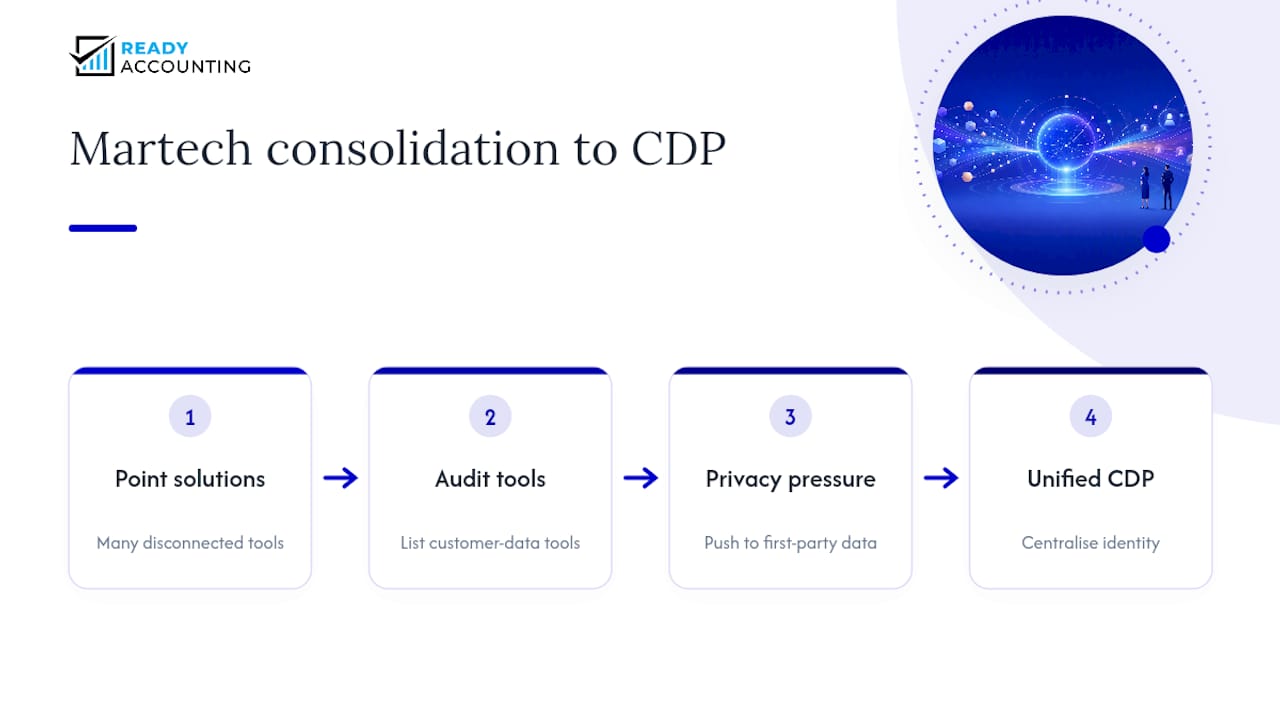
Do this quarter: List every tool touching customer data. If you have more than four disconnected platforms, that’s your consolidation shortlist for next year’s budget cycle.
5. Measurement, ROAS, and cookieless attribution
This is where most teams quietly bleed money. Attribution models built for a cookie-rich world are breaking down, and marketers need modelled or first-party-based measurement to keep ROAS numbers honest.
Do this quarter: Pick one campaign and rebuild its attribution using first-party conversion data instead of platform-reported clicks. Compare the two ROAS figures. The difference tells you how much you’ve been over-trusting the platform.
6. SEO evolution: social search, voice, and topical authority
Search behaviour is fragmenting. Social platforms are increasingly used as search engines in their own right, and Connected TV is expanding as an ad surface marketers can no longer treat as experimental, according to Deloitte’s 2025 Digital Media Trends report. A practical breakdown of 2026 SEO shifts for small businesses covers the tactical side of this well.
Do this quarter: Optimise your top three product or service pages for the actual question a buyer would type into TikTok’s search bar, not just Google’s.
7. Hyper-personalisation at scale
Personalisation used to mean a first name in an email subject line. Now it means dynamic product recommendations, adaptive email send times, and on-site content that shifts by segment in real time, powered by the same AI tools reshaping content production.
Do this quarter: Segment your email list by purchase recency instead of demographics alone, and test one dynamically generated product block.
8. Connected TV and diversified paid media
CTV keeps pulling ad budgets away from linear television as streaming consumption grows, per Deloitte’s trend research cited above. It sits alongside social and search as a channel that needs its own creative format, not a repurposed 30-second spot.
Do this quarter: If you’ve never tested CTV, start with a single geo-targeted campaign at a modest budget before committing to a full flight.
9. Sustainability and purpose-driven marketing
Buyers increasingly weigh brand values alongside price and quality, and vague claims get punished faster than ever on social platforms where scrutiny is public and immediate.
Do this quarter: Audit any sustainability or purpose claim currently live in your marketing. If you can’t point to a specific policy or number behind it, rewrite it or remove it before a customer calls it out for you.
10. Conversational interfaces and AI assistants
Chat-based discovery is changing how people research products, from customer service bots to AI shopping assistants that summarise reviews and compare options before a human ever visits your site.
Do this quarter: Check what an AI assistant currently says about your business when asked to compare it to competitors. If the answer is wrong or outdated, that’s a content gap worth fixing immediately.
Pro Tip: Don’t chase all ten trends simultaneously. Pick the two with the clearest revenue line, usually short-form video and measurement, and give them a full quarter before layering on the rest.
Why marketing measurement has to connect to your accounting system
Here’s the problem almost nobody talks about: your ad platform tells you a campaign generated 40 leads at a great cost-per-click, and your accounting system, weeks later, shows a cash position that doesn’t reflect any of it. That lag is where good campaigns get killed by bad visibility. Even resilient small businesses can’t turn strong marketing leads into reliable cash without systems that talk to each other, a pattern documented in IOL’s coverage of SME digital transformation.
Fixing it isn’t complicated, but it does require deliberate plumbing:
- Map every conversion event to a specific finance ledger code, not a generic “marketing” bucket.
- Tag ad spend at the campaign level so cost data flows automatically into your accounting system via API rather than manual export.
- Build a ROAS-linked cash flow alert that flags when scaled ad spend outpaces incoming revenue recognition.
- Review the digital transformation options available to scaling South African companies that already handle this kind of integration.
Given how mobile-first and social-commerce-driven the South African market already is, per DataReportal, the businesses that win are the ones whose finance teams can see campaign cash impact in real time, not at month-end reconciliation.
Pro Tip: Ask your bookkeeper one question this month: “If I doubled ad spend next week, would you see the cash impact before the invoice arrives?” If the honest answer is no, that’s your integration priority.
Blockchain and decentralization are quietly reshaping ad trust
Blockchain’s marketing relevance isn’t about cryptocurrency hype anymore. It’s about verification. Programmatic ad fraud has pushed some advertisers toward blockchain-based ad verification systems that create an immutable record of where an impression actually served, closing gaps that traditional ad networks can’t audit cleanly.
Decentralised identity is the second thread worth watching. As third-party cookies fade, some platforms are testing blockchain-based identity systems that let users control what data they share without handing a central ad network the keys. This overlaps directly with the privacy-first shift already reshaping measurement.
The practical impact for most marketing teams in 2025 is smaller than the headlines suggest. Loyalty programmes built on tokenised rewards, NFT-based membership tiers, and blockchain-verified supply chain claims (a big lever for sustainability messaging) are where adoption is real, not speculative. If your sustainability claims involve a supply chain, a blockchain-verified record is a stronger trust signal than another certification logo.
The honest advice here is patience with a plan. Don’t build a campaign around a technology your customers don’t understand yet, but do keep a verification layer on your radar if ad fraud or supply chain trust is already costing you money.
Metaverse and augmented reality: past the hype, into utility
The metaverse conversation cooled considerably from its 2022 peak, but augmented reality quietly became one of the most useful tools in the mobile marketing toolkit. Virtual try-on for cosmetics and eyewear, AR-powered furniture placement, and Snapchat or Instagram AR filters tied to product launches all convert better than static product photography for the categories where fit and appearance drive the buying decision.
The distinction that matters for budget planning: full metaverse presence (virtual stores, branded virtual worlds) remains a niche play best suited to large consumer brands with experimentation budgets to spare. AR features embedded directly into existing apps, especially social commerce apps, are the accessible version most mid-sized businesses can actually deploy.
If you sell anything where a customer currently has to guess how a product will look or fit, an AR try-on feature is worth pricing out this year. If your category doesn’t have that friction point, skip it. Chasing metaverse presence without a clear use case is the fastest way to burn a marketing budget on a demo nobody outside your own team ever sees.
Interactive and immersive content formats
Static content is losing the attention fight to formats that ask something of the viewer. Shoppable video, quizzes that route to personalised product recommendations, polls embedded in Stories, and calculators that give a user a number before they ever talk to sales all outperform passive content on time-on-page and lead quality.
The mechanism is simple: interaction creates a data exchange. A quiz that asks three questions before revealing a result gives you first-party data in exchange for value delivered, which ties directly back into the privacy-first data strategy covered earlier. That’s a better trade than a cookie ever was.
Live shopping events, blending short-form video with real-time commerce, are the fastest-growing format in this category, particularly for brands already active on TikTok Shop or Instagram’s commerce features. The barrier to entry is lower than most teams assume: a phone, a host, and a product worth demonstrating live.
Start small. One interactive quiz or calculator embedded on your highest-traffic page will tell you more about format-fit for your audience than a full content calendar built on assumption.
Influencer marketing keeps professionalising
Influencer marketing has moved past the awkward “gift a product, hope for a mention” phase into something closer to a formal media buy, with contracts, disclosure requirements, and performance clauses attached. Regulators in multiple markets have tightened disclosure rules around sponsored content, and platforms have followed with built-in “paid partnership” labelling that makes non-disclosure far easier to catch.
The strategic shift worth noting: micro and nano influencers, those with smaller but highly engaged niche followings, consistently outperform mega-influencers on conversion rate, even though the reach numbers look smaller on paper. Authenticity, the same driver behind short-form video’s dominance, is the reason.
Long-term ambassador relationships are also replacing one-off sponsored posts. A creator who genuinely uses a product across six months builds more trust than the same creator posting a single paid clip, and the content itself tends to perform better because it doesn’t read as an ad.
Build your influencer budget around three or four consistent voices in your niche rather than one expensive, short-term mega-influencer campaign. Confirm every partner clearly discloses the relationship. It protects the creator, the brand, and the campaign’s credibility.
Omnichannel journeys have to actually connect
Most brands can list the channels they’re active on. Far fewer can trace a single customer’s path across those channels without gaps. A prospect who sees a TikTok ad, researches on Google, abandons a cart on mobile, and completes the purchase from a desktop email link should register as one journey, not four disconnected touchpoints across four dashboards.
The technical fix runs through the same infrastructure already covered under martech consolidation: a unified customer data platform that stitches identity across devices and channels using first-party signals instead of third-party cookies. Without that stitching, your attribution data will keep crediting the wrong channel for the sale, and your budget allocation will follow the wrong signal quarter after quarter.
The practical test is simple. Pick one recent customer and try to trace their actual path through your systems. If you can’t reconstruct it without guessing, your omnichannel setup is a collection of channels, not a journey.
Sequencing your 2025 bets: what to test now versus later
Not every trend deserves budget this quarter. Run the cheap, fast tests first: AI-assisted creative variants against narrow paid audiences, and a first-party data capture point you can launch this week. Both give you a read within days, not months.
The medium-term investment is measurement infrastructure, a proper CDP, cookieless attribution modelling, and campaign-to-ledger integration. That work takes a quarter or two to implement but pays back every quarter after.
The long game is organisational: building AI literacy across your team so personalisation and automation tools get used well rather than switched on and abandoned. Teams that skip this step end up with expensive software nobody trusts.
Sequence it in that order. Fast tests build confidence and quick wins. Infrastructure builds the ability to trust your own numbers. Skills make sure both survive past the person who set them up.
— Johan
Turn campaign data into cash flow you can actually see
Most marketing teams can tell you their ROAS. Fewer can tell you, on any given day, what that ROAS actually did to the bank balance. That reconciliation lag, campaign data sitting in one system while cash data sits in another, is exactly the gap Readyaccounting was built to close. Through API bridging, ad spend and conversion data flow directly into your accounting infrastructure instead of a manual monthly export. Automated tagging means every campaign cost lands against the right ledger code the moment it’s spent, not weeks later. And with fractional CFO oversight, someone is actually watching whether scaled ad spend is a smart bet or a cash flow risk before it becomes a problem. If you want to see exactly how this kind of automation protects runway while your marketing team scales spend, see how automation improves cash flow and book a consult to map your own campaign-to-ledger setup.
Sources
- Digital 2025: South Africa — DataReportal
- Integrating artificial intelligence across the marketing process framework: an empirical study in an emerging economy — Frontiers
- Digital South Africa 2025: 60+ data-backed insights — Chilli Media
- How South African SMEs are thriving through digital transformation — IOL
Recommended
- Digital marketing basics for South African SMEs: 2026 guide | Ready Accounting
- Marketing strategies for SMEs: your 2026 South African guide | Ready Accounting
- Leadership skills for success: your 2026 guide | Ready Accounting
- Corporate social responsibility: a 2026 guide for leaders | Ready Accounting