

Digital marketing basics for South African SMEs: 2026 guide
Executive Summary
- South African small and medium businesses should prioritize a phased, mobile-first digital marketing approach. Focusing on essential channels like SEO, paid ads, and email marketing helps maximize budget efficiency. Local factors such as load shedding and platform preferences significantly influence campaign success.
Digital marketing basics refer to the essential principles and strategies South African small and medium businesses use to attract, engage, and convert customers online. South Africa has 51.7 million internet users with 79.6% penetration, and users spend an average of 9 hours 27 minutes online daily. That figure is the highest globally, which means your customers are reachable online at almost any hour. The fundamentals of online marketing give you a structured way to reach them without wasting your budget.
South African SMEs that apply a phased, channel-specific approach to digital marketing see 30–60% better budget efficiency than those who spread spend randomly. Mobile devices drive 64% of web traffic locally, so a mobile-first website is not a preference. It is the starting point for every strategy covered here.
What are the core components of digital marketing basics?
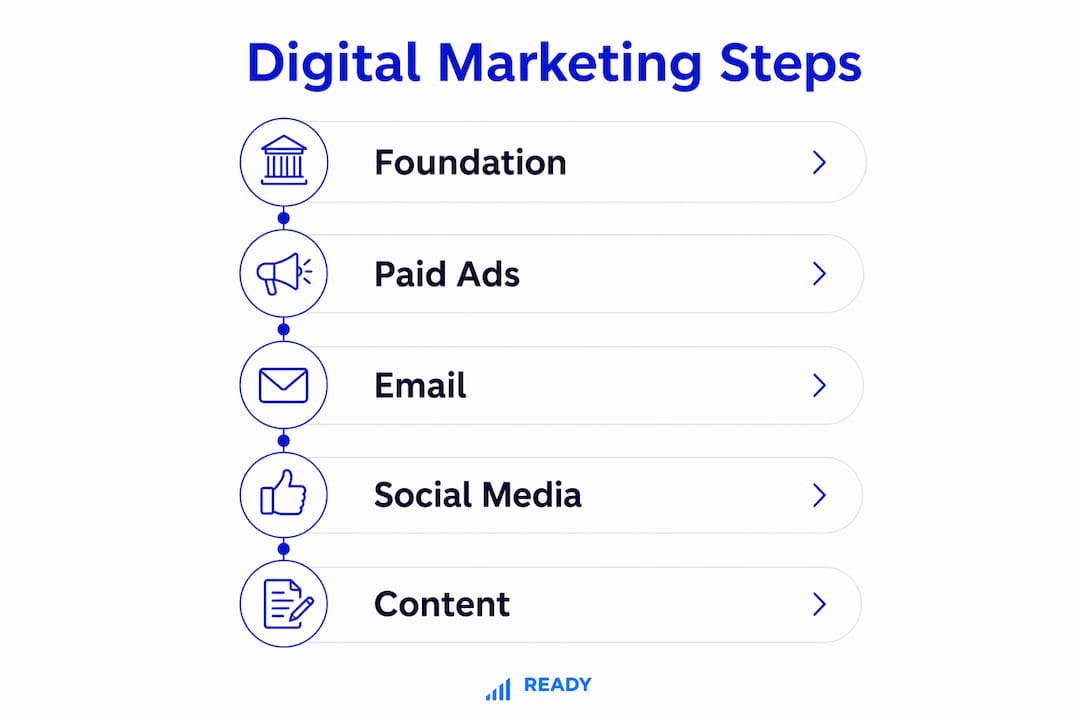
The six core channels of digital marketing are SEO, paid advertising, email marketing, social media, content marketing, and website optimization. Each serves a different purpose, and the best results come from combining them in the right order for your business stage.
Search engine optimization (SEO)
SEO is the process of making your website appear higher in Google search results without paying for each click. Results take time. Early SEO results appear within 3–6 months, and the channel becomes reliable after 6–12 months. The long-term payoff is significant because organic traffic compounds over time without ongoing ad spend.

Local SEO is a specific subset that South African SMEs often overlook. Claiming and optimizing your Google Business Profile can increase customer engagement by 20–40% within three months. That is a fast, free win for any business with a physical location or service area.
Paid advertising
Google Ads and Meta (Facebook and Instagram) ads deliver leads within days of launch. This makes paid advertising the right channel when you need results quickly, such as during a product launch or a slow sales period. The trade-off is that results stop the moment you stop paying, so paid ads work best alongside longer-term channels like SEO.
Email marketing
Email marketing shows revenue gains within 2–4 weeks in South Africa. It is also one of the highest-return channels available because you own the list. South African mid-market businesses that invest in retention channels like email and automation report 25–40% higher customer lifetime value than those focused only on acquisition.
Social media and content marketing
LinkedIn works best for B2B audiences in South Africa, while Facebook and Instagram dominate B2C. Content marketing, which includes blog posts, videos, and guides, supports both SEO and social media by giving you material to share and rank. A fast, mobile-optimized website ties all of these channels together. Without it, traffic from every other channel converts poorly.
Pro Tip: Set up your Google Business Profile before spending a single rand on paid ads. It costs nothing and delivers measurable results within weeks.
How should South African SMEs sequence their digital marketing efforts?
A phased approach prevents the most common and costly mistake in digital marketing: spreading a limited budget across too many channels at once. Copying competitor tactics without mapping them to your own business stage, audience, and budget wastes 40–60% of your marketing spend. The solution is a three-stage plan.
Stage 1: Foundation (months 1–2)
- Build or fix your website so it loads fast on mobile and has clear calls to action.
- Claim and optimize your Google Business Profile with accurate contact details, photos, and service descriptions.
- Set up Google Analytics and Google Search Console to track all incoming traffic from day one.
- Create a simple email capture mechanism on your website, such as a lead magnet or newsletter signup.
Stage 2: Fast results (months 2–4)
- Launch Google Ads targeting your highest-value service or product keywords.
- Start a basic email marketing sequence for new subscribers and existing customers.
- Run Meta ads if your audience is primarily B2C and you have a clear offer to test.
- Begin publishing one to two pieces of SEO-focused content per month.
Stage 3: Compounding growth (month 3 onward)
- Scale SEO and content marketing as your site gains authority and rankings improve.
- Shift more budget toward email and retention as your customer base grows.
- Use AI-driven personalization in email and chatbot flows to increase engagement without adding headcount.
- Review channel performance monthly and reallocate budget to what is working.
South African mid-market businesses allocate 6–11% of revenue to marketing. If your monthly revenue is R150,000, a starting budget of R15,000 per month is within that range. At R450,000 monthly revenue, a R45,000 budget gives you enough to run all three stages simultaneously.
Pro Tip: Never split a small budget across five channels. Pick two channels for your first 60 days, measure results, then add a third only when the first two are profitable.
| Stage | Primary channels | Timeline | Goal |
|---|---|---|---|
| Foundation | Website, Google Business Profile | Months 1–2 | Build the base |
| Fast results | Google Ads, email marketing | Months 2–4 | Generate leads quickly |
| Compounding growth | SEO, content, automation | Month 3 onward | Lower cost per lead over time |
What local South African market realities affect your digital strategy?
South Africa’s digital environment has specific characteristics that change how you apply the fundamentals of online marketing. Ignoring them leads to campaigns that work in theory but fail in practice.
The most critical factor is mobile dependency. Mobile-first website design is not optional for South African businesses. With 64% of web traffic coming from mobile devices, a site that loads slowly or displays poorly on a phone loses the majority of its visitors before they read a single word.
Load shedding adds another layer of complexity. Consumers often browse on mobile data rather than fixed-line internet, which means page speed directly affects your conversion rate. A page that takes more than three seconds to load on a 4G connection will lose a significant portion of its audience.
Other local realities to factor into your planning:
- Language and culture: South Africa has 11 official languages. English dominates online content, but Zulu, Xhosa, and Afrikaans content can significantly improve engagement in specific regions and demographics.
- Ecommerce trust: South African ecommerce grows at 12–16% annually but faces persistent trust, payment, and delivery challenges. Displaying trust signals like secure payment badges, clear return policies, and customer reviews is not optional. It is a conversion requirement.
- Platform preferences: WhatsApp is the dominant messaging platform in South Africa and works well for customer service and follow-up sequences. LinkedIn outperforms other platforms for B2B lead generation.
- Multiple SIM usage: Many South African consumers use more than one mobile network. This affects how you target audiences through mobile advertising and which networks you prioritize for SMS campaigns.
Which digital marketing metrics should South African SMEs track?
Measurement is what separates businesses that grow from those that stay stuck. Without clear numbers, you cannot tell which channels are working or where to cut spend.
The metrics that matter most for an introduction to digital marketing are:
- Website traffic by source: Know exactly how many visitors come from Google organic search, paid ads, social media, and direct visits. Google Analytics provides this for free.
- Cost per lead: Divide your total ad spend by the number of leads generated. This single number tells you whether a channel is profitable or not.
- Conversion rate: The percentage of website visitors who take a desired action, such as filling in a contact form or making a purchase. A low conversion rate usually points to a website problem, not an advertising problem.
- Email open and click rates: These indicate whether your messaging resonates with your audience. Low open rates suggest your subject lines need work. Low click rates suggest your content or offer is not compelling enough.
- Customer lifetime value: Businesses that track retention metrics alongside acquisition metrics consistently outperform those focused only on new leads.
Set up conversion tracking in Google Ads from day one. Without it, you are paying for clicks with no way to know which ones became customers. Review your key metrics weekly during the first 90 days, then shift to monthly reviews once you have a clear performance baseline.
Pro Tip: Track offline leads too. If customers call you after seeing your ad, use a call tracking number so that conversion is captured in your data, not lost.
Key takeaways
A phased, mobile-first digital marketing strategy built on SEO, paid ads, email, and clear measurement gives South African SMEs the most reliable path to online growth.
| Point | Details |
|---|---|
| Start with the foundation | Build a fast, mobile-optimized website and claim your Google Business Profile before spending on ads. |
| Phase your channel rollout | Launch paid ads and email in months 2–4, then layer in SEO for compounding long-term results. |
| Budget with focus | Allocate 6–11% of revenue to marketing and concentrate spend on two channels before expanding. |
| Track cost per lead | Measure every channel by cost per lead and conversion rate to know exactly what is working. |
| Adapt to local realities | Account for load shedding, mobile data usage, and ecommerce trust barriers in every campaign. |
Why most South African SMEs get digital marketing wrong
The pattern I see most often is a business owner who watches what a competitor is doing and copies it. They run the same type of Facebook ads, write similar blog posts, and wonder why the results are different. The problem is that tactics only work in context. What works for a competitor with a R200,000 monthly ad budget and a three-year-old domain will not work for a business starting from scratch with R15,000.
The AI-driven personalization tools available today genuinely level the playing field. A small team can now run email sequences, chatbot follow-ups, and personalized content recommendations that would have required a full marketing department five years ago. AI-driven personalization can increase customer engagement by up to 30% for South African SMEs, even without technical expertise. That is a real competitive advantage if you use it early.
The businesses I have seen grow consistently are the ones that define a clear numerical goal, pick two channels, measure weekly, and adjust. They are not doing anything exotic. They are applying the digital marketing strategies that match their stage and budget, and they stay patient through the months when SEO is building and email lists are small. That discipline is rarer than any tactic.
— Johan
How Readyaccounting supports your growth beyond marketing
Digital marketing brings customers in. Financial automation keeps the business healthy enough to serve them. Readyaccounting works with South African SMEs to replace manual bookkeeping with cloud infrastructure and real-time financial dashboards, so you always know your cash position as revenue grows. Understanding how automation improves cash flow is the natural next step once your marketing starts generating consistent leads. Readyaccounting also acts as your Fractional CFO, helping you allocate marketing budgets against real financial data rather than guesswork. Speak to the team at Readyaccounting to see how financial automation and cloud accounting benefits can support your next stage of growth.
FAQ
What are digital marketing basics for beginners?
Digital marketing basics are the core channels and principles used to attract and convert customers online, including SEO, paid advertising, email marketing, social media, and website optimization. South African SMEs should start with a mobile-optimized website and Google Business Profile before adding paid channels.
How long does digital marketing take to show results in South Africa?
Google Ads delivers leads within days, email marketing shows revenue gains within 2–4 weeks, and SEO produces reliable results after 6–12 months. A phased approach that starts with paid channels and layers in SEO over time gives the best return on investment.
How much should a South African SME spend on digital marketing?
South African mid-market businesses allocate 6–11% of revenue to marketing. A business generating R150,000 per month should budget at least R15,000 for marketing, concentrated on two channels rather than spread across many.
Why is mobile-first design critical for South African businesses?
Mobile devices drive 64% of web traffic in South Africa, and many users browse on mobile data networks affected by load shedding and variable speeds. A site that loads slowly on mobile loses the majority of its potential customers before they engage with your content.
What is the biggest digital marketing mistake South African SMEs make?
Copying competitor tactics without mapping them to your own business stage, audience, and budget wastes 40–60% of your marketing spend. Focus on two channels, measure cost per lead weekly, and expand only when those channels are profitable.