

Key Difference Between Accountant and Auditor for SA Businesses
Every business in South Africa needs to keep their financial house in order. People often mix up accountants and auditors, assuming they do the same thing. However, only certain types of companies in South Africa are legally required to have audits, while everyone needs accounting support from day one. That means your business could be missing out or overspending just because you do not know the real difference.
Table of Contents
- Roles And Duties: Accountant Vs Auditor
- When Does Your South African Business Need Each?
- How Accountants And Auditors Support Compliance And Tax
- Choosing The Right Partner For Cloud-Based Solutions
Quick Summary
| Takeaway | Explanation |
|---|---|
| Employ Accountants for Continuous Support | Accountants manage daily financial operations, ensuring compliance and accurate reporting for businesses. |
| Auditors Provide Independent Verification | Auditors verify the accuracy of financial statements, ensuring reliability and compliance with regulations. |
| Engage Accountants Early in Business | Early engagement with accountants is vital for startups to manage transactions and tax submissions effectively. |
| Know When to Conduct Audits | Mandatory audits apply based on specific criteria, ensuring compliance and validating financial health for certain businesses. |
| Choose Cloud Partners for Security and Compliance | Selecting the right cloud accounting partners ensures robust security and compliance with regulations, supporting digital financial management. |
Roles and Duties: Accountant vs Auditor
In the complex world of financial management for South African businesses, understanding the distinct roles of accountants and auditors is crucial for maintaining financial integrity and compliance. While both professionals work with financial data, their responsibilities and approaches differ significantly.
Recording vs Verifying Financial Information
Accountants serve as the primary architects of a company’s financial records. According to the U.S. Bureau of Labor Statistics, they are responsible for preparing and examining financial records, ensuring accuracy and compliance with regulatory standards. In the South African context, this means managing ledgers, computing taxes for SARS, preparing financial statements, and providing strategic financial advice to businesses.
By contrast, auditors function as independent financial detectives. Their primary role is to verify the work of accountants and ensure the complete accuracy and reliability of financial reporting. Accounting Insights highlights that auditors conduct thorough examinations of financial statements, inspect account books, and assess internal controls to identify potential risks or instances of fraud.
Strategic Financial Management and Compliance
Accountants play a proactive role in financial strategy. They assist businesses in budgeting, forecasting, and making informed financial decisions. For South African companies, this involves understanding local tax regulations, VAT requirements, and CIPC compliance. They help businesses optimize their financial performance by identifying cost-saving opportunities and providing insights into financial health.
Auditors, meanwhile, maintain a more reactive and investigative stance. Their objective is to provide an independent assessment of a company’s financial statements. They ensure that financial reports comply with South African accounting standards and regulations. An auditor’s report serves as a critical validation of a company’s financial transparency and can be essential for investors, stakeholders, and regulatory bodies.
Scope of Professional Responsibilities
The day-to-day work of an accountant involves continuous financial record-keeping, transaction processing, and generating regular financial reports. They work closely with businesses throughout the year, offering ongoing financial guidance and support. For cloud accounting services in South Africa, this might include managing digital financial records, preparing annual financial statements, and assisting with tax registration and submissions.
Auditors typically engage with a business periodically, conducting comprehensive reviews of financial records. Their work is more episodic and focused on providing an independent evaluation. They might conduct internal audits to help businesses improve their financial processes or external audits required by regulatory frameworks.
Understanding these distinctions is vital for South African businesses seeking comprehensive financial management. While accountants provide continuous financial support and strategic insights, auditors offer critical independent verification that ensures financial integrity and compliance. Learn more about financial management strategies for your business.
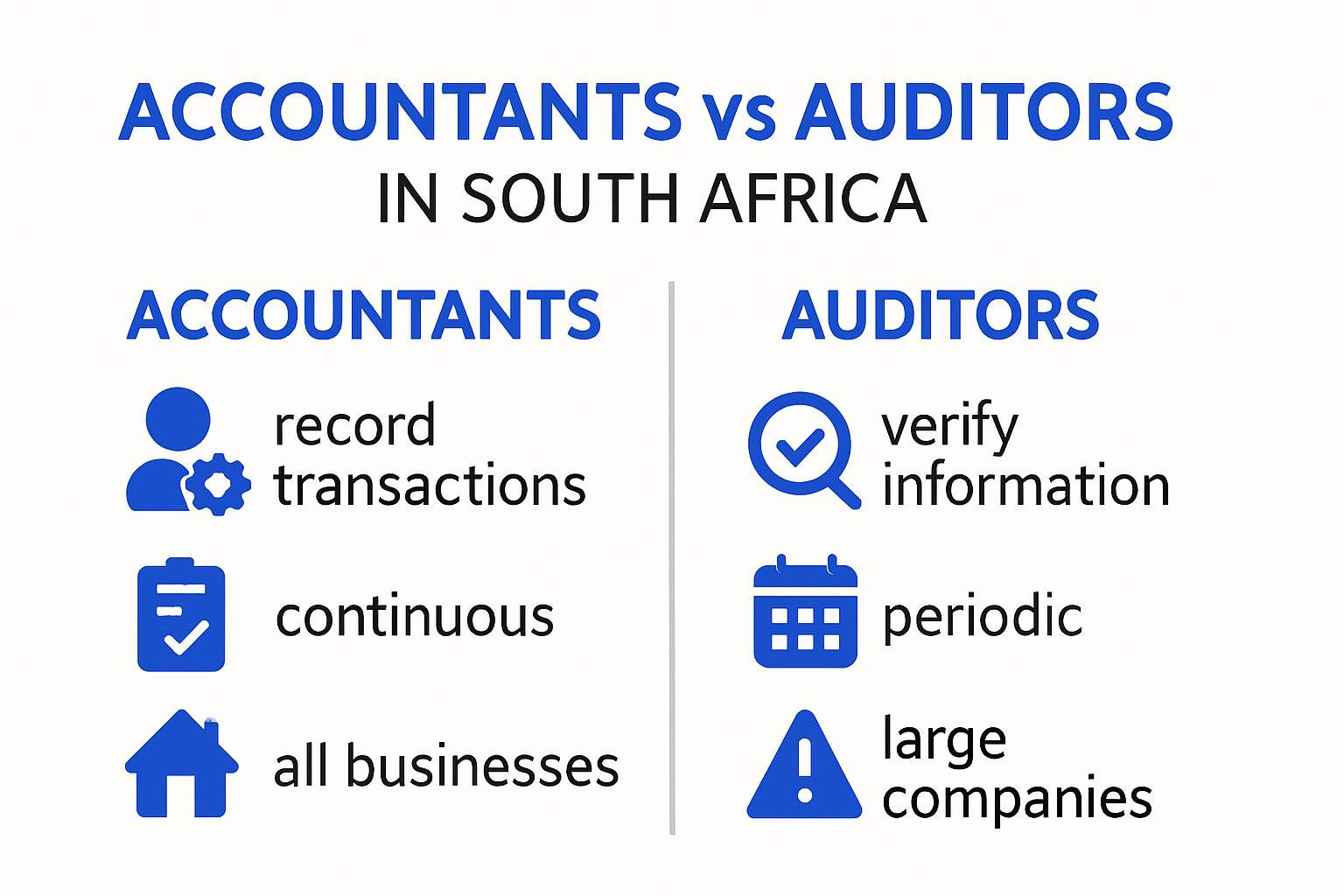
To help clearly distinguish the roles and duties of accountants and auditors for South African businesses, the following comparison table summarises their key responsibilities and approaches:
| Aspect | Accountant (SA) Responsibilities | Auditor (SA) Responsibilities |
|---|---|---|
| Core Function | Prepares and manages financial records | Verifies and assesses accuracy of financial records |
| Approach | Continuous, proactive financial management | Independent, periodic verification |
| Key Activities | Bookkeeping, tax calculation & submissions, reporting | Examining statements, internal controls assessment |
| Compliance | Ensures day-to-day regulatory adherence | Validates overall regulatory compliance |
| Engagement Frequency | Ongoing (daily/regular support) | As needed (often annual or by requirement) |
| Strategic Role | Provides insights for financial decisions & planning | Identifies risks, ensures transparency/reliability |
When Does Your South African Business Need Each?
Navigating the financial landscape of South African businesses requires strategic decisions about when to engage accountants and auditors. Understanding the right time to leverage each professional’s expertise can significantly impact your company’s financial health and compliance.
Accounting Services: Continuous Financial Support
For most South African businesses, engaging an accountant is not just recommended but essential from the earliest stages of operations. According to the South African Institute of Chartered Accountants (SAICA), businesses require ongoing financial management services that accountants provide. Small businesses and startups particularly benefit from professional accounting support to manage daily financial transactions, prepare tax submissions for SARS, maintain accurate financial records, and ensure compliance with local regulations.
Critical scenarios demanding immediate accounting services include:
- Company Registration: When registering with CIPC and establishing initial financial structures
- VAT Registration: Navigating complex VAT requirements and submissions
- Payroll Management: Ensuring accurate salary processing and tax calculations
- Annual Financial Statement Preparation: Developing comprehensive financial reports for stakeholders
Audit Requirements: Periodic and Mandatory Assessments
The Independent Regulatory Board for Auditors (IRBA) provides clear guidelines on when South African businesses require mandatory audits. Typically, companies meeting specific criteria must undergo external audits. These include:
- Publicly traded companies
- Businesses with annual revenue exceeding specified thresholds
- Entities operating in regulated industries like financial services
- Companies seeking significant investor funding or bank loans
Beyond mandatory requirements, businesses might consider voluntary audits to:
- Validate financial statements
- Identify potential financial risks
- Improve internal financial controls
- Enhance credibility with investors and stakeholders
Strategic Timing for Financial Professional Engagement
Deciding between accounting and audit services depends on your business stage and specific needs. Startups and small businesses typically require consistent accounting support to manage daily financial operations. As businesses grow and become more complex, the need for periodic audit services increases.
Key indicators that your business might need an audit include:
- Significant growth in annual revenue
- Plans for expansion or seeking external investment
- Mergers or acquisitions
- Requirement to demonstrate financial transparency
For most South African SMEs, a proactive approach involves maintaining robust accounting services while being prepared for potential audit requirements. Learn more about managing your business financial strategy to ensure comprehensive financial management.
Remember, professional financial guidance isn’t just about compliance it’s about building a strong, sustainable financial foundation for your business. Consulting with qualified accounting and audit professionals can provide invaluable insights tailored to your specific business needs.
Below is a summary table highlighting when South African businesses typically require accounting and audit services, based on specific milestones or triggers mentioned in the article:
| Business Stage / Scenario | Need Accountant? | Need Auditor? | Reason / Notes |
|---|---|---|---|
| Company Registration (CIPC formality) | Yes | No | Set up initial financial structures |
| VAT Registration | Yes | No | Manage VAT submissions to SARS |
| Payroll Management | Yes | No | Process salaries, tax calculations |
| Annual Financial Statement Preparation | Yes | No | Prepare reports for stakeholders |
| Publicly Traded, Regulated, or High Revenue Co. | Yes | Yes | Audit mandated by law/regulation |
| Applying for Major Funding/Bank Loans | Yes | Yes | Audit enhances credibility/validation |
| Experiencing Significant Growth/Mergers | Yes | Yes | Transparency, may trigger audit requirement |
| Routine Daily Operations | Yes | No | Continuous accounting support essential |
How Accountants and Auditors Support Compliance and Tax
In the intricate world of South African business finance, accountants and auditors play pivotal roles in ensuring tax compliance and maintaining financial integrity. Their collaborative efforts help businesses navigate complex regulatory landscapes while minimizing potential risks and penalties.
Tax Compliance and Strategic Financial Management
According to the U.S. Department of the Treasury, accountants and auditors have complementary functions in maintaining organizational compliance with tax laws and financial regulations. For South African businesses, this means developing comprehensive strategies to meet SARS requirements efficiently.
Accountants serve as the primary architects of tax compliance, responsible for:
- Accurate preparation of income tax returns
- Calculating VAT submissions
- Managing payroll tax calculations
- Tracking and documenting business expenses for potential tax deductions
- Ensuring timely submission of all required financial documentation
Risk Mitigation and Financial Transparency
Auditors provide an additional layer of financial scrutiny, independently verifying the accuracy of financial records and tax submissions. Their role extends beyond mere number checking to comprehensive risk assessment. By conducting thorough reviews, auditors help businesses identify potential compliance gaps, procedural weaknesses, and areas of potential financial vulnerability.
Key audit functions related to compliance include:
- Reviewing financial statements for accuracy
- Verifying tax calculations and submissions
- Assessing internal financial control mechanisms
- Identifying potential areas of financial risk or non-compliance
- Providing independent validation of financial reporting
Navigating Complex Regulatory Requirements
South African businesses face a complex regulatory environment that demands meticulous financial management. Explore our comprehensive guide on SARS record-keeping requirements to understand the intricate details of maintaining compliant financial records.
Both accountants and auditors work together to help businesses:
- Stay updated with changing tax legislation
- Implement robust financial reporting systems
- Minimize potential risks of non-compliance
- Develop proactive financial management strategies
- Maintain accurate and transparent financial records
For small and medium enterprises in South Africa, professional financial guidance is not just about meeting regulatory requirements. It’s about building a strong financial foundation that supports sustainable business growth. By leveraging the expertise of both accountants and auditors, businesses can create a comprehensive approach to financial management that protects their interests and supports long-term success.

Remember, effective tax compliance is an ongoing process that requires strategic planning, attention to detail, and a deep understanding of local financial regulations. Investing in professional financial services is an investment in your business’s future stability and growth.
Choosing the Right Partner for Cloud-Based Solutions
In the rapidly evolving digital landscape of South African business finance, selecting the right accounting and auditing professionals for cloud-based solutions has become increasingly critical. The transition to digital financial management requires strategic partnerships that can navigate technological complexities while ensuring robust financial integrity.
Security and Compliance in Cloud Accounting
According to the Association of Chartered Certified Accountants (ACCA), cloud solution professionals must demonstrate comprehensive expertise in infrastructure security. For South African businesses, this means evaluating potential partners based on their ability to manage network architecture, security controls, and implement sophisticated monitoring systems.
Key considerations when selecting cloud accounting partners include:
- Robust firewall and intrusion prevention configurations
- Advanced Security Information and Event Management (SIEM) capabilities
- Comprehensive incident response strategies
- Compliance with local data protection regulations
- Proven track record in handling sensitive financial information
Technological Expertise and Integration Capabilities
The ideal cloud accounting and auditing partner should offer seamless technological integration that supports your business’s unique operational requirements. This involves more than just technical competence it requires a deep understanding of South African business ecosystems and regulatory frameworks.
Critical technological capabilities to assess include:
- Compatibility with local tax reporting systems
- Real-time financial reporting capabilities
- Scalable cloud infrastructure
- Advanced data analytics tools
- Secure multi-factor authentication mechanisms
Selecting the Right Professional Partnership
Choosing between cloud accounting services requires careful evaluation of professional credentials, technological capabilities, and alignment with your business objectives. Discover the transformative potential of cloud accounting for your business growth and understand how the right technological partnership can revolutionize your financial management.
When evaluating potential cloud accounting and auditing partners, consider:
- Professional certifications from recognized bodies
- Experience working with businesses in your industry
- Demonstrated commitment to continuous technological learning
- Transparent pricing and service level agreements
- Flexible and customizable service offerings
For South African businesses, the right cloud-based financial partner is not just a service provider but a strategic ally in navigating complex financial landscapes. By prioritizing security, technological expertise, and adaptability, businesses can transform their financial management approach, driving efficiency, transparency, and sustainable growth.
Remember, in the digital age, your financial technology partner is as crucial as the services they provide. Choose wisely, and invest in a partnership that understands the unique challenges and opportunities of South African business environments.
Frequently Asked Questions
What is the main difference between an accountant and an auditor in South Africa?
Accountants manage day-to-day financial operations, preparing and maintaining financial records, while auditors independently verify the accuracy and compliance of those records through periodic assessments.
When should I hire an accountant for my South African business?
You should engage an accountant from the very beginning of your business operations to manage daily financial transactions, prepare tax submissions, and ensure compliance with local regulations.
Are audits mandatory for all businesses in South Africa?
No, only certain types of businesses, such as publicly traded companies or those exceeding specific revenue thresholds, are mandated to undergo audits. Other businesses may opt for voluntary audits for credibility and risk assessment.
How do accountants and auditors support tax compliance in South Africa?
Accountants prepare and file tax returns, ensuring accuracy and compliance with SARS requirements, while auditors conduct reviews to verify financial statements and identify potential compliance gaps.
Ready to Move Beyond Confusion? Simplify Your Business Finances Today
Understanding the difference between an accountant and an auditor is crucial for your South African business. If you are feeling unsure about when you need ongoing financial support, when audit requirements apply or how to stay truly compliant, you are not alone. Many business owners worry about overspending or missing mandatory obligations because they do not have the right guidance or systems in place. The key is not just understanding these roles, but knowing how to implement the right expertise quickly and accurately. That is exactly what our team at Ready Accounting does best.

If you have been grappling with accounting headaches, want to streamline VAT and payroll, or need help preparing for audits, let us show you how modern cloud solutions and expert local support can transform your business. Visit Ready Accounting now or get a tailored consultation to secure reliable, ongoing financial management. The sooner you take action, the sooner you can remove the confusion and start building lasting financial stability for your business.
Recommended
- Difference Between Bookkeeping and Accounting Explained for SA Businesses 2025 – Ready Accounting
- Role of Accountants in Business: Essential Support for SA Companies 2025 – Ready Accounting
- Basic Accounting Principles for South African Businesses 2025 – Ready Accounting
- SARS Record-Keeping Rules for Businesses – Ready Accounting