

Cybersecurity for SMEs: a practical South African guide
Executive Summary
- South African SMEs face a resilience gap in cybersecurity, with half experiencing recent attacks. Implementing affordable controls like multi-factor authentication and regular staff training strengthens security and compliance. Combining these measures with operational practice, such as tabletop exercises, improves overall business resilience.
Cybersecurity for SMEs is the practice of protecting small and medium-sized businesses from digital threats through appropriate technical and organisational controls. South African SMEs face this challenge at scale: 1 in 2 businesses experienced a cybersecurity incident in the past 12 months. That statistic signals a resilience gap, not just a technology gap. The Protection of Personal Information Act (POPIA) adds a legal dimension that makes cybersecurity a compliance obligation, not just an IT preference. For South African SME owners, treating digital security as a core business priority is now non-negotiable.
What are the most critical cybersecurity risks facing South African SMEs?
Phishing, ransomware, and social engineering are the three attack types that cause the most damage to South African small businesses. Phishing tricks staff into handing over credentials through fake emails or websites. Ransomware encrypts your files and demands payment before restoring access. Social engineering manipulates people directly, often bypassing technology controls entirely.

The MITRE ATT&CK framework identifies the tactics attackers use most often against local businesses. 66% of South African business compromises can be addressed by focusing on just four tactics: Initial Access, Persistence, Privilege Escalation, and Lateral Movement. That means you do not need to defend against every possible threat. Prioritising coverage of these four areas gives you the highest return on your security investment.
AI-driven attacks are raising the stakes further. Attackers now use AI to craft convincing phishing emails at scale, personalise social engineering attempts, and automate credential-stuffing attacks. SMEs without dedicated IT staff are the most exposed to this shift in threat sophistication.
The business impact of a successful attack goes beyond data loss. Downtime, reputational damage, client notification obligations under POPIA, and potential fines all compound the direct financial cost. For a small business, a single serious incident can threaten continuity.
- Phishing: Fake emails or sites that steal login credentials
- Ransomware: Malware that encrypts data and demands payment for restoration
- Social engineering: Manipulation of staff to bypass security controls
- Credential theft: Stolen passwords used to access financial and client systems
- Insider threats: Accidental or deliberate data exposure by employees
Pro Tip: Run a free phishing simulation using tools like KnowBe4’s free trial or Google’s Phishing Quiz to benchmark your team’s current vulnerability before investing in training.
Which affordable cybersecurity measures can SMEs implement effectively?
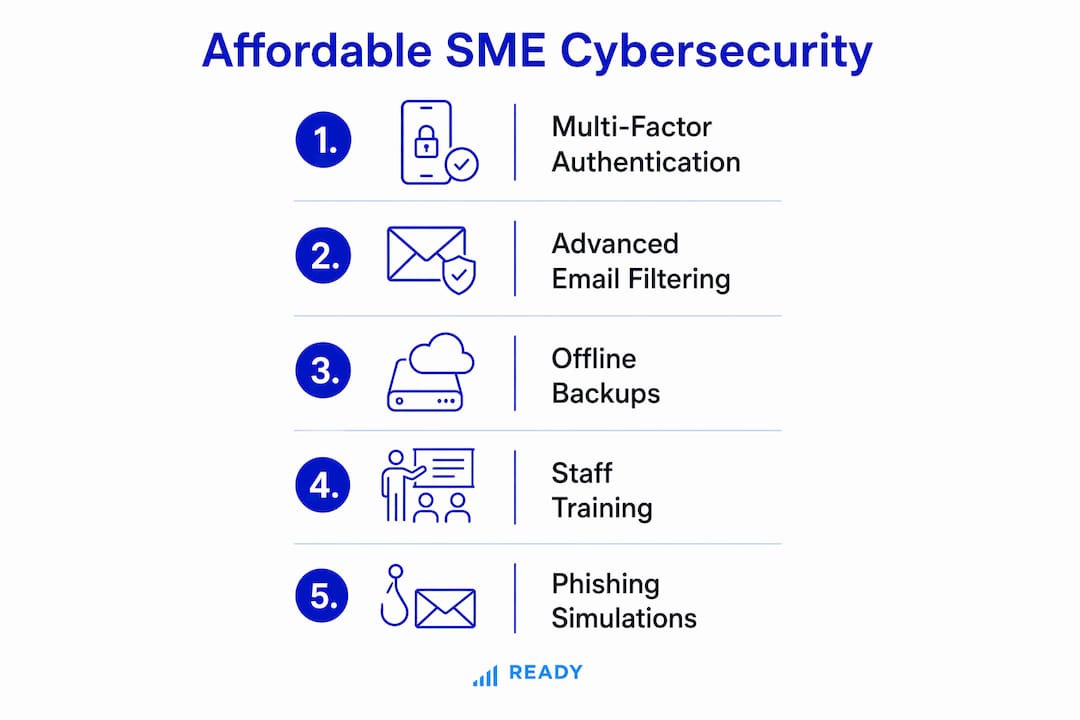
Cost is the most common reason South African SMEs delay security improvements. The good news is that the most effective controls are also among the most affordable. You do not need an enterprise security budget to close the biggest gaps.
-
Enable multi-factor authentication (MFA) on all accounts. MFA blocks the vast majority of credential-based attacks. Apply it to email, cloud accounting platforms, banking portals, and any system holding client data. Most cloud services include MFA at no extra cost.
-
Run regular staff cybersecurity training. Consistent security training can reduce phishing vulnerability from over 31% to under 5% within 12 months. That is one of the highest-impact, lowest-cost interventions available to any SME.
-
Apply the 3-2-1-1-0 backup rule. Keep three copies of your data, on two different media types, with one copy offsite, one copy offline or immutable, and zero unverified backups. The 3-2-1-1-0 backup rule is the industry standard for surviving ransomware. Testing your recovery process matters as much as having the backup.
-
Use cloud-based SaaS solutions with built-in security. Cloud providers adhering to frameworks like OWASP security standards give SMEs enterprise-grade protection without large overheads. Cloud accounting platforms, for example, handle patching, encryption, and access controls automatically.
-
Keep software and systems patched. Unpatched software is one of the most common entry points for attackers. Set operating systems, browsers, and business applications to update automatically wherever possible.
-
Implement role-based access controls. Staff should only access the data and systems they need for their specific role. Limiting access reduces the blast radius of any single compromised account.
Pro Tip: Pair layered security controls such as MFA, advanced email filtering, and offline backups together. Each layer compensates for the weaknesses of the others.
How to align cybersecurity practices with POPIA compliance for SMEs?
POPIA is South Africa’s primary data protection law, and it directly shapes how SMEs must approach information security. Section 19 of POPIA mandates that responsible parties implement proportional security safeguards appropriate to the sensitivity of the personal information they hold. “Appropriate and reasonable” is the legal standard, which means your controls must match your actual risk profile.
Section 22 of POPIA requires breach notification to the Information Regulator and affected data subjects as soon as reasonably possible. The commonly applied benchmark is 72 hours after discovery. Non-compliance carries penalties of up to R10 million or imprisonment. That is a serious financial and legal exposure for any SME.
The practical steps to demonstrate POPIA compliance overlap directly with good cybersecurity practice:
- Appoint an Information Officer. Every business processing personal information must designate a responsible person. This person manages breach response, documentation, and staff training.
- Conduct and document risk assessments. POPIA requires evidence of ongoing verification of your safeguards. A documented risk assessment is your primary proof.
- Maintain an incident response plan. A written plan that covers detection, containment, notification, and recovery satisfies both POPIA obligations and operational resilience needs.
- Review third-party data processors. Any supplier handling your client data on your behalf must also meet POPIA standards. Check contracts and data processing agreements.
| POPIA requirement | Practical cybersecurity action |
|---|---|
| Section 19: security safeguards | MFA, encryption, access controls, patch management |
| Section 22: breach notification | Incident response plan with 72-hour notification trigger |
| Information Officer appointment | Assign a named person with documented responsibilities |
| Risk assessment documentation | Annual written assessment reviewed after any incident |
| Third-party processor oversight | Data processing agreements with all cloud and SaaS vendors |
POPIA compliance is also a commercial asset. SMEs demonstrating POPIA compliance and tested incident response plans win more enterprise contracts. Compliance signals trustworthiness to larger clients who conduct supplier due diligence.
How can SMEs improve operational resilience beyond technology?
Buying security tools is not the same as being secure. Only 36% of South African SMBs test their backups regularly, despite 71% having backup tools in place. That gap between having a tool and using it effectively is where most SMEs are most vulnerable.
Operational resilience requires embedding security into your business culture, not just your technology stack. The most effective way to do this is through regular practice and executive involvement.
- Run quarterly tabletop exercises. Tabletop exercises with legal and finance participation dramatically improve incident response effectiveness and reduce downtime costs. These are structured simulations where your team walks through a mock attack scenario without real systems being affected.
- Engage executives directly. Cybersecurity as a business risk requires executive oversight, not delegation to junior technical staff. When the business owner understands the risk, budget and attention follow.
- Consider a managed security service provider (MSSP). SMEs without in-house IT expertise can outsource monitoring, threat detection, and incident response to an MSSP. This gives you specialist capability at a fraction of the cost of a full-time security team.
- Prepare for AI-driven threat complexity. Attackers are using AI to personalise attacks and automate exploitation. Your defences need to keep pace through regular training updates and threat intelligence subscriptions.
Pro Tip: Use the SME cybersecurity survival guide from Readyaccounting to map your current controls against the most common South African threat scenarios before your next tabletop exercise.
Key takeaways
South African SMEs that combine technical controls, staff training, and POPIA-aligned governance close the resilience gap faster than those that rely on tools alone.
| Point | Details |
|---|---|
| Half of SA SMEs were attacked | 1 in 2 South African SMBs experienced a cyber incident in the past 12 months. |
| Training cuts phishing risk sharply | Consistent training reduces phishing vulnerability from over 31% to under 5% within 12 months. |
| POPIA carries real penalties | Non-compliance with POPIA breach notification obligations can result in fines up to R10 million. |
| Tools without testing fail | 71% of SMBs have backup tools, but only 36% test them, creating a false sense of security. |
| Compliance wins contracts | SMEs with tested incident response plans and POPIA compliance secure more enterprise business. |
Why most SMEs get cybersecurity backwards
Most SME owners I speak with have bought at least one security product. Antivirus software, a firewall, maybe a cloud backup subscription. What they have not done is test any of it. They have no idea whether their backups actually restore, whether their staff would recognise a phishing email, or whether their incident response plan exists anywhere outside a folder nobody opens.
The uncomfortable truth is that cybersecurity spending without operational follow-through is close to useless. A backup you have never tested is not a backup. A policy document nobody has read is not a control. The resilience gap in South African SMEs is not a budget problem. It is a practice problem.
The second misconception I encounter constantly is that cybersecurity is an IT issue. It is not. It is a business risk issue, and it belongs on the same agenda as cash flow, SARS compliance, and client retention. When the business owner treats it that way, everything else follows. Staff take training seriously. Budgets get allocated. Incidents get reported instead of hidden.
My practical advice: start with one tabletop exercise this quarter. Gather your key people, pick a realistic attack scenario like a ransomware infection, and walk through what you would actually do. You will find the gaps faster than any audit. Then fix the two or three most critical ones before the next exercise. That cycle, repeated consistently, builds real resilience. No enterprise budget required.
— Johan
How Readyaccounting supports your financial security and compliance
Cybersecurity and financial governance are two sides of the same risk coin for South African SMEs. Readyaccounting’s cloud accounting automation gives your financial data the same protection standards your cybersecurity controls demand: encrypted cloud infrastructure, role-based access, and real-time visibility that supports both SARS compliance and POPIA obligations. When your financial systems are automated and properly governed, you reduce the manual handling that creates data exposure risk. Readyaccounting also helps you build the financial reporting structure that enterprise clients and investors expect to see. For SMEs ready to treat financial management as a competitive asset, explore cloud accounting benefits or contact Readyaccounting directly to discuss your specific needs.
FAQ
What is cybersecurity for SMEs?
Cybersecurity for SMEs is the set of technical and organisational controls that protect small and medium-sized businesses from digital threats such as phishing, ransomware, and data breaches. It covers technology, staff training, and governance processes.
Does POPIA require SMEs to have a cybersecurity policy?
POPIA Section 19 requires SMEs to implement security safeguards appropriate to the personal information they process. This effectively requires documented policies, risk assessments, and an appointed Information Officer.
What is the 3-2-1-1-0 backup rule?
The 3-2-1-1-0 rule means keeping three copies of data on two different media types, with one copy offsite, one copy offline or immutable, and zero unverified backups. It is the industry standard for surviving ransomware attacks.
How much does cybersecurity cost for a small business in South Africa?
The most impactful controls, including MFA, staff training, and cloud-based backups, are available at low or no cost through existing software subscriptions. An MSSP engagement for monitoring and response is the main variable cost for SMEs without in-house IT staff.
How does cybersecurity compliance help SMEs win more business?
SMEs that demonstrate POPIA compliance and tested incident response plans are increasingly preferred by enterprise clients during supplier due diligence. Security compliance functions as a procurement differentiator, not just a legal obligation.
Recommended
- Cybersecurity for small businesses: your 2026 survival guide | Ready Accounting
- Digital transformation in SMEs: a practical guide for South Africa | Ready Accounting
- Financial forecasting: a practical guide for SA SMEs | Ready Accounting
- Understanding auditing: a guide for South African SMEs | Ready Accounting