

Cybersecurity for small businesses: your 2026 survival guide
Executive Summary
- Cybersecurity is essential for South African small businesses to protect their digital assets and comply with regulations. Implementing affordable controls like multi-factor authentication, staff training, and tested backups significantly reduce breach risks. Managed security services offer enterprise-grade protection at low cost, enhancing reputation and investor confidence.
Cybersecurity for small businesses is the practice of protecting your company’s digital assets, financial data, and customer records from unauthorized access, theft, and disruption. South African SMEs face a sharp increase in targeted attacks in 2026, and the stakes are higher than most owners realize. 43% of cyber-attacks target smaller businesses directly. The average data breach costs a South African company approximately R44.1 million. Add POPIA fines of up to R5 million per violation, and the financial exposure becomes impossible to ignore.
What are the main cybersecurity risks facing small businesses today?
Small businesses face the same attack methods as large corporations, but with far fewer defenses. Attackers know this. They exploit it deliberately.
The most common threats targeting SMEs include:
- Phishing emails that trick staff into handing over login credentials or approving fraudulent payments
- Ransomware that encrypts your files and demands payment before restoring access
- Business Email Compromise (BEC), where attackers impersonate your CEO or a supplier to redirect payments
- Supply chain attacks, where your business is used as a stepping stone to breach a larger client
“SMEs are often underprepared and underestimated as cyber targets due to misconceptions about their size. This leads to increased vulnerability and chronic underinvestment in basic controls.” Source: ITWeb
BEC is particularly dangerous for South African SMEs. Attackers monitor your email for weeks, learn your payment patterns, then strike at the right moment. A single fraudulent invoice approval can drain your operating account. The risk compounds when you consider that email domain impersonation and shadow AI use are growing threats that most small teams never monitor.
Supply chain risk deserves special attention. Large South African corporates and government entities now audit their suppliers’ security posture before awarding contracts. If your business cannot demonstrate basic controls, you lose the deal. Cybersecurity has become a procurement requirement, not just an IT concern.
What affordable cybersecurity practices can small businesses implement immediately?
The good news is that the most effective controls cost very little. Most require time and discipline, not budget.

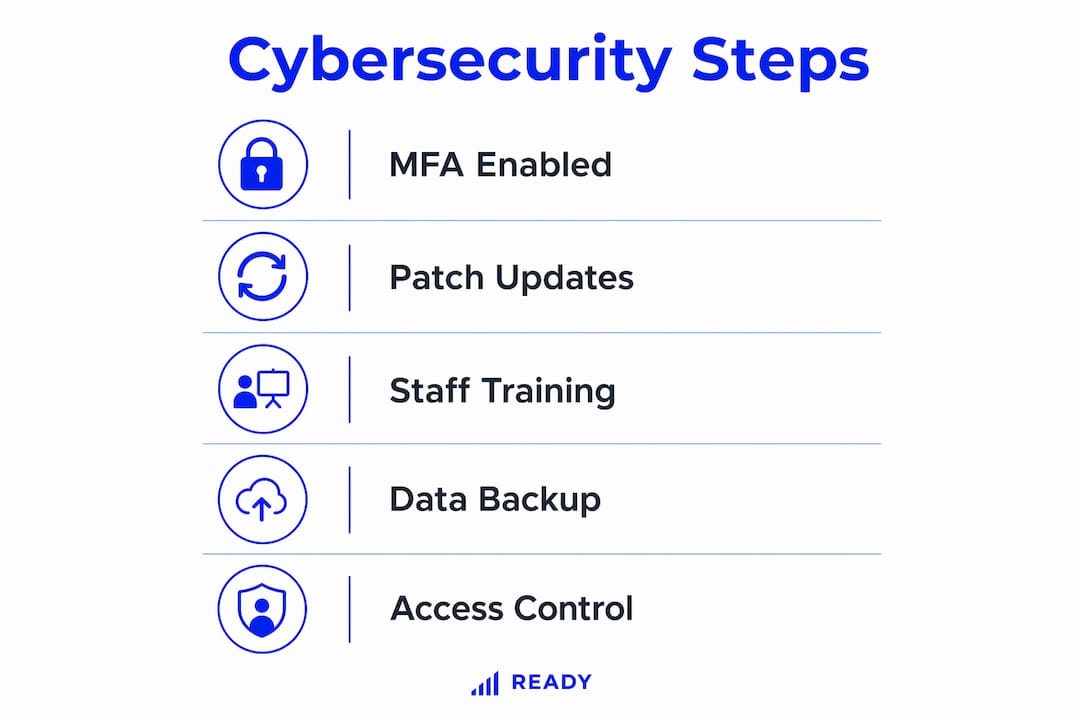
1. Enable multi-factor authentication on every critical account
Multi-factor authentication (MFA) is the single most effective immediate control available to SMEs. MFA requires a second verification step, such as a code sent to your phone, before granting access. Security automation and MFA together reduce total breach costs by 32%. Enable MFA on your email, cloud accounting platform, banking portal, and any system that holds customer or financial data.
2. Patch and update software without delay
Attackers actively scan for unpatched software. An update that sits uninstalled for two weeks is an open door. Set all operating systems, browsers, and business applications to update automatically. Assign one person to verify that updates have applied each week.
3. Train your staff on phishing and secure email habits
Your team is your biggest vulnerability and your best defense. Run monthly phishing simulations using free tools like Google’s Phishing Quiz or your email provider’s built-in security training. Teach staff to verify any request to change bank details by calling the supplier directly on a known number. Disabling auto-forwarding and enforcing bank-detail change protocols are two of the highest-impact email security steps an SME can take.
Pro Tip: Create a one-page “What to do if you click a suspicious link” guide and pin it near every workstation. Simple, visible reminders reduce response time when something goes wrong.
4. Back up your data and test the restore process
A backup you have never tested is not a backup. It is a false sense of security. Quarterly recovery drills that include full data restores and account recovery confirm that your business can actually recover within your Recovery Time Objective. Store backups in at least two locations, with one copy offsite or in the cloud.
5. Maintain an asset register and restrict admin privileges
Know exactly what devices and accounts exist in your business. Remove admin rights from standard user accounts. An employee who accidentally installs malware on a standard account causes far less damage than one with full admin access. This also helps you comply with POPIA’s requirement for reasonable technical and organizational measures, including audit logs.
How can small businesses use managed security services to enhance protection?
Most small businesses cannot afford a full-time IT security specialist. Managed Security Service Providers (MSSPs) solve this problem directly.
An MSSP gives your business access to enterprise-grade security tools and expertise at a fraction of the cost of hiring internally. Key services include:
- 24/7 monitoring of your network and endpoints for suspicious activity
- Security Information and Event Management (SIEM), which aggregates logs from all your systems and flags anomalies in real time
- Incident response, so that when something goes wrong, a trained team acts immediately rather than waiting for you to notice
- DMARC, SPF, and DKIM configuration to protect your email domain from impersonation
MSSPs provide telemetry, SIEM, and round-the-clock monitoring that SMEs simply cannot replicate with internal resources. This is the fastest way to close the gap between your current exposure and a defensible security posture.
AI-powered platforms take this further. Managed service providers using AI-driven SIEM and SOAR platforms enable SMEs to achieve enterprise-level detection and response at affordable monthly costs. Automation handles the volume of alerts that would overwhelm a small team, and the 32% reduction in breach costs from security automation makes the investment straightforward to justify.
Pro Tip: When evaluating an MSSP, ask specifically about their experience with South African POPIA compliance and whether they provide breach notification support. Not all providers understand local regulatory requirements.
For businesses that want managed IT support with cybersecurity built in, look for providers that bundle endpoint protection, monitoring, and incident response into a single monthly fee.
Why is cybersecurity a competitive advantage for South African SMEs?
Strong security does more than prevent losses. It opens doors.
“South African investors view strong cybersecurity as a proxy for operational maturity, affecting startup valuations and funding access.” Source: South African News 24
Lenders and investors now scrutinize your security posture during due diligence. Weak cybersecurity can reduce your business valuation by up to 15% and increase your cost of capital. That is a direct financial penalty for neglecting controls that cost relatively little to implement.
The procurement angle is equally significant. Large South African enterprises and public sector buyers require suppliers to demonstrate basic security controls before awarding contracts. Cybersecurity is no longer just an IT cost. It is a procurement requirement that determines whether you qualify for certain contracts at all.
| Business area | Impact of strong cybersecurity |
|---|---|
| Supplier contracts | Qualifies your business for enterprise and government procurement |
| Investor due diligence | Signals operational maturity and reduces perceived risk |
| Lender assessments | Supports better valuations and lower cost of capital |
| POPIA compliance | Avoids fines up to R5 million and protects customer trust |
| Business continuity | Reduces downtime and protects revenue during an incident |
POPIA compliance sits at the center of all of this. The Act requires reasonable technical measures, timely breach notifications, and maintained audit logs. Many SMEs fail on the audit log requirement alone. Getting this right protects you from regulatory penalties and demonstrates to clients that you handle their data responsibly. For more on protecting your financial data integrity, the Readyaccounting guide on financial reporting integrity covers the overlap between financial controls and data security in practical terms.
Key takeaways
Cybersecurity for small businesses requires MFA, tested backups, staff training, POPIA compliance, and MSSP support to reduce breach risk and protect business value.
| Point | Details |
|---|---|
| MFA is the top control | Enable multi-factor authentication on all critical accounts before any other measure. |
| Backups need testing | Run quarterly restore drills to confirm you can actually recover within your Recovery Time Objective. |
| POPIA fines are real | Violations carry fines up to R5 million; maintain audit logs and breach notification procedures. |
| MSSPs close the talent gap | Managed security providers deliver 24/7 monitoring and AI-driven detection at affordable monthly costs. |
| Security affects valuation | Weak cybersecurity can reduce your business valuation by up to 15% during investor or lender due diligence. |
Why I think most SMEs are solving cybersecurity in the wrong order
The most common mistake I see South African small business owners make is spending money on antivirus software while leaving their email completely unprotected. Antivirus catches known threats after they land. A properly configured DMARC record stops impersonation attacks before they reach your inbox. The sequence matters enormously, and most generic advice gets it backwards.
The second mistake is treating cybersecurity as a once-off project. You set up MFA in January, feel secure, and move on. Attackers update their methods constantly. SMEs must constantly revisit their security measures and run regular drills, not just install tools. Security is a habit, not a checkbox.
The third thing I want to challenge is the belief that your business is too small to be a target. That belief is exactly what makes you a target. Attackers automate their scans. They do not care about your revenue. They care about whether your defenses are weak. A small accounting firm with access to client VAT numbers and SARS credentials is a very attractive target. The digital transformation journey that most SMEs are on right now increases exposure if security does not keep pace with technology adoption.
Leadership engagement is the final piece. When the owner treats security as an IT problem, the whole team follows that lead. When the owner asks about last month’s phishing simulation results in a team meeting, the culture shifts. That shift costs nothing and changes everything.
— Johan
How Readyaccounting supports your financial security and compliance
Cybersecurity and financial management are two sides of the same coin for South African SMEs. A breach that exposes your financial data or disrupts your cash flow can be just as damaging as a tax penalty. Readyaccounting builds cloud-based financial infrastructure that keeps your reporting clean, your controls tight, and your SARS compliance current. Our automation tools improve cash flow visibility and reduce the manual processes that create both financial errors and security gaps. If you want to understand how your current financial setup holds up under scrutiny, contact Readyaccounting for a consultation tailored to your business.
FAQ
What is the biggest cybersecurity risk for small businesses in South Africa?
Phishing and Business Email Compromise are the most common and costly threats for South African SMEs. Attackers use email impersonation to redirect payments or steal credentials, often going undetected for weeks.
How much does a data breach cost a South African SME?
The average cost of a data breach for a South African company is approximately R44.1 million. Even a smaller incident carries direct costs from downtime, recovery, and potential POPIA fines of up to R5 million.
What is the most affordable cybersecurity practice for small businesses?
Enabling multi-factor authentication across all critical accounts is the highest-impact, lowest-cost control available. It requires no budget and blocks the majority of credential-based attacks immediately.
Do small businesses need to comply with POPIA cybersecurity requirements?
Yes. POPIA requires all South African businesses to implement reasonable technical measures, maintain audit logs, and submit breach notifications online. Non-compliance carries fines up to R5 million.
When should a small business consider hiring an MSSP?
An SME should consider a Managed Security Service Provider as soon as it handles customer data, processes payments, or works with enterprise clients. MSSPs provide 24/7 monitoring and SIEM capabilities that internal teams cannot replicate at the same cost.