
60–90 Minute Creative Brainstorming Teams Can Copy for SMEs
60–90 Minute Creative Brainstorming Teams Can Copy for SMEs
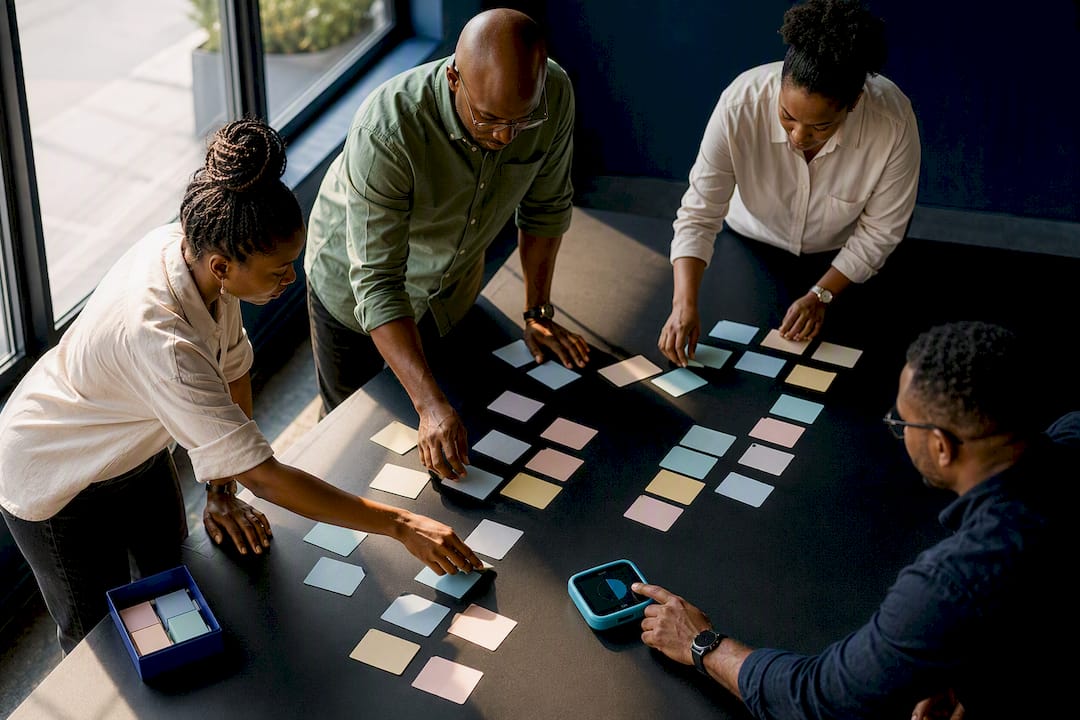
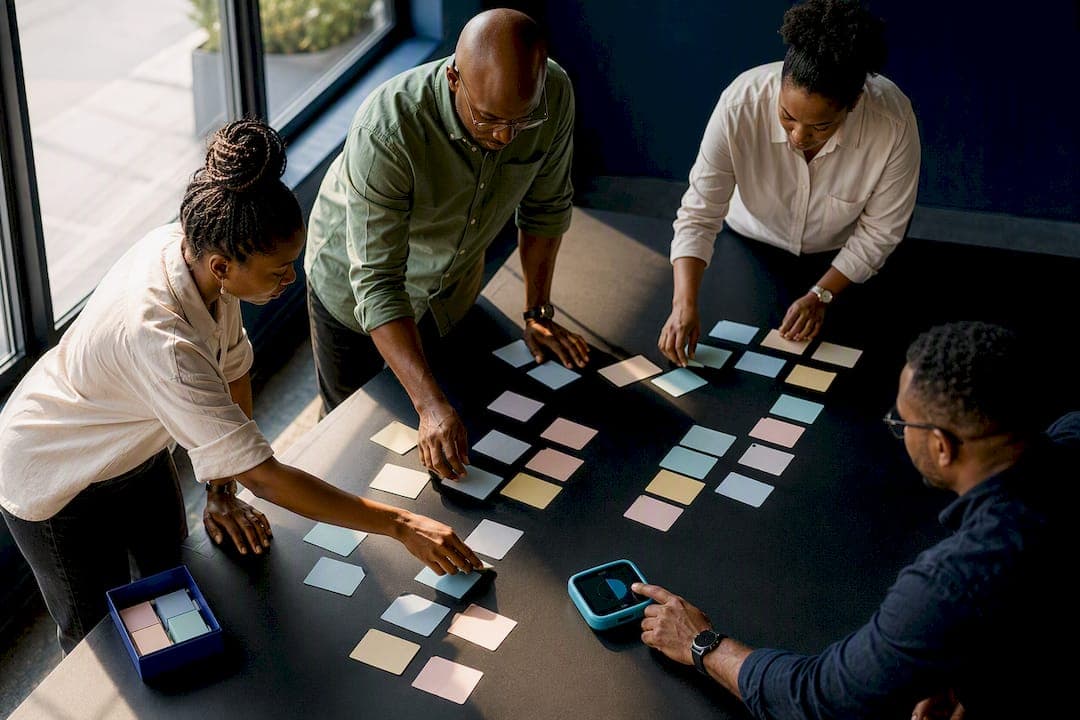
Run a 60 to 90 minute, facilitator-led sprint that pairs 10 minutes of silent ideation with structured sharing, affinity mapping, and a quick vote, following visual storytelling tips to boost collaborative creative impact. That single format beats an open floor discussion almost every time because it forces contribution before groupthink sets in. Below you’ll find a shortlist of proven creative brainstorming techniques, a copy-ready agenda, and the facilitation habits that keep any session from collapsing into the usual five people doing all the talking.
Executive Summary
- Using structured techniques like brainwriting and silent ideation helps generate diverse ideas while minimizing hierarchy influence and social pressure.
- Affinity mapping and impact-effort filtering are crucial for turning scattered ideas into actionable themes and prioritizing high-impact, low-effort solutions first.
- Remote teams should adapt with digital tools, extend timebox durations, and ensure active engagement to maintain participation quality.
- Facilitator skill is key; effective moderation that protects psychological safety and manages energy produces more useful ideas than choosing a perfect technique.
Table of Contents
- Twelve creative brainstorming techniques you can run this week
- Matching the method to the problem: categories and a quick checklist
- A copyable 60 to 90 minute session agenda
- Keeping the session safe, honest, and productive
- Turning raw ideas into a prioritised, owned backlog
- Adapting group brainstorming techniques for remote and hybrid teams
- Readyaccounting’s take: ideation has to become a habit, not an event
- Sources
Twelve creative brainstorming techniques you can run this week
Most brainstorming sessions fail for one reason: they ask a group to be creative on command with no structure at all. Asana’s roundup of brainstorming techniques recommends starting with free idea capture before moving into refinement and evaluation, and that sequence shows up in nearly every method below. Pick two or three, not all twelve, and match them to the problem you’re actually solving.
-
Brainwriting. Goal: generate volume without letting the loudest voice dominate. Run it by having everyone write 3 ideas silently on sticky notes (5-minute), passing their notes to a neighbor to build on (5 minutes), then reading all ideas aloud as a group. Timebox: 20 minutes. Prompt example: “Write three ways we could cut invoice processing time in half.” Works best when hierarchy or shyness usually kills participation.
-
Silent idea generation. Goal: protect first-draft thinking from instant judgment. Give everyone a blank page and one prompt, set a timer, and collect ideas anonymously before any discussion starts. Timebox: 10 minutes. Prompt example: “What’s one thing a customer complains about that we’ve stopped noticing?” Works best as the opening move of almost any session.
-
Mind mapping. Goal: explore how ideas connect rather than treating them as a flat list. Write the central problem in the middle of a whiteboard, branch out with related themes, then branch again with specific ideas under each theme. Timebox: 15 to 20 minutes. Prompt example: “Map every touchpoint a new client has with our onboarding process.” Best for messy, multipart problems where relationships matter more than raw quantity.
-
SCAMPER. Goal: force fresh angles on an existing product or process. Run through each letter as a lens: Substitute, Combine, Adapt, Modify, Put to another use, Eliminate, Reverse, spending 2 to 3 minutes per letter. Timebox: 25 minutes. Prompt example: “What happens if we eliminate the manual approval step entirely?” Best when a team feels stuck improving something familiar.
-
How-Now-Wow. Goal: sort ideas by feasibility and originality at the same time. Generate ideas freely, then plot each one on a 2x2 grid of “how difficult” versus “how original,” and prioritise anything landing in the Wow quadrant (easy and original). Timebox: 20 minutes. Best used right after a volume-generating round like brainwriting.
-
Starbursting. Goal: pressure-test an idea before committing resources to it. Take one promising idea and hit it with who, what, when, where, why, and how questions until gaps appear. Timebox: 15 minutes. Prompt example: “Who actually owns this if it fails halfway through?” Best for the shortlist stage, not the wide-open generation stage.
-
5 Whys. Goal: get past symptoms to the actual root cause. Ask “why” about a problem, then ask why again about that answer, repeating roughly five times. Timebox: 10 minutes. Prompt example: “Why do clients miss the VAT submission deadline?” leading down to the real process gap. Best for operational or compliance headaches, not open-ended innovation.
-
SWOT-lite. Goal: give a fast, structured gut-check on a new idea. List strengths, weaknesses, opportunities, and threats in four quick columns with one to two lines each. Timebox: 15 minutes. Best as a filter step before a bigger idea gets full investment.
-
Mash-up (forced combination). Goal: break stale thinking by colliding two unrelated concepts. Pick your problem and a completely unrelated object or business model, then force a combination between them. Timebox: 15 minutes. Prompt example: “What would a subscription-box version of client onboarding look like?” IDEO U’s brainstorming resources treat this kind of forced analogy as one of the more reliable ways to escape obvious answers. Best for teams that keep landing on the same three ideas every time.
-
Prototyping / rapid experiment. Goal: test an idea cheaply before building it properly. Sketch, mock up, or roleplay the idea in its roughest possible form, then get one piece of real feedback within the same session. Timebox: 20 minutes. Best when the team’s default is to over-plan before testing anything.
-
Affinity mapping. Goal: turn a wall of scattered ideas into workable themes. Write every idea on its own note, then move the notes around in silence until natural clusters emerge, and name each cluster. Timebox: 15 minutes. Best as the bridge between generating ideas and deciding what to do with them.
-
Timed sprint / round-robin. Goal: guarantee everyone contributes, not just the confident talkers. Go around the room (or the call) giving each person 60 seconds to add one idea, no skipping and no debate until the round finishes. Timebox: 10 to 15 minutes. SessionLab’s technique catalog rates round-robin formats as low-difficulty and high-yield for exactly this reason. Best when a few people usually dominate and quieter voices get lost.
Pro Tip: Anonymise idea capture whenever a junior team member is brainstorming alongside their manager. People self-censor around hierarchy far more than they realize, and a stack of unattributed sticky notes fixes that instantly.
Pro Tip: Set a visible countdown timer for every round. A hard deadline produces more honest, less polished ideas than an open-ended “take your time” instruction ever will.
Matching the method to the problem: categories and a quick checklist
Not every technique for brainstorming suits every problem. Group them into five rough categories and the right choice gets obvious fast:
- Divergent (brainwriting, mash-up, mind mapping): built for volume and range, best used early.
- Convergent (How-Now-Wow, SWOT-lite, dot voting): built for narrowing down, best used late.
- Silent/async (silent idea generation, brainwriting): removes social pressure and dominant personalities.
- Visual (mind mapping, affinity mapping): best when relationships between ideas matter more than a flat list.
- Analytic (5 Whys, starbursting): best for stress-testing rather than generating.
Before picking a method, run through this checklist:
- What kind of problem is this: open exploration, or a specific stuck point?
- How much time do we actually have: 15 minutes or a full 90?
- Is psychological safety a concern in this group?
- Do we need raw volume, or a decision by the end?
- How diverse is the room in seniority, function, or background?
If you need volume fast, pair a timed sprint with brainwriting. If you need depth on one thorny issue, pair mind mapping with 5 Whys. If the room is nervous or hierarchical, lean on silent and anonymised formats before anything verbal.
A copyable 60 to 90 minute session agenda
Preparation matters more than most facilitators admit. Before the session starts, nail down a specific problem statement (not “improve sales” but “reduce quote turnaround from 5 days to 2”), invite a genuinely mixed group of 5 to 8 people, book a room or digital whiteboard, and optionally send a prework prompt ahead so people arrive with a seed idea.
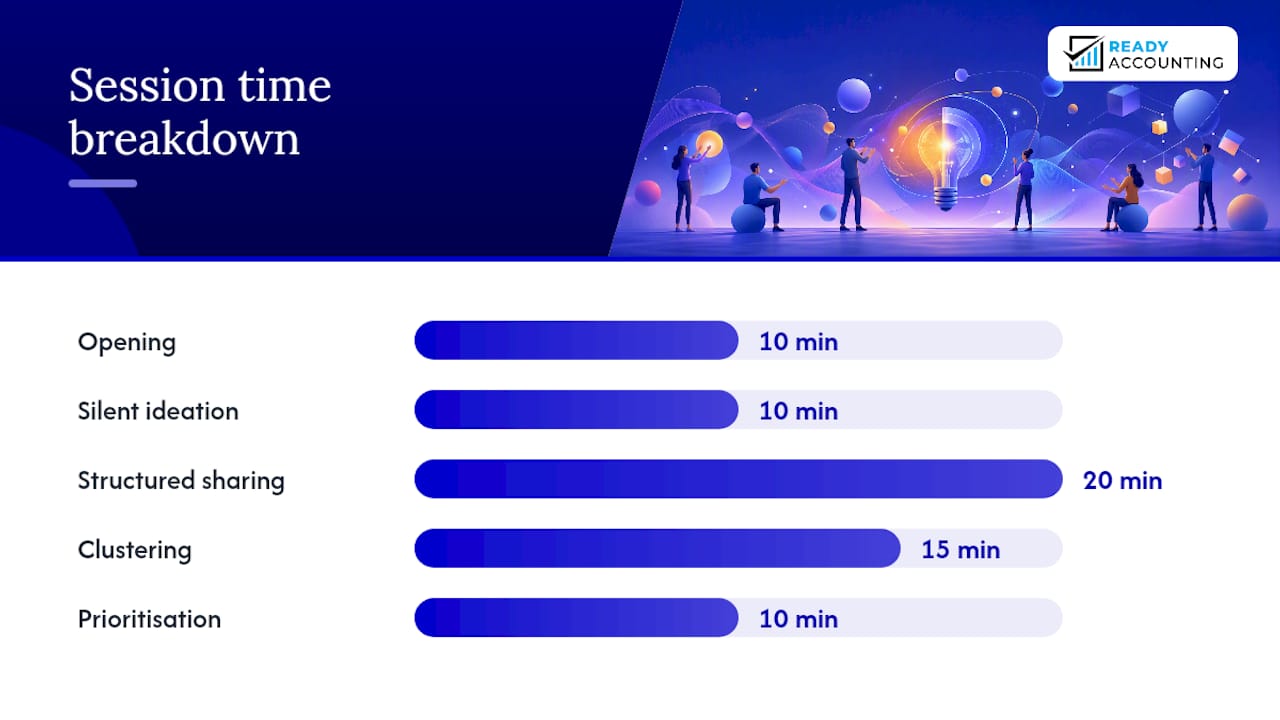
- Opening (10 minutes). State the problem statement out loud, set ground rules (no judging ideas early, one conversation at a time), and confirm the goal for the session.
- Silent ideation (10 minutes). Everyone writes ideas alone, no talking, no debating.
- Structured sharing (20 minutes). Go round-robin so every person reads out their ideas before open discussion starts.
- Clustering (15 minutes). Group similar ideas using affinity mapping, naming each cluster as it forms.
- Prioritisation (10 minutes). Dot-vote or apply a quick impact/effort filter to narrow the clusters to two or three worth pursuing.
- Wrap and owners (5 to 15 minutes). Assign a named owner and a first micro-step to each surviving idea, and set a follow-up date.
After the session, document everything in a shared doc within 24 hours while memory is fresh, confirm owners understood their next step, and schedule a short check-in, a week or two out, to see what actually moved.
Pro Tip: Never skip the silent ideation step even when the group is short on time. Harvard Business Review’s research on brainstorming points out that better questions and better structure, not longer meetings, are what actually produce breakthrough ideas.
Keeping the session safe, honest, and productive
A brainstorm dies the moment one person’s opinion becomes the unofficial answer everyone else defers to. Open with a quick ground-rules statement: no idea gets shot down during generation, and evaluation happens later, as a separate step. A short round where everyone states one thing they’re currently stuck on works well as an icebreaker that also builds trust.
- Use structured rounds so quieter voices get a guaranteed turn, not just an open invitation.
- Borrow IDEO’s “build on it” habit: respond to someone else’s idea by extending it rather than replacing it.
- Let people submit ideas privately first when rank or tenure in the room could suppress honesty.
- Delay evaluation deliberately. Judging too early is the single fastest way to shrink the idea pool.
- Watch energy, not just the clock. If the room goes flat, switch formats rather than pushing through.
DarkMatter’s work on high-energy creative workshops makes the point plainly: unstructured free-for-all meetings rarely produce anything usable, while sessions with clear constraints and skilled facilitation consistently do.
Pro Tip: If two people start debating one idea for more than a minute, park it on a separate “discuss later” list and keep the group moving. Debate kills momentum faster than almost anything else.
Turning raw ideas into a prioritised, owned backlog
A pile of sticky notes is not a plan. Once ideas are captured, cluster them by theme using affinity mapping: group similar notes, name each cluster, then rank clusters using a simple two-axis grid of impact against effort. High impact, low effort clusters go first.
- Dot-vote on clusters, giving each person 3 votes to place wherever they see the strongest potential.
- For every idea that survives voting, assign one owner, one first micro-step, and one deadline, not a vague “someone should look into this.”
- For async or remote teams, write a short context note next to each idea explaining why it mattered, so nobody has to reconstruct the reasoning weeks later.
Research on smaller organisations backs up why this step matters more than people assume. A study on SME knowledge management practices found that structured ideation is one of the more reliable ways smaller businesses capture the tacit, undocumented knowledge that usually walks out the door with an employee. Skipping the capture and prioritisation step throws that value away.
Adapting group brainstorming techniques for remote and hybrid teams
Distributed teams need the same structure, just translated into different tools. Use a digital whiteboard for clustering and mind mapping, an async idea wall for prework and quieter contributors, a simple polling tool for dot-voting, and breakout rooms if the group is larger than eight.
- Extend timeboxes by 20 to 30% for remote sessions; typing takes longer than talking or writing on paper.
- Ask everyone to switch cameras on during sharing rounds, since visible engagement noticeably changes contribution rates.
- Assign one person purely to notes and capture so the facilitator can focus on running the room.
- Run a 5 minute tech check before the real session starts, especially with new tools or new participants.
A related guide to remote collaboration tools for digital teams covers tool selection in more depth, and the same remote communication norms that keep daily standups useful apply directly to brainstorm facilitation too.
Readyaccounting’s take: ideation has to become a habit, not an event
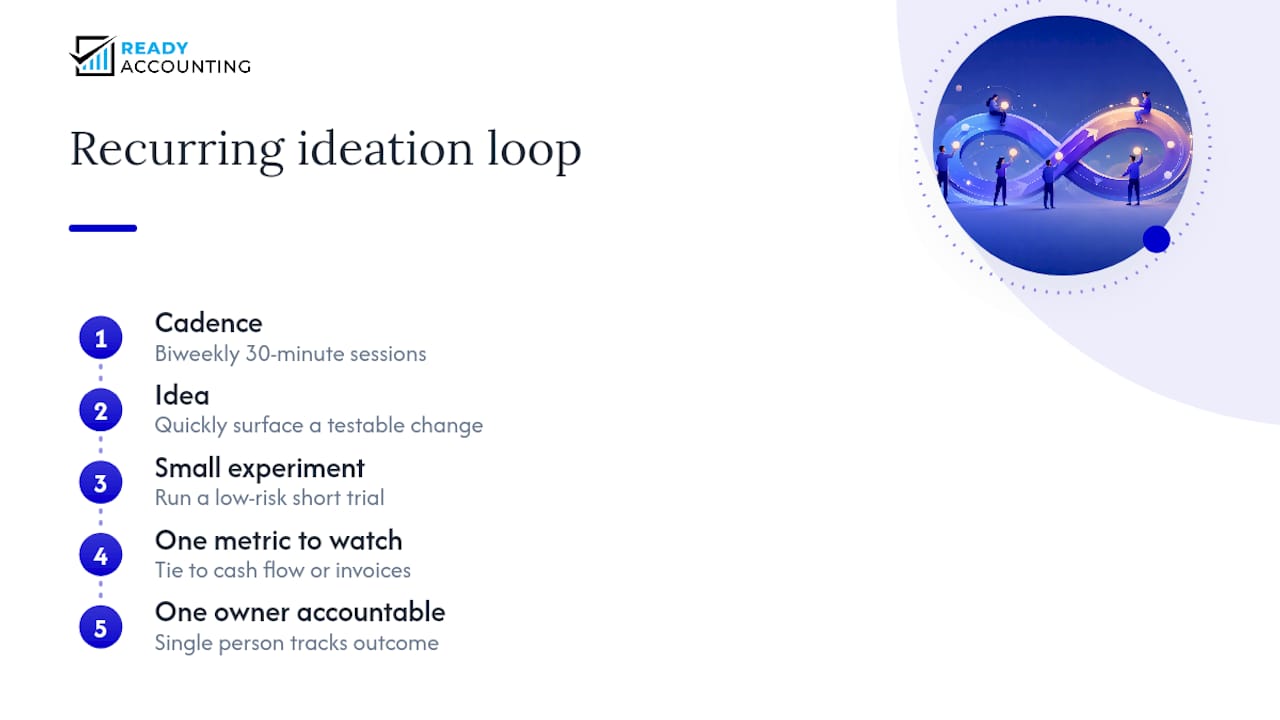
Most SMEs treat brainstorming as an emergency response to a stalled project. That’s backwards. The businesses that actually improve month over month run a short, recurring loop: idea, small experiment, one metric to watch, one owner accountable for it. A biweekly 30-minute session beats an annual all-day offsite because it keeps tacit knowledge, the stuff nobody writes down, moving through the team instead of leaving with whoever quits next.
At Readyaccounting, we see the payoff clearest when ideas tie directly to the numbers a business already tracks: cash flow, invoice turnaround, payroll accuracy. An idea that never touches a dashboard rarely survives past the meeting it was born in. If your team is generating good ideas about process or efficiency but nothing sticks, the fix usually isn’t more creativity. It’s tighter execution linked to visible metrics. That’s where cloud accounting and automation genuinely earns its place, turning a brainstormed process fix into something you can watch move in real time.
If your team’s best ideas keep dying in a notebook somewhere, put a real system behind them. Readyaccounting helps South African SMEs connect operational improvements to live financial dashboards so every idea has a metric attached to it, not just good intentions. Get in touch with our team to talk through how automation improves cash flow once your brainstorm turns into a real project, whether that means SARS compliance clean up, VAT registration support, CIPC filings, or a full Annual Financial Statement built on cloud accounting infrastructure. Contact Readyaccounting today to schedule a consultation and turn your next good idea into a tracked, owned, measurable result.
Facilitation skill matters more than any single technique on this list. A mediocre method run well by someone who protects psychological safety and keeps energy up will beat a “perfect” method run badly, every single time. Teams obsess over finding the right framework when the real lever is almost always the person holding the marker: are they asking sharper questions, noticing who hasn’t spoken yet, and refusing to let evaluation creep into the generation phase? Most facilitators skip straight to judgment because it feels productive. It isn’t. The gap between a session that produces three forgettable ideas and one that produces a genuinely usable backlog is rarely the technique on the whiteboard. It’s whether someone in the room was disciplined enough to protect the process.
— Johan
Sources
- Brainstorming Techniques: 29 Ways to Generate Ideas - Asana
- Better Brainstorming - Harvard Business Review
- 43 brainstorming techniques and games for creating new ideas - SessionLab
- Creativity on demand: The secret sauce of high-energy workshops - DarkMatter