

Cost savings from outsourcing for South African SMEs
Executive Summary
- Outsourcing accounting and payroll can lead to significant cost savings by replacing fixed costs with predictable monthly fees. This strategy improves cash flow, reduces errors, and mitigates SARS penalties through automation and compliance controls. Many SMEs see their ROI within the first month after switching to outsourced financial services.
Outsourcing your accounting and payroll will, in most cases, produce net cost savings within a few months. The mechanism is straightforward: fixed headcount and software licence costs convert into a predictable monthly fee that is almost always lower than the sum of what you were spending. A study of Cape Town SMMEs confirmed that outsourcing accounting functions positively influences performance by reducing operational costs and improving time management. Add SARS penalty avoidance and POPIA compliance protection, and the financial case gets stronger still. Your first move: pull last month’s payroll cost, your accounting software subscriptions, and any SARS penalty notices into one page. That baseline is where the ROI calculation starts.
Table of Contents
- Where do the real cost savings from outsourcing come from?
- How to calculate your outsourcing ROI: a step-by-step worked example
- Which finance functions should you outsource, and what does it cost in South Africa?
- What does implementation look like, and what should you budget for?
- What are the SARS, POPIA, and compliance risks, and how does outsourcing reduce them?
- Questions to ask before you choose an outsourced accounting provider
- Key takeaways
- Why the fractional CFO model changes the ROI conversation
- How Readyaccounting helps you capture these savings
Where do the real cost savings from outsourcing come from?
The savings fall into three buckets, and most founders underestimate the second and third.
Direct savings are the easiest to quantify. When you outsource bookkeeping or payroll, you remove or redeploy the salaried staff who were doing those tasks. With them go employer contributions (UIF, SDL), equipment, and the slice of office space allocated to the finance function. Software licences for payroll engines and accounting platforms often consolidate too, because your provider runs their own stack.

Indirect savings are slower to appear but just as real. Faster month-end close means you get management accounts in days, not weeks, which shortens the gap between a cash problem forming and you knowing about it. Fewer bookkeeping errors reduce rework hours and the advisory time needed to untangle them. Automation and cloud accounting integrations cut manual reconciliation time significantly, which is where a lot of hidden labour cost lives.
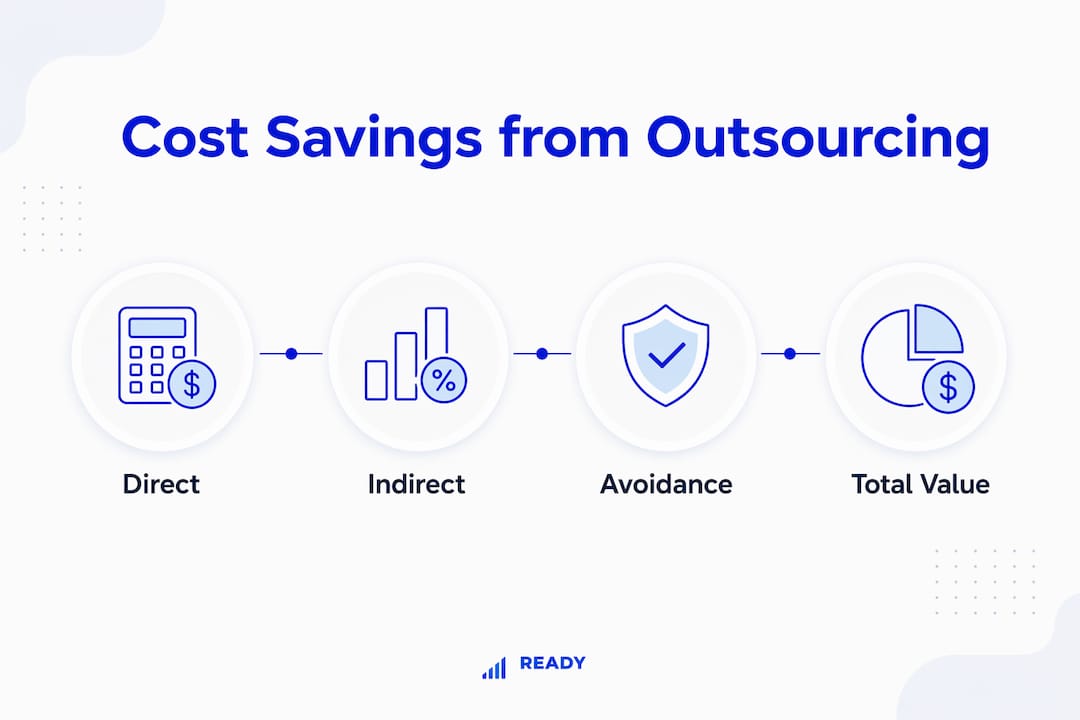
Avoidance savings are the category most ROI models ignore entirely. Late VAT or PAYE submissions trigger SARS interest and penalties that can exceed the cost of an entire year’s outsourced fees. UIF and SDL miscalculations compound the exposure. A provider with documented submission procedures and automated validation checks removes most of that risk. Common bookkeeping mistakes — duplicate entries, missed cut-offs, incorrect VAT codes — are exactly the errors that attract SARS scrutiny.
Pro Tip: Start your cost audit with two lines: your monthly payroll run (gross cost including your time) and your recurring accounting software subscriptions. These two lines typically account for the largest share of finance overhead in an SME and are the fastest to convert into a lower outsourced equivalent.
How to calculate your outsourcing ROI: a step-by-step worked example
The method has four steps. Run it in a spreadsheet and you will have a payback period in under an hour.
Step 1: List every current monthly cost tied to your finance function. Include gross salaries and employer contributions for anyone doing bookkeeping or payroll, software licences, a fair allocation of office costs, and an honest estimate of management time spent on accounting tasks.
Step 2: List projected outsourced costs. This means the monthly retainer, any per-payroll fees, and one-off clean-up or implementation fees amortised over 12 months.
Step 3: Add risk-adjusted avoidance savings. A conservative estimate of reduced SARS penalties and rework hours belongs here. Even one avoided late-submission penalty can shift the payback period materially.
Step 4: Subtract Step 2 from the sum of Steps 1 and 3. The result is your net monthly saving. Divide the one-off setup cost by that figure to get your payback period in months.
| Cost line | Current monthly ® | Outsourced monthly ® |
|---|---|---|
| Payroll software licence | — | — (included in retainer) |
| Accounting software (Xero/Sage) | — | — (included) |
| Payback period | ~1 month |
Note: figures are illustrative. Your baseline will differ. The structure of the calculation stays the same.
The clean-up fee deserves its own line because it is a real one-off cost. Amortising it over 12 months gives you a realistic view of true payback rather than a first-month distortion. You can reproduce this table in Google Sheets or Excel and swap in your actual numbers.
Outsourcing accounting functions positively influenced performance by reducing operational costs and improving time management for Cape Town SMMEs — a finding that holds across the direct, indirect, and avoidance savings categories outlined above.
Which finance functions should you outsource, and what does it cost in South Africa?
The highest-impact functions to outsource first are the ones with fixed recurring labour and hard SARS deadlines.
- Bookkeeping and accounts payable/receivable: monthly reconciliations, supplier payments, and debtor tracking. Errors here flow directly into incorrect VAT returns.
- Payroll and PAYE/UIF submissions: monthly payroll runs, IRP5 reconciliations, and EMP501 submissions. Missing a PAYE deadline is one of the fastest ways to accumulate SARS interest.
- VAT registration and returns: VAT201 submissions on the correct cycle (monthly, bi-monthly, or annual depending on your turnover). The R1 million VAT registration threshold means many growing SMEs hit this obligation without realising the compliance burden it carries.
- Annual Financial Statements (AFS): required for CIPC compliance and for most lenders and investors. Outsourcing AFS preparation removes a significant year-end crunch.
- Fractional CFO services: strategic financial oversight, cash-flow forecasting, and investor reporting without the cost of a full-time CFO. Readyaccounting’s fractional CFO approach combines fixed monthly advisory with project-based fees for tax year-end tasks.
Typical SA pricing models range from fixed monthly retainers for bundled bookkeeping and payroll, to per-employee per-run payroll fees, to hourly or fixed-project clean-up fees for historical backlogs. The payroll outsourcing benefits extend beyond cost: SARS compliance and management time recovery are consistently cited as the primary drivers.
What does implementation look like, and what should you budget for?
Most outsourcing migrations follow a predictable four-phase timeline.
| Phase | Activity | Typical duration |
|---|---|---|
| Discovery | Scope review, current system audit, access setup | 1–2 weeks |
| Clean-up and migration | Historical data correction, ledger migration, opening balances | 2–8 weeks |
| Automation and integration | API connectors, bank feed setup, dashboard configuration | 2–6 weeks |
| Steady-state handover | First live month-end, reporting sign-off, SLA confirmation | 2–4 weeks |
The clean-up phase is where most surprises hide. A business with 12+ months of unreconciled transactions will sit at the longer end of that 2–8 week range. Budget for it explicitly rather than treating it as a free service.
Onboarding checklist — have these ready before day one:
- Last 3 months of bank statements (all accounts)
- SARS eFiling login credentials and authorised representative details
- Current payroll records and employee tax numbers
- CIPC registration documents and most recent AFS
- Existing accounting software login (Xero, Sage, or QuickBooks)
- Last 6 months of VAT201 and EMP201 submissions
Providers commonly require admin access to cloud accounting ledgers, bank feeds, and an authorised SARS eFiling user for handover. Plan for secure credential transfer and role-based access from the start.
What are the SARS, POPIA, and compliance risks, and how does outsourcing reduce them?
South Africa’s regulatory environment creates specific cost exposure that a good outsourced provider is designed to absorb.
SARS penalties for incorrect or late VAT and PAYE filings, UIF and SDL miscalculations, and CIPC filing failures are all real financial risks. POPIA adds a data-handling layer: employee payroll data and client financial records are personal information under the Act, and a provider who stores them carelessly exposes you to regulatory action.
Recommended contract clauses to insist on:
- POPIA data processing agreement with explicit data retention and deletion terms
- SLA specifying filing deadlines and escalation procedures
- Exit clause requiring full data return in a portable format
- Indemnity provisions tied to provider negligence, not blanket liability caps
Ask for evidence of secure cloud infrastructure, SA client references, and a sample management pack before signing. Financial consulting expertise in tax penalty reduction is a useful benchmark for understanding what proper compliance controls look like.
Questions to ask before you choose an outsourced accounting provider
Use this scoring template during vendor selection. Weight each criterion and score out of 5.
| Criterion | Weight | What to look for |
|---|---|---|
| Cost transparency | — | Itemised pricing, clear scope, no hidden per-transaction fees |
| SARS/VAT/PAYE compliance processes | — | Documented SOPs, submission track record, penalty history |
| Automation and cloud integration | — | API connectors, bank feed automation, real-time dashboards |
| Reporting quality | — | Sample management pack, reporting cadence, fractional CFO access |
| Client references | 10% | SA-based clients, verifiable outcomes, response time SLAs |
Outsourcing makes the most sense when you have irregular finance headcount, recurring late submissions, high software costs, or a need to scale without hiring a senior finance manager. The outsourcing execution framework for small SA businesses is a useful starting point for structuring your vendor conversations.
Key takeaways
Outsourcing accounting and payroll converts fixed finance overhead into a lower, predictable monthly fee, and the net savings typically cover the setup cost within the first month for most South African SMEs.
| Point | Details |
|---|---|
| Run a one-page cost baseline first | Collect payroll, software licences, and SARS penalty records before requesting any quote. |
| Three savings categories matter | Direct (headcount), indirect (speed and errors), and avoidance (SARS penalties) all belong in your ROI model. |
| Amortise clean-up costs | Spread one-off migration fees over 12 months to see true payback period clearly. |
| Prioritise payroll and VAT first | These carry the hardest deadlines and the highest penalty exposure under SARS. |
| Readyaccounting’s model | Readyaccounting combines managed bookkeeping, payroll, AFS, and fractional CFO services with cloud automation for real-time financial visibility. |
Why the fractional CFO model changes the ROI conversation
Most outsourcing guides focus on cost reduction as if it were purely defensive. That framing misses the bigger shift. When you replace a part-time bookkeeper with a provider who also delivers monthly management accounts and cash-flow forecasts, you are not just cutting a cost line. You are buying the financial visibility that most SMEs only get when they can afford a full-time CFO.
The businesses that extract the most value from outsourcing are the ones that treat the management pack as a decision tool, not a compliance artefact. Real-time dashboards and automated bank feeds mean you know your cash position on a Tuesday morning, not three weeks after month-end. That speed has a value that does not appear in a salary comparison, but it shows up in better decisions, faster fundraising conversations, and fewer expensive surprises.
The compliance argument is real, but it is the floor, not the ceiling.
How Readyaccounting helps you capture these savings
Readyaccounting is built specifically for scaling South African SMEs and VC-backed startups that need more than a bookkeeper but are not ready to hire a full finance team. The offering covers managed bookkeeping, payroll and PAYE/UIF submissions, VAT returns, AFS preparation, and fractional CFO services, all connected through cloud infrastructure and API integrations that deliver real-time cash-flow visibility.
The diagnostic process starts with a scoping call. Bring your last three months of bank statements, your current software subscriptions, and any outstanding SARS correspondence. From there, Readyaccounting maps your current finance costs against a proposed outsourced structure and gives you a clear savings estimate before you commit to anything.
To get started, visit the outsourced accounting services page or book a diagnostic call directly. The first conversation costs nothing; the cost of not having it tends to show up on your next SARS statement.
This article provides general information about outsourcing and financial management. It is not professional accounting, tax, or legal advice. Confirm your specific obligations with SARS, a registered tax practitioner, or a qualified accountant for your own situation.