

Cost of bookkeeping services for South African small businesses
Cost of bookkeeping services for South African small businesses
Most South African small businesses pay a range of monthly fees for bookkeeping, depending on transaction volume, turnover, and the services bundled in. On an hourly basis, bookkeeping rates typically run R100–R400 per hour, with most straightforward monthly engagements landing well below the hourly ceiling once a fixed package is agreed.
Three quick anchors to orient your budget:
- Basic bookkeeping (up to 30 transactions/month, sole trader or micro-business): roughly R400–R900/month
- Mid-range outsourced bookkeeping (up to 60 transactions/month, small business with payroll): roughly R1,100–R1,600/month
- Full-service packages for growing SMEs (turnover R1m–R5m, VAT, payroll, management reports): a typical monthly fee falling within a moderate price range
The single biggest driver of cost is transaction volume, followed by payroll complexity and whether you need VAT returns and management reporting included.
Key takeaways
South African small businesses typically pay R600–R11,000 per month for bookkeeping, with transaction volume and payroll complexity being the two factors that move the needle most.
| Point | Details |
|---|---|
| Monthly cost range | Most SMEs pay R600–R7,500/month; full-service packages for R5m+ turnover reach R15,000/month. |
| Transaction volume drives price | Moving from 30 to 90 transactions/month can triple your monthly bookkeeping fee. |
| Fixed retainers beat hourly billing | Monthly retainers give you predictable costs and reduce scope disputes versus open-ended hourly rates. |
| Outsourcing beats in-house below R5m | A full-time junior bookkeeper costs R18,000–R25,000/month all-in; outsourced packages cover the same scope for far less. |
| Readyaccounting | Offers fixed-fee, automation-first bookkeeping packages for South African SMEs with transparent scope and built-in SARS compliance. |
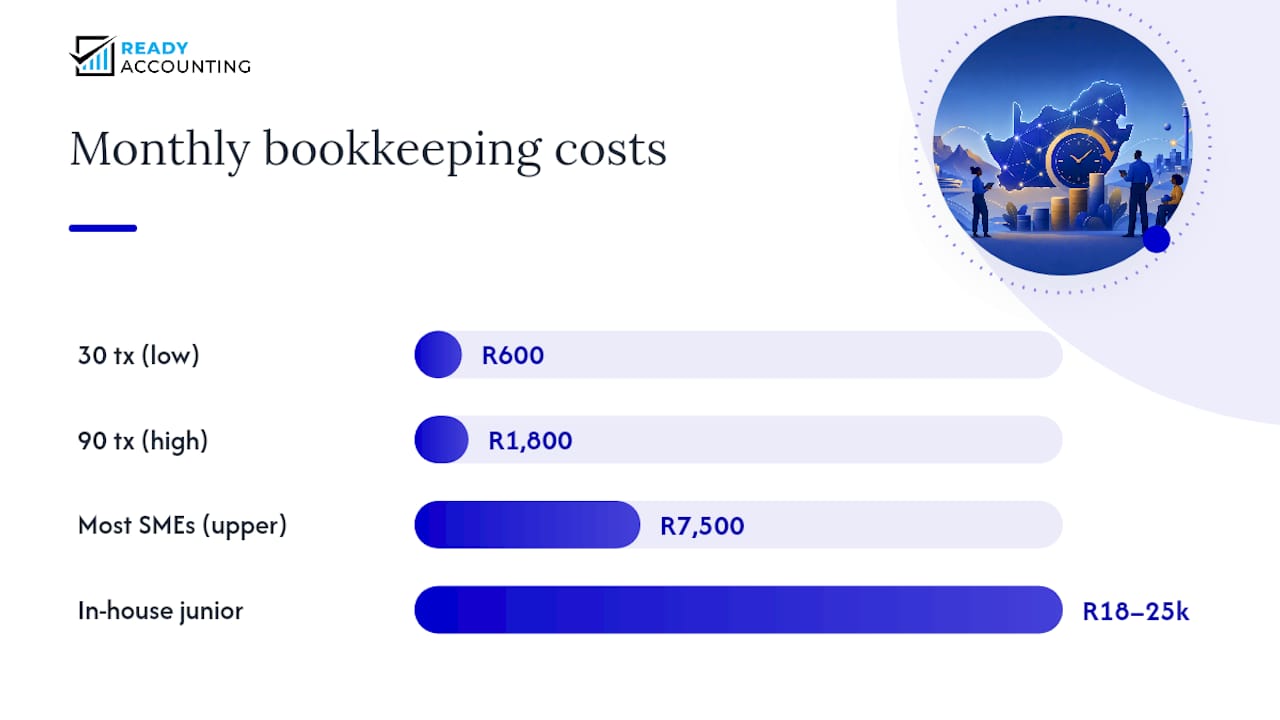
Table of Contents
- What does bookkeeping cost by turnover tier in South Africa?
- How do bookkeepers charge? Fee structures explained
- What do you actually get for the money?
- What makes bookkeeping more expensive?
- Outsourcing vs hiring in-house: which costs less?
- Eight questions to ask before you sign a bookkeeping contract
- How these estimates were built
- How Readyaccounting thinks about pricing
- Get a tailored bookkeeping quote from Readyaccounting
- Sources
What does bookkeeping cost by turnover tier in South Africa?
The most practical way to estimate your monthly bookkeeping fees is to match your annual turnover with your typical monthly transaction count. The figures below draw on Procompare’s 2026 business accounting price list, which covers bundled accounting, bookkeeping, payroll, tax, and compliance packages across South African providers.
| Annual turnover | Transactions/month | Typical monthly range | What’s usually included |
|---|---|---|---|
| Up to R1 million | Up to 30 | R400–R900 | Bank recon, basic VAT, trial balance |
| Up to R1 million | Up to 60 | R1,100–R1,600 | Above + payroll entries, monthly report |
| R1 million–R5 million | Up to 90 | R3,800–R7,500 | Above + VAT returns, management accounts |
| R1 million–R5 million | Full service | R3,800–R7,500 | Full outsourced accounting and compliance |
| Above R5 million | Full service | R8,000–12,000 | CFO-level reporting, payroll, tax, SARS liaison |
Three quick client profiles to make this concrete:
- Cape Town freelance designer, R400k turnover, 20 invoices/month: Basic bookkeeping to trial balance, no payroll. Expect R500–R700/month.
- Johannesburg retail shop, R2m turnover, 70 transactions/month, 3 employees: Monthly bookkeeping, VAT201 submissions, payroll processing. Expect R3,500–R5,500/month.
- Durban hospitality business, R8m turnover, 120+ transactions/month, 15 staff: Full-service package with management accounts, payroll compliance, and SARS correspondence. Expect R8,000–R12,000/month.
Pro Tip: Before requesting quotes, count your average monthly transactions for the last three months. That single number will anchor every quote you receive and prevent providers from quoting a low tier that doesn’t actually cover your volume.
How do bookkeepers charge? Fee structures explained
The billing model matters almost as much as the headline rate in bookkeeping software. Accounting Weekly’s guidance on modern billing models notes that the South African accounting industry is shifting away from pure hourly billing toward fixed fees, monthly retainers, and value-based pricing — and for good reason. Hourly billing creates uncertainty for clients; a fixed retainer lets you budget with confidence.
Here are the four models you’ll encounter:
- Hourly billing: R100–R400/hour depending on the bookkeeper’s experience and location. Useful for once-off cleanups or ad hoc work, but unpredictable for ongoing monthly needs. A backlog cleanup of three months of records can easily run 10–20 hours.
- Flat monthly retainer: A fixed fee for a defined scope, typically covering bank reconciliations, VAT, payroll entries, and a monthly report. This is the most common structure for ongoing engagements and the easiest to budget.
- Per-transaction pricing: Some providers charge per invoice or transaction processed, which suits businesses with highly variable monthly volumes. Rates vary, but the transaction-band examples above give a reliable proxy.
- Value-based pricing: Less common but growing, especially among cloud-accounting firms. The fee reflects the outcomes delivered (cash flow visibility, SARS compliance, audit readiness) rather than hours spent. Typically sits at the higher end of the retainer range.
Pro Tip: When a provider quotes a flat monthly fee, ask for a written scope of work that lists every task included. “Bookkeeping” means different things to different firms. A scope document protects you from surprise invoices when VAT season arrives.
What do you actually get for the money?
Bookkeeping fees vary partly because “bookkeeping” is used loosely. A monthly bookkeeping checklist for a South African business typically covers several core tasks, but providers draw the line between standard and extra differently.
Standard inclusions at most price points:
- Bank account and credit card reconciliations
- Accounts payable and receivable processing
- VAT input/output recording (not necessarily the VAT201 submission)
- Basic payroll journal entries
- Trial balance close at month-end
- Monthly management report (income statement and balance sheet)
Commonly excluded or charged as add-ons:
- VAT201 submission and SARS correspondence
- Payroll tax (PAYE, UIF, SDL) calculations and EMP201 submissions
- CIPC annual returns and company secretarial work
- Annual Financial Statements (AFS) prepared to IFRS for SMEs
- Forensic cleanup of prior-period errors or backlog
- Tax consulting and provisional tax calculations
The gap between a R700/month package and a R5,000/month package is almost entirely explained by this list. The cheaper option handles the data entry; the more expensive one handles the compliance. For a VAT-registered business, skipping the VAT201 submission from your bookkeeping package and managing it separately is a false economy — errors attract SARS penalties that dwarf the monthly fee difference.
What makes bookkeeping more expensive?
Transaction volume is the primary lever, but several other factors push bookkeeping fees up or down in practice.
- Monthly transaction count: The clearest cost driver. Moving from 30 to 90 transactions per month can triple the monthly fee, as the Procompare data shows.
- Number of employees and pay runs: Each payroll run adds processing time. A business with 15 employees on a weekly pay cycle costs significantly more to service than one with 3 employees paid monthly.
- Industry complexity: Retail and hospitality businesses typically have high transaction volumes, cash handling, and stock movements that require more reconciliation time. Professional services firms with a handful of invoices per month are cheaper to service.
- Backlog and cleanup: If your records are behind by six months, expect a once-off cleanup fee before any monthly retainer kicks in. Hourly rates apply here, and a serious backlog can cost R3,000–R10,000 to resolve before normal monthly fees begin.
- Reporting frequency: Monthly management accounts cost more than quarterly ones. Businesses that need weekly cash flow reports or real-time dashboards pay a premium.
- Software integrations: If your bookkeeper needs to work across multiple platforms (POS system, inventory software, payroll app, cloud accounting), the integration and reconciliation work adds time.
On the flip side, cloud accounting tools like Xero, Sage Business Cloud, or QuickBooks Online can meaningfully reduce ongoing costs. When bank feeds import automatically and invoices are captured digitally, the bookkeeper spends less time on data entry and more on review.
Outsourcing vs hiring in-house: which costs less?
For most South African small businesses, outsourcing wins on cost until you reach roughly 5–8 full-time employees and a transaction volume that justifies a dedicated person.

A junior in-house bookkeeper in South Africa earns roughly R12,000–R18,000/month in basic salary. Add UIF, SDL, medical aid contributions, a laptop, accounting software licences, and the time cost of recruiting and managing that person, and the real monthly cost sits closer to R18,000–R25,000. An outsourced package covering the same scope typically runs R3,800–R7,500/month for a business in the R1m–R5m turnover range.
The math shifts when you need someone on-site daily, when your transaction volume is very high, or when your business requires real-time financial oversight. Forbes’ analysis of outsourcing decisions frames it clearly: outsource non-core finance functions when the cost of internal salary plus overheads exceeds the market retainer and when specialist skills (VAT, payroll compliance, SARS audit support) are needed intermittently rather than daily.
Hidden costs of in-house hiring worth factoring in:
- Recruitment fees (typically one month’s salary)
- Annual leave, sick leave, and cover during absence
- Ongoing training as tax legislation changes
- Software licences (Xero, Sage, or Pastel per user)
- Risk of a single point of failure if the person resigns
Pro Tip: A hybrid model works well for businesses in the R2m–R5m turnover range: a part-time fractional bookkeeper handles the monthly close and compliance, while automation tools handle bank feeds, invoice capture, and expense categorisation. You get specialist oversight at a fraction of a full-time salary.
For more on outsourced bookkeeping rates in Cape Town and how regional pricing varies, Readyaccounting’s 2026 rate guide breaks it down by city and service tier.
Eight questions to ask before you sign a bookkeeping contract
Getting three quotes is a start. Knowing what to ask is what separates a good decision from an expensive mistake.
- What is the exact scope of work? Ask for a written list of every task included. “Bookkeeping” without a scope is a blank cheque.
- Which accounting software do you use, and who pays for the licence? Xero, Sage Business Cloud, and QuickBooks Online are the main options in South Africa. Confirm whether the software subscription is included or billed separately.
- What are your turnaround times for monthly close and VAT submissions? VAT201 deadlines are fixed; your bookkeeper needs to commit to a date before the 25th of each month.
- How do you handle SARS correspondence and audits? A bookkeeper who has never dealt with a SARS verification letter is a liability for a VAT-registered business.
- Do you handle payroll, and are PAYE/UIF/SDL submissions included? Payroll compliance is a separate skill set. Confirm whether EMP201 submissions are in scope.
- Can you provide two client references in a similar industry? Any reputable provider will have these. No references is a red flag.
- What is the notice period and data handover process? You own your financial data. Confirm you can export it in a standard format (CSV, Xero backup) with 30 days’ notice.
- How do you handle out-of-scope work? Ask for the hourly rate that applies when you request something outside the retainer. This prevents disputes later.
Red flags to watch for:
- Vague scope with no written service agreement
- Open-ended hourly estimates with no monthly cap
- No mention of SARS or VAT experience
- Reluctance to provide references
- No clarity on data ownership or exit terms
Typical contract terms in South Africa run month-to-month or on a 12-month retainer with a 30-day notice clause. Onboarding usually takes 2–4 weeks, during which the bookkeeper reconciles your opening balances and sets up the software. Budget for a once-off onboarding fee of R1,500–R3,500 at most providers.
How these estimates were built
The monthly ranges in this article draw on two primary sources: Procompare’s 2026 bookkeeping price list, which aggregates quotes from South African accounting firms across transaction bands, and Procompare’s 2026 business accounting price list, which covers bundled monthly packages by turnover tier. Both were accessed in 2026 and reflect current market pricing.
The sample budgets were modelled by combining three variables: annual turnover tier, monthly transaction count, and a standard service inclusion set (bank recon, VAT, payroll entries, monthly report). The client profiles are illustrative composites based on common SME structures in South Africa, not specific named clients.
Limitations: Prices vary by province, bookkeeper experience, and the specific accounting software used. A Johannesburg CA(SA)-supervised firm will charge more than a sole-practitioner bookkeeper in a smaller town. These figures are market benchmarks, not quotes. Request a tailored proposal from at least two providers before committing to a retainer.
Regional variation is real. Cape Town rates tend to run slightly higher than Gauteng equivalents at the entry level, while rural practices often charge less. The figures here represent a national mid-market range.
How Readyaccounting thinks about pricing
Most pricing conversations I have with SME owners start the same way: they’ve received two quotes that are R3,000 apart and have no idea what explains the gap. Nine times out of ten, it’s scope. One provider included VAT201 submissions and a monthly management report; the other quoted for data entry only.
At Readyaccounting, we build packages around three principles. First, scope clarity upfront: every engagement starts with a written task list so there are no surprises at month-end. Second, automation-first: we use cloud accounting infrastructure to reduce manual data entry, which keeps ongoing fees lower and reduces the risk of human error that triggers SARS queries. Third, compliance awareness: VAT, PAYE, and Annual Financial Statement deadlines are built into our workflow, not treated as add-ons.
The practical result is that clients know their monthly fee on day one and don’t receive unexpected invoices when VAT season arrives. For a business owner managing cash flow carefully, that predictability is worth as much as the bookkeeping itself.
Get a tailored bookkeeping quote from Readyaccounting
The ranges in this article give you a solid starting point, but your actual monthly fee depends on your specific transaction volume, payroll structure, VAT status, and current software setup. A tailored quote takes about 15 minutes to prepare once you have four numbers ready: your approximate annual turnover, average monthly transactions, number of employees, and current accounting software (or “none” if you’re starting fresh).
Readyaccounting works with South African SMEs and VC-backed startups, combining cloud accounting infrastructure with hands-on SARS compliance support. If you want to know exactly what your books should cost and what you should be getting for that fee, see how automation reduces your monthly overhead and then get in touch for a no-obligation scope review. You’ll receive a written proposal with a fixed monthly fee, a recommended software stack, and an onboarding timeline.
Sources
- Procompare
- Effective Pricing Strategies for South African Accountants: A Guide to Modern Billing Models — Accounting Weekly
- Forbes
This article is general information, not a substitute for advice from a qualified financial advisor. Consult a qualified financial professional about your own circumstances before acting on anything here.
Recommended
- Understanding the Cost of Accounting Services in 2025 - Ready Accounting
- Accounting firms for small business: what South African owners should pick | Ready Accounting
- Outsourced bookkeeping rates Cape Town: 2026 guide | Ready Accounting
- What does a bookkeeper do? Essential guide for SA businesses | Ready Accounting