

Bridging finance explained for South African SMEs
Executive Summary
- Bridging finance is a short-term asset-backed loan used to cover specific cash-flow gaps. It requires a clear exit strategy and unencumbered collateral worth twice the loan amount. Its high interest rates make it suitable only for one-off timing issues with a guaranteed repayment source.
Bridging finance is a short-term, asset-backed loan designed to cover a defined cash-flow gap until a confirmed repayment source arrives. South African business owners use it to move fast when timing is everything: a property transfer delay, an auction window, or a government grant still in process. Approvals typically take 24–48 hours, with funds disbursed within 2–3 business days. That speed comes at a cost, and understanding the full picture is what separates a smart funding decision from a costly mistake. Readyaccounting works with South African SMEs every day to make sure that distinction is clear before any loan is signed.
What is bridging finance and how does it work?

Bridging finance is a loan secured against an asset or a confirmed receivable, not against your monthly cash flow. The lender looks at what you own or what you are owed, not at your profit and loss statement. That is the core difference between a bridge loan and a standard term loan.
Repayment terms typically run 6–12 months, with interest-only monthly payments and a single bullet repayment at the exit event. The exit event is the moment your repayment source arrives: a property sale completes, a debtor pays a large invoice, or a grant is released. Without a clear exit event, a bridge loan is the wrong product.
Interest rates in South Africa run at roughly 17.25% annualized, or 2%–6% per month depending on your risk profile. That is significantly higher than a commercial bond or overdraft facility. The premium exists because the lender is taking on speed and short-term risk.
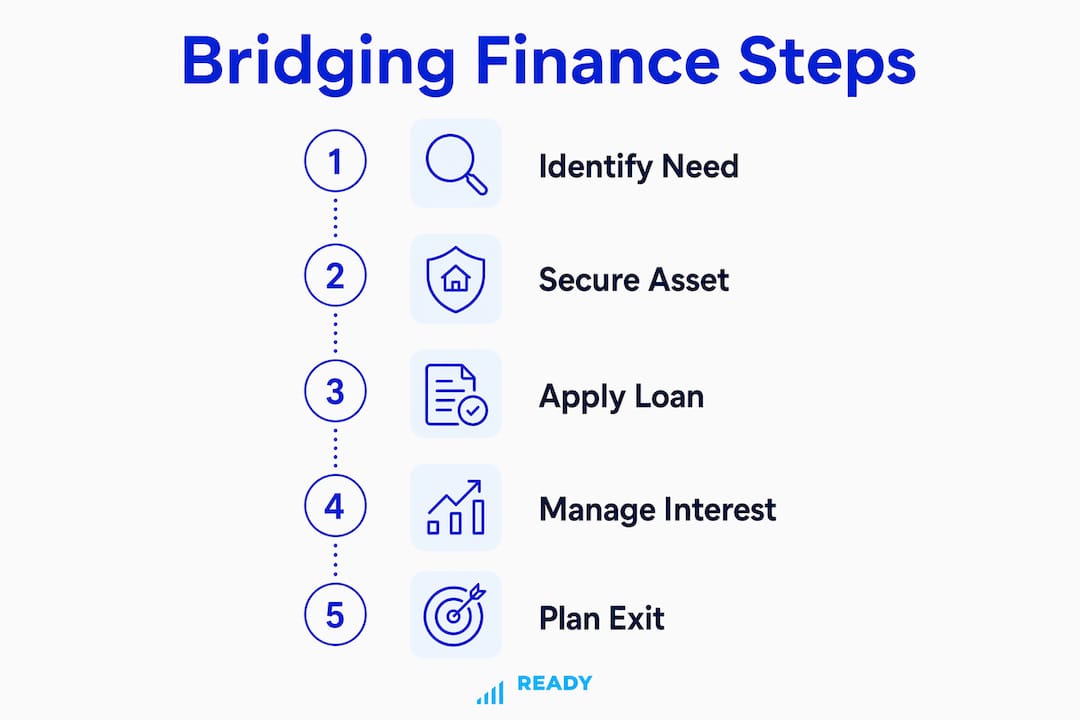
Here is how the typical process works:
- Application: You submit asset documentation, proof of the expected repayment source, and your exit plan.
- Approval: A private lender or specialist finance house assesses collateral and exit strategy, not trading history.
- Disbursement: Funds arrive within 2–3 business days of approval.
- Repayment: You pay interest monthly and repay the full principal at the exit event.
Pro Tip: Before you apply, write your exit strategy in one sentence. If you cannot state clearly when and how the loan will be repaid, the lender will reject you. And they will be right to do so.
When should SMEs consider using bridging finance?
Bridging finance fits one specific situation: a short-term timing gap with a guaranteed repayment source. It is not a general cash-flow fix. Using it for the wrong reason is one of the most expensive mistakes a South African SME owner can make.
Bridging finance is ideal for one-off cash-flow hurdles with a defined repayment event, not for ongoing operational funding or long-term asset building. That distinction matters because the monthly interest compounds quickly if the exit event is delayed.
The right use cases for South African SMEs include:
- Property transfer delays. You have sold a property but transfer is taking 60–90 days. You need capital now to fund your next purchase or cover operating costs.
- Auction purchases. Property and asset auctions require immediate payment. A bridge loan covers the purchase window while you arrange permanent financing.
- Government grant delays. Your SEFA or NYDA grant has been approved but disbursement is weeks away. A bridge loan covers the gap.
- Large invoice awaiting payment. A confirmed debtor owes you R500,000 but payment terms are 60 days. A bridge loan releases that value now.
- Stock purchases for a confirmed order. You have a signed purchase order but need to buy stock before the client pays.
The wrong use cases are equally clear. Do not use bridging finance to cover recurring salary shortfalls, to fund a business that is structurally losing money, or to replace a proper working capital facility. Bridging finance is an emergency tool, not a substitute for sound cash-flow management. Businesses that use it repeatedly for operational gaps end up in a debt cycle that is very difficult to exit.
Costs and risks: what every business owner must know
The cost of a bridge loan is higher than almost any other business finance product in South Africa. That is not a flaw in the product. It is the price of speed and flexibility. The question is whether the cost of delay is higher than the cost of the loan.
| Cost element | Typical range in South Africa |
|---|---|
| Monthly interest rate | 2%–6% per month |
| Annualized rate | ~17.25% |
| Loan term | 6–12 months |
| Collateral required | Assets worth at least twice the loan amount |
| Repayment structure | Interest-only monthly, bullet at exit |
Lenders require unencumbered assets worth at least twice the loan amount. That means a R1,000,000 bridge loan requires R2,000,000 in unencumbered collateral. If your assets are already bonded or pledged elsewhere, you will not qualify.
The biggest risk is a delayed exit event. Monthly interest accumulates fast if your repayment source is delayed. A 3-month delay on a 2% monthly rate adds 6% to your total cost. At 6% monthly, a 3-month delay adds 18%. That is a material hit to your margins.
Pro Tip: Always build a buffer into your exit timeline. If you expect a property transfer in 60 days, plan your bridge loan for 90 days. The cost of the extra month is far lower than the stress of scrambling for an extension.
The secondary risk is lender quality. South Africa has reputable specialist lenders, but the urgency of bridge finance also attracts predatory operators. Always verify that your lender is registered with the National Credit Regulator (NCR) before signing anything.
How to prepare a strong bridging finance application
A strong application is built around two things: a clear exit strategy and solid collateral. Lenders approve bridge loans based on what you own and how you will repay, not on your VAT returns or SARS compliance history.
The documentation you need includes:
- Proof of the asset used as collateral (title deed, invoice, or confirmed purchase order)
- A written exit plan showing the repayment source and expected date
- Valuation of the collateral asset from a registered valuer
- Company registration documents from CIPC
- Bank statements for the last 3–6 months
- Any signed agreements related to the exit event (sale agreement, grant approval letter, debtor confirmation)
Private lenders focus on exit strategy and asset value rather than operating cash flow. That means a startup with a strong asset base can qualify where an established business with weak collateral cannot. Understanding this shifts how you prepare.
Timing also matters. Speed is the core advantage of bridging finance, and missing a short transaction window can cost more than the premium interest. Prepare your documentation before you need the loan, not after the opportunity appears.
Selecting a reputable lender is non-negotiable. Check NCR registration, ask for a full fee disclosure upfront, and get independent legal advice before signing. The South African market has credible specialist lenders, but due diligence protects you from the ones that are not.
What are the alternatives to bridging finance for SMEs?
Bridging finance is one tool in a broader set of short-term funding options. Matching the right product to the right cash-flow gap is what separates businesses that manage capital well from those that are always in crisis mode.
Successful SMEs combine multiple financing products, matching the loan shape to the cash-flow gap. A capital stack approach that combines bridging finance, invoice discounting, and term loans gives you more flexibility and lower overall risk than relying on any single product.
| Product | Best for | Typical term |
|---|---|---|
| Bridging finance | One-off timing gaps with confirmed exit | 6–12 months |
| Invoice discounting | Recurring debtor cycles | Rolling, 30–90 days |
| Business overdraft | Day-to-day cash-flow fluctuations | Revolving |
| Term loan | Growth investment or equipment | 1–5 years |
| Purchase order funding | Confirmed orders needing stock finance | Per order |
Invoice discounting is often a better fit than bridging finance for businesses with a regular debtor book. You release cash tied up in invoices on a rolling basis, without the high monthly interest of a bridge loan. For a deeper look at how debt products fit into your overall capital structure, the Readyaccounting guide on debt vs equity financing for South African SMEs is worth reading before you make any borrowing decision.
For businesses exploring short-term finance options more broadly, understanding the full range of products available helps you negotiate from a position of knowledge rather than urgency.
Key takeaways
Bridging finance is a high-cost, short-term tool that works only when you have a confirmed repayment source, solid collateral, and a defined exit timeline.
| Point | Details |
|---|---|
| Speed is the core value | Approvals take 24–48 hours and funds arrive within 2–3 business days. |
| Collateral drives approval | Lenders require unencumbered assets worth at least twice the loan amount. |
| Monthly interest adds up fast | Rates of 2%–6% per month make delayed repayment very expensive. |
| Exit strategy is non-negotiable | Without a confirmed repayment source, a bridge loan is the wrong product. |
| Combine products for best results | Invoice discounting, overdrafts, and term loans each serve different cash-flow gaps. |
My honest take on bridging finance for South African SMEs
I have seen bridging finance save businesses and I have seen it sink them. The difference is almost always preparation, not the product itself.
The businesses that use it well treat it like a surgical tool. They know exactly what the repayment source is, they have the documentation ready, and they have already stress-tested what happens if the exit event is delayed by 30 days. They borrow the minimum amount needed and repay as fast as possible.
The businesses that get into trouble treat bridging finance like a lifeline for a structurally broken cash-flow model. They borrow to cover salaries they cannot afford, or to fund growth that has no confirmed revenue attached to it. The monthly interest compounds, the exit event keeps moving, and what started as a 3-month loan becomes a 9-month crisis.
The uncomfortable truth is that bridging finance is not the problem. The problem is borrowing without a plan. South African SMEs operate in a tough environment: SARS compliance pressure, VAT timing mismatches, slow-paying government debtors. Those are real challenges. But they call for better financial systems and planning, not expensive short-term debt used repeatedly.
My advice: before you apply for a bridge loan, spend an hour with your accountant or a fractional CFO mapping your cash-flow cycle. If the gap you are trying to fill is structural, fix the structure first. If it is genuinely a one-off timing issue with a confirmed exit, bridging finance is a legitimate and useful tool. The budgeting and cash-flow planning work you do before the crisis is what makes the difference.
— Johan
How Readyaccounting helps SMEs manage cash flow and borrowing decisions
Readyaccounting works with South African SMEs and startups to build the financial visibility that makes borrowing decisions clearer and cheaper. Real-time cash-flow dashboards, automated debtor tracking, and cloud accounting infrastructure mean you see your funding gaps before they become emergencies. That visibility is what lets you choose the right product at the right time, rather than grabbing the fastest option under pressure. If you want to see how automation improves cash flow for businesses like yours, Readyaccounting has the tools and the expertise to get you there. Contact Readyaccounting for a consultation tailored to your business.
FAQ
What is bridging finance in simple terms?
Bridging finance is a short-term loan secured against an asset or confirmed receivable, designed to cover a cash-flow gap until a defined repayment source arrives. It is not a long-term funding solution.
How fast can I get bridging finance in South Africa?
Private lenders approve bridge loans within 24–48 hours and disburse funds within 2–3 business days, making it one of the fastest business finance products available in South Africa.
What interest rate does bridging finance charge?
South African bridging finance rates run at approximately 2%–6% per month, or around 17.25% annualized, depending on your risk profile and collateral quality.
What collateral do I need for a bridge loan?
Lenders typically require unencumbered assets worth at least twice the loan amount. This can include property, confirmed invoices, or other tangible assets with a clear valuation.
Is bridging finance suitable for ongoing cash-flow problems?
No. Bridging finance is designed for one-off timing gaps with a confirmed repayment source. Using it for recurring operational shortfalls leads to compounding interest costs and a debt cycle that is difficult to exit.