

Bookkeeping clean-up pricing in South Africa: 2026 guide
Most South African SMEs generally pay a range per month of backlog for a professional bookkeeping clean-up, with total project fees varying significantly depending on the complexity of the reconstruction ahead of an Annual Financial Statement (AFS) or SARS audit. The final number depends on how many months need fixing, how many transactions and bank accounts are involved, and whether VAT returns or payroll corrections are in scope.
Providers typically bill clean-ups in one of five ways:
- Hourly billing depending on seniority and complexity
- Per-month-of-backlog flat fee, commonly used for SMEs
- Per-transaction pricing when volume drives cost
- Fixed scoped package with one price for a defined deliverable
- Value-based retainer priced on outcome rather than hours
All figures in this guide are in South African Rand (ZAR). SARS compliance and AFS readiness are almost always part of the scope, which is why clean-up pricing is higher than standard monthly bookkeeping.
Key takeaways
Bookkeeping clean-up pricing in South Africa typically runs R1,500–R8,000 per month of backlog, and fixed scoped packages with milestone payments are the most reliable way to control total cost and avoid disputes.
| Point | Details |
|---|---|
| Typical ZAR range | R1,500–R8,000 per month of backlog; projects range widely depending on complexity. |
| Fixed scope beats hourly | Always request a fixed scoped quote with a stop date — open-ended hourly engagements have no cost ceiling. |
| Key cost drivers | Months of backlog, transaction volume, bank accounts, VAT and payroll complexity, and software used all shift the final price. |
| Must-ask questions | Define “transaction,” confirm the stop date and deliverables, and ask for a milestone payment schedule before signing. |
| Readyaccounting | Offers fixed per-month-of-backlog or scoped package pricing with a 48-hour proposal turnaround for South African SMEs. |
Table of Contents
- What is a bookkeeping clean-up and when does your business need one?
- How providers price clean-ups and what drives the cost
- Worked South African sample quotes for typical SME situations
- What a clean-up package usually includes and what it does not
- Typical timelines and what to expect at each phase
- How to get an accurate, comparable quote from any supplier
- How Readyaccounting scopes and prices clean-ups for South African SMEs
- Why the cheapest quote is usually the most expensive mistake
- Readyaccounting’s clean-up service: get a scoped quote in 48 hours
- Sources
What is a bookkeeping clean-up and when does your business need one?
A bookkeeping clean-up is a forensic reconciliation of past accounting periods. The goal is to produce accurate, SARS-compliant records from a set of books that have fallen behind, contain errors, or were never properly set up. It is not the same as ongoing monthly bookkeeping, which maintains records going forward, and it is not an audit, which independently verifies records a third party has already prepared.
You likely need a clean-up rather than a fresh start if any of these apply:
- You have received a SARS query, penalty notice, or VAT audit request
- VAT returns are outstanding or were filed on incorrect figures
- Bank statements and your accounting software do not reconcile across multiple months
- You are preparing for investor due diligence, a business sale, or an M&A transaction
- Payroll figures in your books do not match payslips or EMP201 submissions
- Your accountant cannot produce a trial balance because the underlying data is unreliable
The distinction matters for pricing. A clean-up is scoped, time-limited work with a defined stop date. Ongoing bookkeeping is a recurring service. Mixing them up leads to vague quotes and scope creep.
Pro Tip: If your bank reconciliation shows unexplained differences in three or more consecutive months, and your VAT returns were filed from those same records, you almost certainly need a clean-up before your next SARS submission — not just a catch-up on recent months.
How providers price clean-ups and what drives the cost
Understanding the pricing models helps you read a quote critically. CIBA provides a practical framework covering five models, scope-tier templates, and a minimum-rate calculator that practitioners adapt to set sustainable clean-up fees. Here is how each model works in practice:
- Hourly billing — straightforward but risky for buyers. Without a ceiling, a complex clean-up can run far over budget. Best used for small, well-defined tasks where the scope is genuinely uncertain.
- Per-month-of-backlog flat fee — the most common model for SME clean-ups. The provider prices each calendar month of records to be cleaned and multiplies by the number of months. Transparent and easy to compare across suppliers.
- Per-transaction pricing — useful when the backlog is short but the transaction volume is unusually high (e.g., a retail business with thousands of daily sales). Less useful when transaction counts are hard to estimate upfront.
- Fixed scoped package — one price for a defined deliverable (e.g., “12 months of reconciled books to trial balance, VAT re-preparations included”). The best model for budget certainty, provided the scope is written clearly.
- Value-based or retainer pricing — priced on the outcome (SARS-compliant, AFS-ready books) rather than inputs. Typically used for larger or ongoing engagements where the provider takes responsibility for the end result.
What actually changes the quote
The single biggest driver is months of backlog. After that, in rough order of impact:
- Monthly transaction volume (more transactions = more reconciliation time)
- Number of bank accounts and credit cards to reconcile
- Whether VAT returns need to be recalculated and resubmitted
- Payroll complexity and whether EMP201 corrections are needed
- The accounting software in use (Xero, QuickBooks, and Sage are the most common in South Africa; a migration adds cost)
- Volume of coding errors, duplicate entries, or missing source documents
- Whether the engagement needs to produce an AFS-ready trial balance or just tidy records
Pro Tip: Ask every supplier how they define a “transaction” before accepting a per-transaction quote. Some providers count each line item on a bank statement; others count each invoice or journal entry. The difference can double the quoted price for the same set of books.
Worked South African sample quotes for typical SME situations
These examples use realistic South African inputs. They assume a single business bank account unless stated, average transaction volumes, and no payroll unless noted. VAT is excluded from the clean-up fee itself.
Scenario A — Micro business, 2 months of backlog A sole trader with roughly 80 transactions per month, one bank account, no VAT registration. A provider charges R2,000 per month of backlog on a fixed package basis. Estimated fee: R4,000. Timeline: 3–5 business days.
Scenario B — Small business, 6 months of backlog A small retail company with 250 transactions per month, two bank accounts, VAT-registered, no payroll in scope. Provider uses a per-month flat fee of R3,500. Estimated fee: R21,000. Timeline: 2–4 weeks.
Scenario C — Medium business, 12 months of backlog A services company with 400 transactions per month, three bank accounts, VAT re-preparations needed, payroll catch-up for several employees. Provider quotes a fixed scoped package. Estimated timeline: several weeks.
Scenario D — Complex reconstruction, 18+ months A growing SME preparing for investor due diligence, multiple entities, historical system migration from a desktop package to Xero, AFS-ready output required. Value-based pricing applies. Estimated fee: R80,000–R150,000+. Timeline: 3–5 months, phased.
These ranges align with how packaged cleanup services benchmark pricing by business size and volume. Use them as a sanity-check when you receive quotes, not as fixed market rates — your specific inputs will shift the number.
What a clean-up package usually includes and what it does not
Knowing what is standard helps you compare quotes on equal terms. A well-scoped clean-up package typically covers:
- Bank and credit card reconciliations for all accounts in scope
- Transaction categorisation and chart-of-accounts corrections
- Correcting journals for misposted entries
- VAT re-preparation and reconciliation to VAT201 submissions (if VAT is in scope)
- Payroll catch-up and EMP201 reconciliation (if payroll is in scope)
- Trial balance to an AFS-ready position
- A handover report summarising what was corrected and why
Common exclusions and add-ons that attract separate fees:
- Filing outstanding VAT returns or tax returns with SARS (a separate compliance engagement)
- Paying arrears, penalties, or interest to SARS
- Negotiating with SARS on your behalf (tax defence work)
- Forensic investigation of suspected fraud or misappropriation
- Historical system migrations from one accounting platform to another
- Cash-count audits or physical stock counts
Accounting Weekly recommends moving away from vague hourly arrangements toward fixed fees with explicit inclusions and exclusions, noting that clear contract language is the primary defence against scope creep. Before you sign anything, insist the quote specifies: the exact deliverable, the stop date, the number of revision rounds included, and the acceptance criteria for sign-off.
Pro Tip: Ask the supplier to define “complete” in writing. A clean-up is “complete” when the bank reconciliation balances to zero, the trial balance ties to source documents, and VAT figures reconcile to filed returns — not when the provider says they are done.
Typical timelines and what to expect at each phase
A bookkeeping clean-up moves through four phases regardless of size. Understanding them helps you plan operations and cashflow around the engagement.
Phase 1: Discovery and scoping (2–5 days). The provider reviews a sample of your records, counts transactions, identifies error types, and issues a fixed scoped proposal with a milestone payment schedule.
Phase 2: Bulk reconciliation (the longest phase). Bank statements are matched to accounting entries, unreconciled items are flagged, and missing source documents are requested from you. This phase scales directly with backlog size.
Phase 3: Corrections and journals. Misposted transactions are corrected, duplicate entries removed, and opening balances verified. VAT and payroll figures are recalculated if in scope.
Phase 4: Final review and handover. The provider produces a clean trial balance, a correction summary, and (if agreed) an AFS-ready set of accounts. You review, raise queries, and sign off.
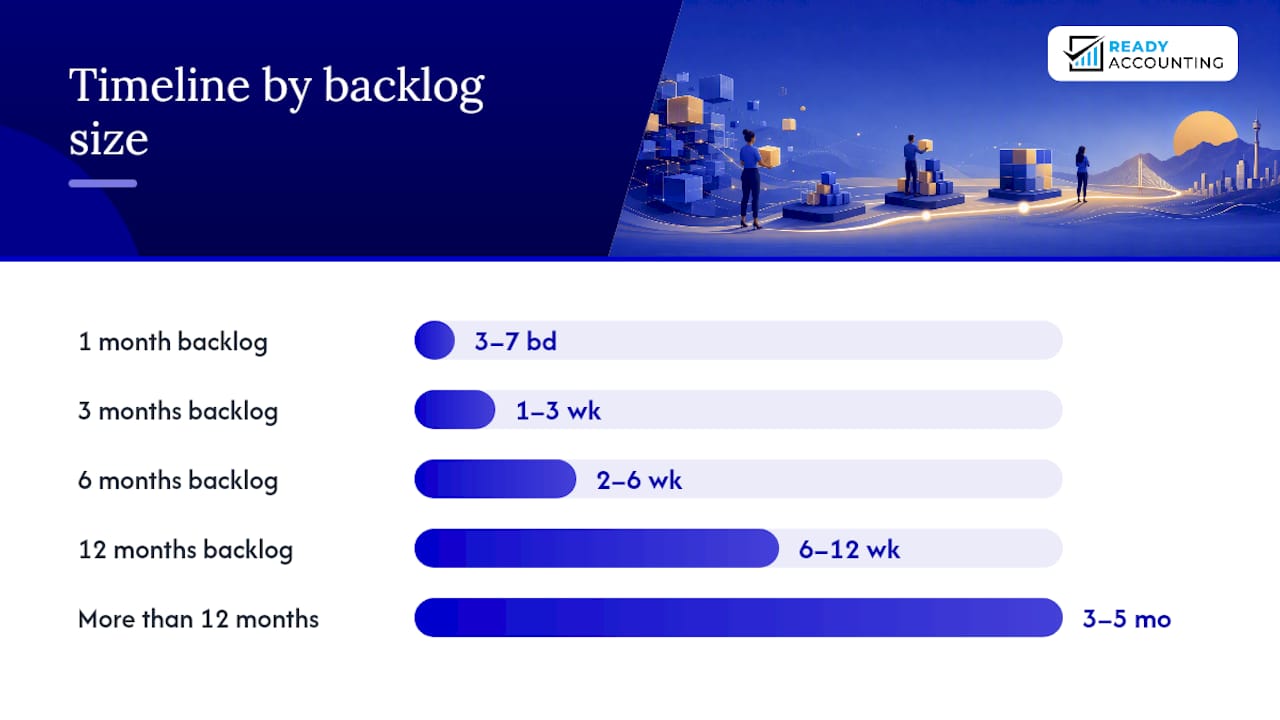
Timeline guidance by backlog size:
- 1 month of backlog: 3–7 business days
- 3 months: 1–3 weeks
- 6 months: 2–6 weeks
- 12 months: 6–12 weeks
- More than 12 months: multi-month phased project, typically 3–5 months
A credible supplier will commit to a stop date in writing and offer milestone payments tied to phase completions. If a provider cannot tell you when the work will be done, that is a red flag worth taking seriously.
How to get an accurate, comparable quote from any supplier
Vague quotes produce vague work. Arrive at a discovery call with this information ready and you will receive a fixed scoped proposal rather than an open-ended hourly estimate.
- Months to clean — the first and last month you need reconciled, stated clearly.
- Estimated transactions per month — pull a recent bank statement and count the lines as a proxy.
- Number of bank accounts and credit cards — include dormant accounts if they had activity in the period.
- Payroll headcount and whether EMP201 submissions are outstanding — payroll corrections are a separate skill set and add meaningful cost.
- VAT registration status and whether returns are outstanding — outstanding VAT201s almost always need to be recalculated before filing.
- Current accounting software and whether backups exist — Xero, QuickBooks, and Sage are standard in South Africa; a missing or corrupted file adds scope.
- Access readiness — can you grant the provider read access to your bank feeds and accounting software immediately, or will there be delays?
Once you have this ready, ask every supplier these questions before accepting a quote:
- How do you define a “transaction” for pricing purposes?
- What is the stop date and what does “complete” mean in your contract?
- What are the exact deliverables — trial balance only, or AFS-ready accounts?
- Which accounting software will you work in, and will the clean file be handed back to me?
- What is the milestone payment schedule?
- What happens if you find more errors than expected — is there a cap on out-of-scope hourly rates?
- Can you share a sample handover report so I know what I am receiving?
Red flags to watch for: a supplier who cannot give you a fixed price after seeing your records, a quote with no stop date, or an hourly estimate with no ceiling. These are not signs of caution — they are signs of poor scoping discipline, and they predict disputes.
How Readyaccounting scopes and prices clean-ups for South African SMEs
Readyaccounting follows a four-step scoping process before issuing any price:
- Discovery call (30 minutes): you describe the backlog, software, and SARS position; Readyaccounting identifies the risk areas.
- Document request: a short list of bank statements, VAT returns, and a trial balance export so the team can assess actual error volume.
- Sample reconciliation: Readyaccounting reconciles one month as a proof of concept, which produces a reliable transaction count and error-rate estimate.
- Fixed scoped proposal: a written quote with a stop date, milestone payment schedule, defined deliverables, and acceptance criteria.
Readyaccounting prices most SME clean-ups as a flat per-month-of-backlog fee or a fixed scoped package, depending on complexity. For larger reconstructions or multi-entity engagements, a phased retainer is used so costs are spread across milestones rather than invoiced upfront. Trust signals include SARS compliance experience, SAICA/SAIPA-aligned practice standards, and fractional CFO capability — meaning the clean-up can feed directly into a real-time financial reporting setup rather than just producing a static set of corrected books.
Worked example: A Cape Town-based services company with 9 months of backlog, two bank accounts, VAT-registered, no payroll in scope, using Xero. Readyaccounting provides a scoped proposal charging a fixed fee per month of backlog, payable in milestone instalments. Timeline is several weeks.
For SARS record-keeping compliance and AFS readiness, the handover includes a corrected trial balance, a VAT reconciliation to filed returns, and a correction summary the business can present to SARS if queried.
Pro Tip: Attach your most recent bank statement and a screenshot of your accounting software’s trial balance to your discovery request. Readyaccounting can turn around a scoped fixed proposal within 48 hours when these two documents are provided upfront.
Why the cheapest quote is usually the most expensive mistake
The most common pricing mistake South African business owners make is selecting a bookkeeper on hourly rate alone, without a defined scope. An R400/hour quote with no ceiling can easily exceed a R6,500 fixed-package quote once the provider discovers the actual error volume. By then, you have already committed.
The second mistake is accepting a quote that does not define “complete.” A clean-up that ends when the provider runs out of time — rather than when the books actually balance — leaves you with a partially corrected set of records that may still fail a SARS query. You have paid for work, but you have not bought an outcome.
The practical rule of thumb: for backlogs under 12 months, insist on a fixed scoped quote with milestone payments. For backlogs over 12 months or multi-entity reconstructions, a phased retainer with clear phase deliverables is more realistic — but each phase should still carry a fixed price and a stop date. Never accept an open-ended hourly engagement for clean-up work unless the scope is genuinely unknowable and the provider commits to a ceiling.
One more thing worth noting: professional bodies, including CIBA, encourage pricing based on the value of the outcome (SARS-compliant, AFS-ready books) rather than raw data-entry volume. A provider who prices on outcome has skin in the game. A provider who prices only on hours does not.
Readyaccounting’s clean-up service: get a scoped quote in 48 hours
Readyaccounting gives South African SMEs a fixed-price clean-up with a defined stop date, milestone payments, and a handover that goes beyond a corrected trial balance. The team brings SARS compliance experience and fractional CFO capability to every engagement, so the clean books you receive can feed directly into improved financial reporting and real-time decision-making rather than sitting in a folder until the next tax season.
The process is straightforward: book a discovery call, attach your latest bank statement and trial balance, and receive a fixed scoped proposal within 48 hours. No open-ended hourly estimates, no surprise invoices at handover. Readyaccounting also uses cloud accounting automation to reduce the manual labour in bulk reconciliation, which keeps clean-up costs lower than a purely manual approach for high-volume books.

Request your scoped quote at Readyaccounting.
Sources
- Effective Pricing Strategies for South African Accountants: A Guide to Modern Billing Models — Accounting Weekly
- Myciba
- Clean up your books | QuickBooks Live
This article is general information, not a substitute for advice from a qualified financial advisor. Consult a qualified financial professional about your own circumstances before acting on anything here.
Recommended
- Outsourced bookkeeping rates Cape Town: 2026 guide | Ready Accounting
- Understanding the Cost of Accounting Services in 2025 - Ready Accounting
- Top 6 Monthly Bookkeeping Packages South Africa Agencies 2026 | Ready Accounting
- Monthly Bookkeeping Checklist for South African Businesses 2025 | Ready Accounting