

Benefits of outsourcing accounting for South African Scaling Companies
Many South African business owners assume keeping accounting in-house guarantees better control and lower costs. Yet rising salaries, complex tax regulations, and limited access to modern technology often prove this assumption wrong. Outsourcing accounting offers significant cost savings, flexible scalability, improved compliance, and access to cloud-based insights that transform financial management. This guide explores the core benefits of outsourcing accounting and practical considerations to help your SME reduce expenses, stay compliant, and focus on growth.
Table of Contents
- Key takeaways
- How outsourcing accounting cuts costs and boosts flexibility
- Access to advanced cloud technology and real-time insights
- Improving compliance and reducing risk in complex south african regulations
- Freeing business owners for core operations and improved financial performance
- Explore ready accounting’s outsourced accounting solutions
- Frequently asked questions about outsourcing accounting
Key Takeaways
| Point | Details |
|---|---|
| Cost savings | Outsourcing converts fixed accounting costs into variable service fees and can deliver substantial ongoing savings. |
| Flexible scalability | Pay as you go allows you to scale services up or down with business needs without hiring delays. |
| Improved compliance | Outsourcing provides access to updated processes and expert oversight that reduces regulatory risk. |
| Cloud technology access | Access to enterprise grade cloud accounting delivers real time dashboards automated processes and remote access without large capital investment. |
How outsourcing accounting cuts costs and boosts flexibility
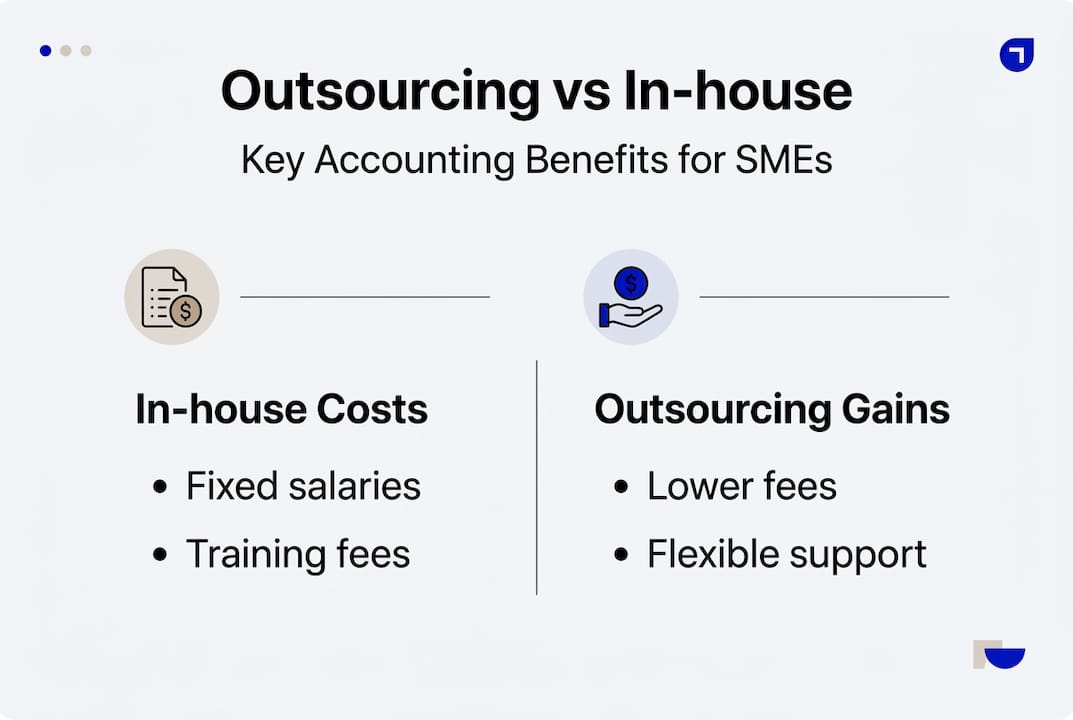
South African SMEs face substantial fixed costs when maintaining in-house accounting teams. Salaries for qualified accountants, software licenses, training programs, office space, and employee benefits quickly add up. Outsourcing accounting converts these fixed expenses into variable service fees that scale with your business needs.
Pay-as-you-go models let you purchase exactly the accounting support required each month. During quieter periods, you reduce service levels and costs. When business accelerates, you scale up without recruitment delays or training investments. This flexibility proves invaluable for seasonal businesses or companies experiencing rapid growth phases.
Hiring and retaining skilled accounting staff presents multiple challenges. Recruitment takes weeks or months. Training new hires requires time and resources. Staff turnover disrupts financial operations and forces repeated hiring cycles. Retrenchments during downturns create legal complications and severance costs. Outsourcing eliminates these HR headaches entirely.
| Cost element | In-house accounting | Outsourced accounting |
|---|---|---|
| Monthly salary | R15,000 to R35,000+ per accountant | R3,000 to R12,000 for equivalent services |
| Benefits and taxes | 30 to 40% additional on salary | Included in service fee |
| Software licenses | R500 to R2,000 per month | Included in service fee |
| Training and development | R5,000 to R15,000 annually | Provider responsibility |
| Office space and equipment | R2,000+ per employee monthly | Not required |
| Recruitment costs | R10,000 to R30,000 per hire | Not applicable |
The cost comparison reveals substantial savings, often reaching 40% or more for small to medium businesses. These savings accumulate month after month, freeing capital for marketing, inventory, or expansion.
Pro Tip: Negotiate service-level agreements that allow quarterly adjustments to your outsourcing package. This ensures you pay only for services actively used while maintaining flexibility to scale up quickly when opportunities arise.
Quality matters significantly when selecting an outsourcing provider. Verify credentials, check client references, and ensure clear contracts define deliverables, timelines, and communication protocols. A detailed outsourced accounting guide helps you evaluate providers and establish productive partnerships. The right provider becomes a strategic partner, not just a cost-saving measure.
Access to advanced cloud technology and real-time insights
Cloud accounting platforms revolutionize financial management by providing instant access to up-to-date financial data from any device. These systems automate transaction recording, bank reconciliations, and report generation. For most SMEs, purchasing and maintaining such technology internally proves prohibitively expensive.

Outsourcing grants immediate access to enterprise-grade cloud accounting systems without capital investment. Your provider handles software subscriptions, updates, security patches, and technical support. You gain sophisticated tools previously available only to large corporations.
Key features available through outsourced cloud accounting include:
- Automated bank feeds that eliminate manual data entry and reduce errors
- Real-time dashboards showing cash flow, profit margins, and key performance indicators
- Multi-user access with customizable permissions for owners, managers, and external advisors
- Automated invoicing and payment reminders that accelerate collections
- Integration with point-of-sale systems, e-commerce platforms, and payroll software
- Mobile apps enabling financial oversight while traveling or away from the office
- Secure cloud storage with automatic backups protecting against data loss
Real-time reporting transforms decision-making speed and quality. Instead of waiting weeks for month-end reports, you monitor financial performance daily. Spot cash flow problems before they become critical. Identify profitable product lines or customer segments immediately. Adjust pricing or expenses based on current data rather than outdated snapshots.
Transparency improves dramatically when both you and your accounting provider view identical real-time data. Questions get answered quickly. Discrepancies surface immediately rather than months later. This shared visibility builds trust and enables proactive financial management.
“Longer outsourcing relationships improve reporting quality significantly. Providers using cloud technology enable real-time access that maintains oversight while delivering professional expertise. This combination drives better financial outcomes for SMEs.”
Pro Tip: Ensure your provider uses SAICA-compliant cloud platforms with robust security certifications. Verify that data encryption, multi-factor authentication, and regular security audits protect your sensitive financial information.
The cloud accounting benefits extend beyond reporting to collaboration and efficiency. Multiple team members access the same system simultaneously without version control issues. Your accountant, bookkeeper, and tax advisor work from identical data, eliminating reconciliation headaches. A comprehensive cloud accounting guide explains implementation steps and best practices for maximizing these advantages.
Improving compliance and reducing risk in complex south african regulations
South African businesses navigate an intricate regulatory landscape involving SARS tax requirements, VAT submissions, PAYE obligations, CIPC annual returns, and industry-specific compliance rules. Regulations change frequently. Penalties for late or incorrect submissions prove costly and damage business reputations.
Outsourcing improves compliance significantly by providing access to specialists who maintain current knowledge of evolving regulations. These experts monitor legislative changes, interpret new requirements, and implement necessary adjustments to your financial processes.
Key compliance challenges South African SMEs face include:
- Monthly VAT returns requiring accurate input and output tax calculations
- PAYE submissions and payments for employee taxes within strict deadlines
- Annual income tax returns with complex deduction rules and documentation requirements
- CIPC annual returns and financial statement submissions maintaining good standing
- Industry-specific regulations for sectors like healthcare, financial services, or food production
- BEE compliance reporting for businesses pursuing government contracts or corporate clients
Specialist accounting providers dedicate resources to regulatory monitoring and staff training. When SARS announces tax law changes or CIPC updates filing requirements, your provider immediately understands implications and adjusts your accounting processes accordingly. You avoid the burden of tracking regulatory updates while managing daily operations.
Accurate VAT and payroll submissions eliminate the most common sources of SARS penalties. Automated systems flag potential errors before submission. Experienced professionals review calculations and supporting documentation. Timely submissions avoid late filing penalties that quickly accumulate.
Hybrid outsourcing models offer flexibility for businesses with specific needs. You might outsource only VAT compliance while handling daily bookkeeping internally. Or outsource payroll processing while maintaining control over accounts receivable. These selective approaches suit edge cases where partial outsourcing delivers optimal results.
Pro Tip: Verify your outsourcing provider’s compliance certifications and request client references specifically related to SARS and CIPC submissions. Ask about their process for handling regulatory changes and how quickly they implement updates to client accounts.
Implementing accounting best practices becomes simpler when working with experienced providers. They establish proper chart of accounts structures, implement effective internal controls, and ensure SARS record-keeping rules are consistently followed. This foundation supports audit readiness and simplifies future compliance requirements.
For businesses managing employees, streamlined payroll management reduces compliance risks associated with employee taxes, UIF contributions, and SDL payments. Outsourced providers handle calculations, submissions, and payments while maintaining detailed records for audits or disputes.
Freeing business owners for core operations and improved financial performance
Accounting tasks consume substantial owner time in most SMEs. Recording transactions, reconciling bank accounts, preparing invoices, chasing payments, and compiling reports divert attention from revenue-generating activities. Outsourcing eliminates this administrative burden, allowing owners to focus on sales, customer service, product development, and strategic planning.
Time freed from accounting administration translates directly into business growth opportunities. You spend more hours meeting potential clients, developing new products, training staff, or optimizing operations. These activities drive revenue and competitive advantage far more effectively than manual bookkeeping.
How outsourcing improves operational focus and business growth:
- Transfer daily transaction recording and bank reconciliation to your provider, freeing 10 to 20 hours weekly
- Redirect reclaimed time toward customer acquisition, relationship building, and sales activities
- Leverage provider expertise for financial planning, budgeting, and forecasting to guide strategic decisions
- Use real-time financial insights to identify and capitalize on profitable opportunities quickly
- Eliminate stress and mental burden associated with compliance deadlines and complex regulations
- Scale operations confidently knowing financial management infrastructure supports growth
Research demonstrates positive links between outsourcing accounting functions and improved financial performance in SMEs. Companies that outsource report better cost efficiency, higher profitability, and superior reporting quality compared to those maintaining all functions internally.
Enhanced financial performance stems from multiple factors:
- Professional expertise identifies cost savings and efficiency improvements owners might miss
- Accurate, timely financial reporting enables data-driven decisions rather than intuition-based guesses
- Better cash flow management through proactive monitoring and forecasting prevents liquidity crises
- Reduced error rates eliminate costly corrections, penalties, and interest charges
- Strategic financial advice from experienced professionals guides growth investments and risk management
Reporting quality improves substantially when specialists handle financial statement preparation. Clear, accurate reports help you understand business performance, secure financing, attract investors, or negotiate better supplier terms. Banks and investors view professionally prepared financials as more credible than owner-generated statements.
“Empirical evidence consistently shows outsourcing accounting correlates with improved profitability and cost efficiency in small and medium enterprises. The relationship strengthens over time as providers develop deeper understanding of business operations and reporting needs.”
Pro Tip: Schedule monthly review meetings with your outsourcing provider to discuss financial reports, performance trends, and strategic questions. These sessions maximize the value of professional expertise while keeping you informed and engaged with financial management.
The benefits of outsourcing accounting extend beyond time savings to strategic advantages. Providers often introduce process improvements, automation opportunities, and e-invoicing benefits that enhance efficiency across your entire operation. For startups and growing businesses, outsourced accounting services provide the financial foundation needed to scale successfully without premature hiring of full-time staff.
Explore ready accounting’s outsourced accounting solutions
Ready Accounting specializes in outsourced accounting services designed specifically for South African SMEs. Our team combines deep regulatory knowledge with modern cloud technology to deliver cost-effective financial management that supports business growth and compliance.
We offer flexible service packages covering bookkeeping, financial reporting, payroll processing, tax compliance, and strategic financial consulting. Whether you need comprehensive accounting support or assistance with specific functions like VAT or PAYE, our scalable solutions adapt to your requirements and budget.
Our cloud accounting expertise ensures you gain real-time access to financial data while we handle the technical complexity. We implement proven cloud-based accounting systems that integrate seamlessly with your existing business processes.
Pro Tip: Contact Ready Accounting for a personalized consultation. We assess your current financial management challenges, recommend appropriate service levels, and provide transparent pricing tailored to your business needs. Visit our website to learn more and schedule your consultation.
Frequently asked questions about outsourcing accounting
What are typical cost savings from outsourcing accounting?
South African SMEs typically save 30 to 50% compared to maintaining in-house accounting staff when they outsource. Savings come from eliminating salaries, benefits, software licenses, training costs, and office space expenses. The exact amount depends on your business size, transaction volume, and service requirements.
Can I outsource only specific accounting functions like payroll or VAT?
Yes, hybrid outsourcing models let you selectively outsource specific functions while handling others internally. Many businesses outsource complex or time-consuming tasks like payroll processing, VAT compliance, or tax returns while maintaining control over daily bookkeeping. This flexibility allows you to address specific pain points without committing to comprehensive outsourcing. Learn more about outsourcing options for small businesses.
How do I ensure my outsourced accounting provider complies with SARS and CIPC?
Verify that providers hold relevant professional certifications, ask for client references specifically related to compliance, and request details about their regulatory monitoring processes. Reputable providers maintain memberships with professional bodies, invest in ongoing staff training, and implement quality control procedures for all submissions. Review their track record with SARS audits and penalty histories.
Is real-time access to my financial data possible with outsourced accounting?
Yes, modern outsourced accounting services use cloud platforms that provide 24/7 access to your financial data from any device. You view the same real-time information your provider uses, enabling transparency and immediate oversight. Most providers offer mobile apps and customizable dashboards showing key metrics, cash flow, and performance indicators updated continuously.
How soon can I expect improvements in business focus and profitability after outsourcing?
Most business owners notice immediate time savings within the first month as administrative burdens transfer to their provider. Financial performance improvements typically become measurable within three to six months as better reporting, cash flow management, and strategic insights influence decision-making. The benefits compound over time as providers develop deeper understanding of your business and identify additional optimization opportunities.
Recommended
- What Is Outsourced Accounting? Simplified Guide for 2025 – Ready Accounting
- How to Outsource Accounting for Small South African Businesses – Ready Accounting
- Why Outsource Accounting: Simplify Finances for SA Businesses – Ready Accounting
- Outsourced accounting for startups: streamline finances 2026 – Ready Accounting