

A beginner's guide to basic knowledge of accounting standards
A beginner’s guide to basic knowledge of accounting standards
Accounting standards are the rulebook that tells a business how to recognise, measure, present, and disclose its financial transactions, so that anyone reading the numbers can trust and compare them. That’s the whole point: comparability and reliability for the people who depend on those numbers, from investors and lenders to regulators and business owners. Building a basic knowledge of accounting standards starts with recognising the names you’ll see everywhere:
- IFRS (International Financial Reporting Standards), set by the IASB
- U.S. GAAP, set by the FASB, used mainly in the United States
- IFRS for SMEs, a simplified version for smaller entities
- Standards of GRAP, used by South African public sector bodies
Executive Summary
- Companies must verify their public interest score and listing requirements to determine if full IFRS or IFRS for SMEs applies, affecting disclosure complexity.
- Moving from SME to full IFRS significantly increases the scope of required disclosures, audit costs, and complexity, especially for listed companies and large entities.
- Framework choices are typically dictated by legal, contractual, or group policy triggers, making early consultation with accountants crucial to avoid penalties.
- Many financial statement anomalies often stem from revenue recognition policies or framework misapplications rather than actual business performance changes.
- Professional guidance from firms like Readyaccounting can prevent costly errors by aligning accounting practices with the correct framework before audits or regulatory reviews.
Table of Contents
- Why accounting standards matter beyond the balance sheet
- What are the core principles behind every accounting standard?
- Which accounting framework applies to your business?
- Who actually writes and updates these rules?
- How do companies actually pick a framework?
- What should a small business actually do with this knowledge?
- Ready Accounting’s take on when to bring in professional help
- Get your accounting standards sorted properly
- Key Takeaways
- Sources
Why accounting standards matter beyond the balance sheet
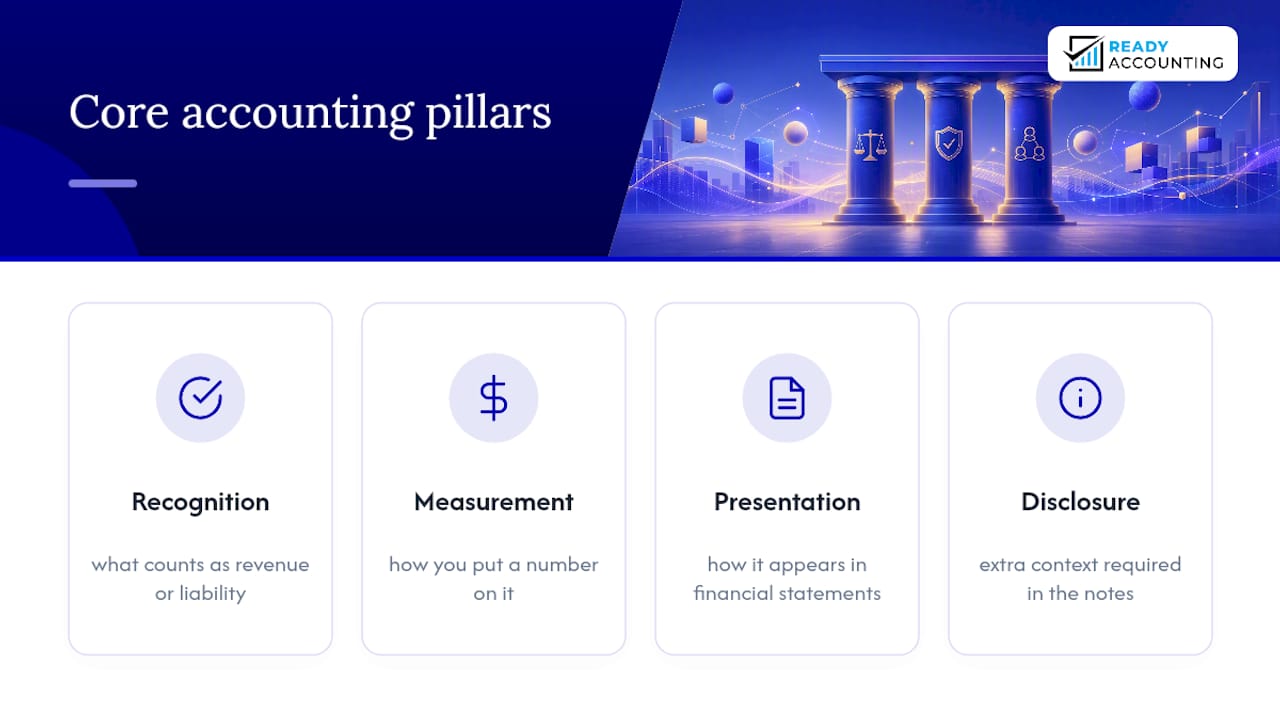
Accounting standards govern four things: what counts as revenue or a liability (recognition), how you put a number on it (measurement), how it appears in the financial statements (presentation), and what extra context you must explain in the notes (disclosure). Get any one of those wrong and the whole set of financial statements becomes unreliable, no matter how accurate the underlying bookkeeping is.
Several groups lean on these rules daily. Investors use them to compare one company against another. Banks use them to decide whether to extend credit. SARS and auditors use them to check that reported profit reflects reality, not creative accounting.
Here’s a concrete case: two companies sell the identical product on a 12-month instalment plan. One recognises the full sale immediately; the other spreads revenue over the contract term. Same cash, wildly different reported profit in year one. That single policy choice can swing a loan application, a valuation, or a tax bill. It’s also why auditors interrogate revenue recognition policy before almost anything else on the file, and why a framework mismatch tends to surface first at tax season or during an audit, not before.
What are the core principles behind every accounting standard?
Every framework, whether IFRS, GAAP, or GRAP, rests on the same handful of qualitative ideas. Learn these and you can reason through almost any accounting choice, even one you’ve never seen before.
- Relevance — information must actually influence a user’s decision, not just exist for its own sake
- Faithful representation — numbers must reflect economic reality, not just legal form
- Comparability and consistency — using the same accounting principles period after period so trends mean something
- Materiality — only information big enough to change a decision needs special treatment
- Accrual basis — recording transactions when they occur, not when cash changes hands
- Going concern — assuming the business will keep operating for the foreseeable future
- Conservatism/prudence — don’t overstate assets or income, don’t understate liabilities or expenses
These ideas live inside what standard setters call the Conceptual Framework, the foundational document the IASB and FASB both use to justify individual rules. When a new standard is drafted, its authors test it against these principles first.
Pro Tip: If a number in a financial statement looks odd, ask which principle might explain it. A big drop in reported profit despite strong sales often traces back to a change in revenue recognition, not a change in the actual business.
Which accounting framework applies to your business?
Not every entity uses the same rulebook, and mixing them up is one of the most common beginner mistakes.
- IFRS is built for listed and internationally active companies. It exists so a fund manager in London can compare a Johannesburg company against a Frankfurt one using the same measurement rules.
- U.S. GAAP, issued by the FASB, applies within the United States and tends to be more rules-based and prescriptive than IFRS’s principles-based approach.
- IFRS for SMEs is a deliberately simplified, redrafted version of full IFRS. SAICA’s guidance describes it as designed to cut complexity and disclosure volume for smaller entities while still producing credible financial statements. It’s not a lesser standard, just a better fit for a business that doesn’t need consolidated group reporting or complex financial instrument disclosures.
- Standards of GRAP govern South African public sector entities. Instead of investor decision-making, GRAP centres on accountability for public money and service delivery, a genuinely different objective from private-sector reporting.
The practical difference shows up in disclosure effort. A JSE-listed company under full IFRS might produce very extensive notes; a small business under IFRS for SMEs might need a fraction of that.
Who actually writes and updates these rules?
A handful of bodies control what ends up in your financial statements, and each has a distinct job.
- The IASB, operating under the IFRS Foundation, drafts and issues IFRS Standards along with supporting interpretations and educational material.
- The FASB sets U.S. GAAP and issues the guidance American companies and their auditors must follow.
- The IPSASB develops public sector standards used internationally, with a conceptual framework built around accountability rather than investor returns, the same philosophy behind GRAP.
- In South Africa, the Accounting Standards Board (ASB) issues the Standards of GRAP for public entities, while SAICA and the Financial Reporting Standards Council (FRSC) support and reference IFRS adoption for the private sector.
For anything official, go straight to the source rather than a summary. The ASB and IFRS Foundation both publish current standards, exposure drafts, and effective dates directly on their sites.
How do companies actually pick a framework?
Framework choice usually isn’t optional, and it isn’t guesswork either. A few concrete triggers decide it for you.
- Check your public interest score (PIS). South Africa’s Companies Act Regulations use a formula built from turnover, employee count, third-party liabilities, and number of shareholders. A higher score often pushes a company toward full IFRS rather than IFRS for SMEs, as the IFRS jurisdiction profile for South Africa confirms.
- Check listing rules. Companies listed on the JSE must use full IFRS, no exceptions, regardless of size.
- Check contractual and group requirements. Lenders, shareholder agreements, or a parent company’s group reporting policy can require a specific framework even when the law would otherwise allow flexibility.
- Confirm with the ASB or your auditor before assuming, since penalties and re-audits for using the wrong framework cost far more than an hour’s consultation upfront.
What should a small business actually do with this knowledge?
If you’re running an SME, IFRS for SMEs is very likely your framework, and that’s good news: it exists specifically to cut administrative load without gutting credibility. The trade-off runs the other way too. Moving up to full IFRS, whether because of a listing, an investor requirement, or crossing a PIS threshold, brings heavier disclosure and higher audit costs almost overnight.
The most common pitfall isn’t picking the wrong framework outright; it’s underestimating how much extra disclosure a framework change demands until an auditor flags it mid-engagement. A close second is assuming SARS and your chosen accounting framework always align, when in practice tax treatment and financial reporting frequently diverge.
Three moves fix most of this:
- Confirm which framework your PIS and structure actually require.
- List every new disclosure requirement before you switch, not after.
- Ask your accountant specifically: “Does this transaction need different treatment under our framework?”
Pro Tip: Ask your accountant this exact question before any major transaction: “Under our current framework, does this change how we recognise or disclose it?” That single question catches most framework surprises before they hit your annual financial statements.
Ready Accounting’s take on when to bring in professional help
We spend most of our week inside exactly these decisions, running cloud accounting and fractional CFO work for South African SMEs and VC-backed startups. Our honest read: the moment your PIS climbs, you take on institutional investors, or a transaction gets structurally unusual (leases, revenue over time, group consolidation), self-taught accounting stops being enough. That’s when a tax accountant or CFO advisor earns their fee, not before. If you’re unsure which framework you’re on, that uncertainty alone is reason to ask.
— Johan
Get your accounting standards sorted properly
Understanding IFRS for SMEs versus full IFRS is one thing. Actually implementing the right framework, catching up on Annual Financial Statement backlogs, and keeping SARS compliance airtight is another job entirely, and it’s the one Readyaccounting does daily for South African businesses. Where a traditional bookkeeper reacts to last year’s numbers, our cloud accounting infrastructure gives you live visibility into which framework decisions are actually costing you money, before your auditor finds them first. If your VAT registration, CIPC filings, or annual financial statements need a proper once-over under the correct standard, read our guide on improving financial reporting for better decision-making and then book an assessment with our team to see exactly where your books stand.
Key Takeaways
Accounting standards work by forcing consistent recognition, measurement, and disclosure rules so financial statements stay comparable across companies, industries, and time.
| Point | Details |
|---|---|
| Standards control four things | Recognition, measurement, presentation, and disclosure all follow the chosen framework’s rules. |
| Principles underpin every framework | Relevance, faithful representation, comparability, materiality, accrual, and conservatism guide every rule. |
| Framework depends on entity type | Listed companies use full IFRS; SMEs typically qualify for IFRS for SMEs; public bodies use GRAP. |
| Public interest score decides South African cases | A company’s turnover, employees, liabilities, and shareholder count influence whether full IFRS or IFRS for SMEs applies. |
| Professional review prevents costly mistakes | Readyaccounting’s fractional CFO and cloud accounting services catch framework and disclosure errors before audits do. |
Authoritative links to read next
- IFRS jurisdiction profile: South Africa — official rules on which framework applies where.
- ASB FAQs on Standards of GRAP — public sector guidance on materiality and application.
- FASB — home page for U.S. GAAP standards and updates.
- Corporate Finance Institute: Accounting standard — accessible definition and history for beginners.
This article is general information, not a substitute for advice from a qualified financial advisor. Consult a qualified financial professional about your own circumstances before acting on anything here.
Sources
- IFRS — Jurisdiction profile: South Africa
- FAQs on Standards of GRAP (Accounting Standards Board)
- Circular: IFRS for SMEs — SAICA
- Introduction to fundamental concepts of U.S. accounting standards (Lumen Learning)