

Avoid VAT Rejections: Bank Financial Statements SA SMEs Need Checklist
Avoid VAT Rejections: Bank Financial Statements SA SMEs Need Checklist

Bank financial statements, in this guide, means the ordinary bank account statements your business gets from Absa, FNB, Nedbank, Standard Bank, or Capitec — the transaction records your accountant needs for bookkeeping, VAT returns, and SARS compliance. The single most important next step: download the official PDF or e-statement version, not a screenshot, and keep it for a safe retention period. SARS can ask for it at any point during that window.
Executive Summary
- Automated bank feeds and proper file naming reduce reconciliation errors and ensure quick retrieval for SARS audits, especially for scaling businesses.
- Bank statement requirements for SARS include maintaining original PDFs or electronic records that preserve data integrity and remain accessible for five years after submission.
- Critical ratios like loan-to-deposit, net interest margin, and capital adequacy reveal a bank’s financial health and potential risks long before crises occur.
- Bank’s financial health is shaped by IFRS standards and Basel III regulations, influencing lending practices and fee structures during economic downturns.
- Regularly checking for rising non-performing loans and liquidity gaps helps identify early warning signs of bank instability before issues become systemic.
Table of Contents
- Understanding bank statements: what’s on them and why accountants care
- Why bank statements count as SARS documentary proof
- How to get, name, and organise your statements properly
- SARS retention rules and electronic-record requirements
- The checklist accountants should run before every VAT submission
- The three statements a bank itself produces, and why they matter
- Reading the numbers: ratios that reveal a bank’s real health
- The rules banks follow: IFRS, Basel III, and local oversight
- Spotting trouble: the red flags hiding in a bank’s own numbers
- Who actually reads these statements, and why
- Automating this is not optional for a scaling business
- How a professional accounting firm can take bank statement admin off your plate
- Key SARS pages worth bookmarking
- Sources
- FAQ
Understanding bank statements: what’s on them and why accountants care
Every bank statement carries the same core fields, and each one earns its keep in your bookkeeping. Understanding bank statements properly means knowing which field answers which question your accountant asks.
- Transaction date — determines which VAT period or financial year a transaction belongs to
- Description/reference — the string your accountant matches against invoices and EFT slips
- Amount and running balance — used to check nothing is missing when reconciling
- Account number and branch code — proves which account the transaction belongs to, critical when you run more than one business account
Reconciliation is where these fields do real work. Your accountant matches deposits against sales invoices to confirm every sale was actually paid, and matches outgoing payments against supplier invoices to confirm expenses claimed for VAT actually left the account. Mismatches here are the number one cause of delayed VAT submissions. For a fuller picture of how these entries flow into your books, see this income statement guide for South African SMEs.
Why bank statements count as SARS documentary proof
SARS does not simply take your word for a deduction or an input tax claim. It requires documentary proof, and bank statements are one of the accepted forms, particularly for businesses on the payments basis for VAT rather than the invoice basis. The SARS interpretation note on documentary proof sets out exactly when a bank statement or payment advice is enough, and when you also need a tax invoice.
Payments-basis vendors often rely on the bank statement as their primary proof of payment — which is why an incorrect EFT reference or a missing deposit slip can turn a valid claim into a rejected one.
What bank proof typically supports:
- Proof that a supplier invoice was actually paid, not just issued
- Proof of a refund received from a customer or supplier
- Proof of a deposit that corresponds to a specific sales invoice
Miss a statement, or have one that doesn’t match your ledger, and SARS can disallow the related input tax claim entirely. That’s not a small administrative hiccup. It’s real money walking out the door on a technicality.
How to get, name, and organise your statements properly
Getting the paperwork right sounds boring until the month you can’t find a statement from fourteen months ago. Here’s the workflow that avoids that problem entirely.
- Download the official e-statement, not an emailed summary. Use your bank’s online portal for the fastest route; branches can usually reissue older statements too, though it may take a few working days and sometimes carries a small fee.
- Name the file consistently — something like
2026-01-fnb-businessaccount.pdf. Year and month first means your folder sorts itself chronologically, which matters enormously when your accountant is importing twelve months at once. - Reconcile before you import. Check the row count and closing balance on the PDF against what your accounting software pulls in. A mismatch here catches a missing page before it becomes a missing VAT input claim.
- Extract to CSV when your software needs it, but never delete the original PDF. The PDF is your audit trail; the CSV is your working file.
- Store originals separately from working files, and log any time you convert or migrate data between systems or formats.
Pro Tip: Keep a dedicated “originals” folder that nothing ever edits, and a separate “working” folder for CSV exports. If SARS ever asks a question about a specific transaction eighteen months later, you want to hand over the untouched original in under a minute, not go hunting through five different exports.
For a deeper look at how bank-derived figures show up in your reporting, this guide to financial statement examples for South African SMEs is worth bookmarking.
SARS retention rules and electronic-record requirements
The retention period is fixed: a safe retention period from the date you submit the relevant tax return, or a safe retention period from the end of the tax period if no return was required. That clock doesn’t start on the transaction date. It starts on the submission date, which means a January 2026 bank statement tied to a return filed in June 2026 needs to survive until roughly mid 2031.
SARS is comfortable with electronic records, but not with just any electronic record. Under GEN-GEN-23-POL02, records must:
- Preserve their integrity — meaning the file hasn’t been altered since it was generated
- Remain accessible and readable by SARS on request, in a usable format
- Be supported by documentation if you’re using bespoke or uncommon software: manuals, a written description of the system, and migration logs
If you want to store records outside South Africa, that’s not automatic. You apply to SARS by emailing ElectronicRecords@sars.gov.za, and a senior SARS official has to authorise it subject to conditions. Businesses running cloud accounting platforms hosted overseas should sort this out before an inspection forces the question, not during one. Ready Accounting’s guide to record-keeping requirements for SA businesses covers this in more detail.
The checklist accountants should run before every VAT submission
Before you hit submit on a VAT return, or respond to a SARS query, run this sequence:
- Confirm the statement date range matches the VAT period exactly. A statement running to the 28th when your period ends on the 30th is a common, avoidable error.
- Match every deposit to a sales invoice. Flag anything unmatched immediately rather than at year-end.
- Collect EFT slips and bank advices for any input tax claimed on the payments basis, since these are often your only proof of payment.
- Classify bank charges and interest correctly in the ledger. These get misfiled more often than any other line item.
- Export and archive the original PDFs plus a CSV ledger extract, and note down any system migration that happened during the period.
Miss step one and the whole submission can be built on the wrong data window, which is a painful thing to discover after filing.
The three statements a bank itself produces, and why they matter
Separately from your own business’s bank account statements, it helps to understand what a bank produces about itself, since your accountant may reference these concepts when assessing which bank to recommend for your business banking relationship.
A bank’s balance sheet shows what it owns (loans, cash reserves, investments) against what it owes (deposits, borrowings) at a point in time. The income statement shows revenue, mostly interest income and fees, against costs over a period, landing on net profit. The cash flow statement tracks actual cash moving through operating, investing, and financing activities, which matters because a bank can look profitable on paper while facing a cash squeeze.
These three together tell a very different story than any one alone. A bank can report solid profit on its income statement while its balance sheet shows a risky concentration of loans in one sector, or its cash flow statement shows financing activity plugging a gap that operations should be covering. For an SME owner, none of this determines your day-to-day bookkeeping, but it does explain why your bank behaves the way it does around lending, fees, and account terms during tight economic periods. Banks under balance sheet pressure tend to tighten lending criteria and raise fees before they publicly say anything about why.
Reading the numbers: ratios that reveal a bank’s real health
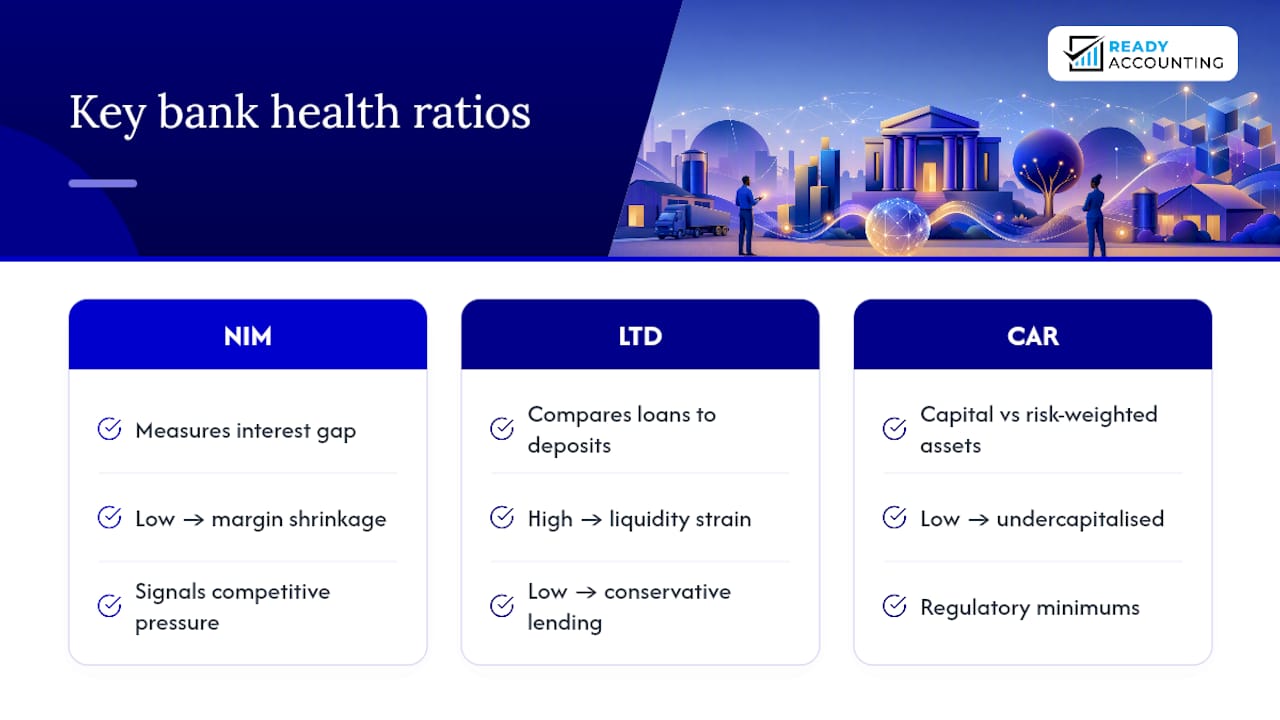
Three ratios do most of the heavy lifting when analysts assess a bank’s financial statements, and each answers a different question.
Net interest margin measures the gap between what a bank earns on loans and what it pays on deposits, relative to its interest-earning assets. A shrinking margin usually means competitive pressure or a shift toward lower-yield lending.
Loan-to-deposit ratio compares total loans against total deposits. A high ratio suggests a bank is lending aggressively relative to its deposit base, which can signal liquidity strain if deposits start leaving. A low ratio suggests a more conservative posture, sometimes at the cost of profitability.
Capital adequacy ratio measures a bank’s capital against its risk-weighted assets, essentially asking whether it has enough of a buffer to absorb losses without collapsing. Regulators set minimum thresholds for this ratio specifically because undercapitalised banks are the ones that fail during downturns.
None of these ratios sit in isolation. A bank with a healthy capital adequacy ratio but a rapidly rising loan-to-deposit ratio is often quietly building risk that won’t show up until deposit withdrawals accelerate. Reading bank financial statements properly means checking these figures against each other across several reporting periods, not just the latest snapshot.
The rules banks follow: IFRS, Basel III, and local oversight
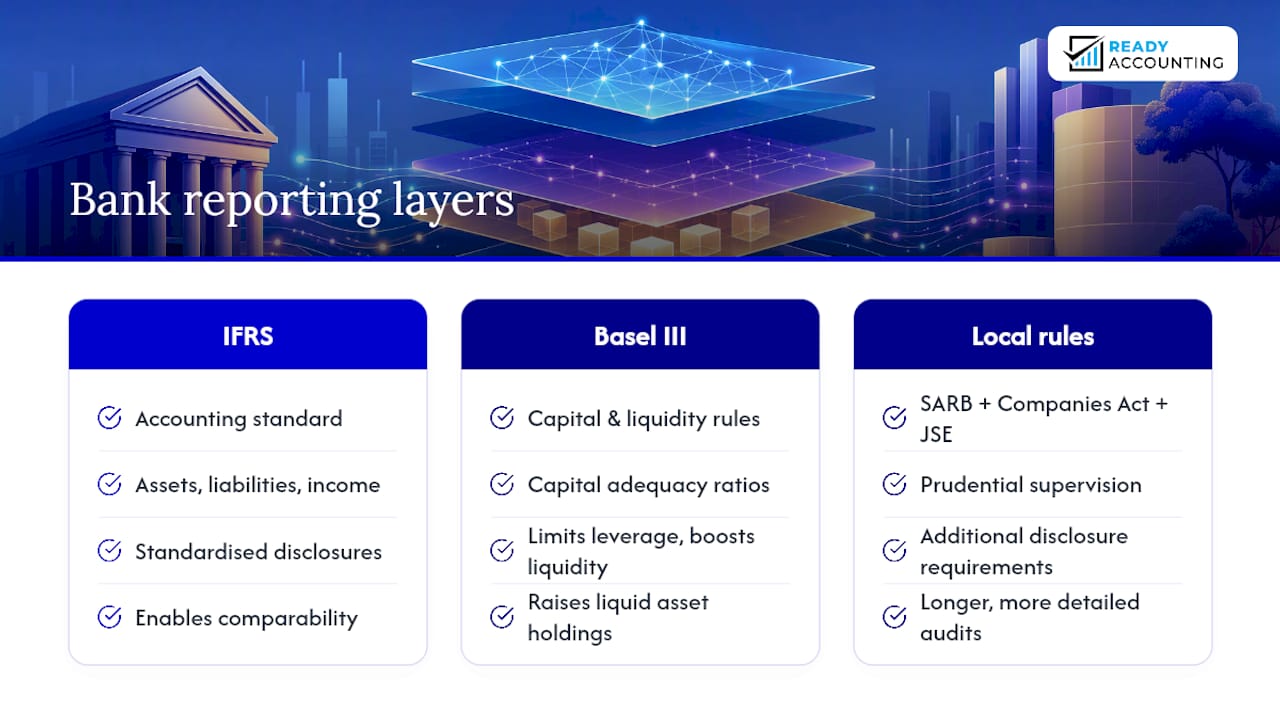
Bank financial reporting doesn’t happen in a vacuum. Most banks, including South African ones, prepare statements under International Financial Reporting Standards (IFRS), which standardises how assets, liabilities, and income get recognised and disclosed. This is what lets an analyst compare one bank’s balance sheet against another’s without adjusting for wildly different accounting choices.
Sitting alongside IFRS is Basel III, the international regulatory framework built after the 2008 financial crisis specifically to strengthen bank capital requirements, limit excessive leverage, and improve liquidity buffers. Basel III is why the capital adequacy ratio matters so much. It sets the minimum threshold banks must clear, and it forces banks to hold more genuinely liquid assets against short-term obligations.
In South Africa, the South African Reserve Bank supervises banks against these standards, and locally listed banks answer to additional Companies Act and JSE disclosure requirements on top of IFRS. This layered framework, international accounting standard, international capital framework, and local prudential supervision, is why bank financial statements carry more disclosure detail than an ordinary company’s annual financial statements. It also explains why bank audit reports tend to run longer and flag more specific risk categories than audits of non-financial companies.
Spotting trouble: the red flags hiding in a bank’s own numbers
Credit risk and liquidity risk leave fingerprints in bank financial statements long before they become headline news. Rising non-performing loan ratios signal that a growing share of a bank’s loan book isn’t being repaid on schedule, which eats directly into profitability and can force the bank to raise more provisions against future losses.
On the liquidity side, a widening gap between short-term liabilities and readily available liquid assets is a warning sign, particularly when it coincides with a rising loan-to-deposit ratio. That combination means a bank has committed more of its deposit base to long-term lending, leaving less cushion if depositors withdraw funds faster than expected.
Watch also for heavy reliance on wholesale funding (borrowing from other institutions) rather than stable retail deposits. Wholesale funding tends to dry up fastest in a crisis, which is precisely when a bank needs it most. None of these signals alone means a bank is in trouble. Together, and trending in the same direction across several reporting periods, they’re exactly what regulators and credit rating agencies watch for.
Who actually reads these statements, and why
Bank financial statements serve three very different audiences, each asking a different question of the same numbers.
Investors read them to judge whether a bank’s earnings are sustainable and whether its capital position can absorb a downturn before deciding to hold or sell shares. Regulators, including the South African Reserve Bank, use them to verify Basel III compliance and to catch early warning signs before a bank’s problems become systemic. Corporate customers, including SME owners choosing a business banking partner, sometimes review a bank’s published financial strength before committing to a long-term relationship, particularly for larger credit facilities or trade finance arrangements.
For most SME owners, this level of analysis matters less day to day than getting your own bank statements organised for SARS. But understanding the framework helps explain bank behaviour, fee changes, lending appetite shifts, that otherwise seem arbitrary.
Automating this is not optional for a scaling business
The conventional view treats bank statement collection as a once-a-month admin chore. That’s backwards for any business actually scaling. Every manually reconciled statement is a chance for a missed deposit, a mismatched reference, or a VAT input claim that quietly falls apart under review. Automated bank feeds and API-linked cloud accounting remove that human error rate entirely, and they compress a task that used to eat a full day into something closer to an ongoing background process. Faster reconciliation means faster, more defensible VAT filing and an audit trail SARS can’t easily poke holes in. If your business has outgrown manual bank statement admin, consider professional financial advisory support before your next filing deadline, not after a query lands.
**
How a professional accounting firm can take bank statement admin off your plate
Chasing down statements, renaming files, and reconciling them by hand doesn’t scale, and it’s exactly the kind of administrative friction Ready Accounting was built to remove. Our cloud accounting service links directly to your bank feeds via API, so statements import automatically instead of landing in your inbox as a monthly fire drill. If SARS comes knocking with a query on old input tax claims, our tax consulting services team builds the documentary proof trail SARS actually expects, referencing the exact interpretation note that governs it. And if your books are already a mess of missing statements and unreconciled accounts, our accounting cleanup and reconstruction service rebuilds the trail from what’s left. For businesses whose reporting readers, be it a bank, an investor, or SARS, need audited numbers, we also handle annual financial statements. Get in touch through our website to book a consultation and find out where your current process is leaking time or exposure.
Key SARS pages worth bookmarking
- SARS record keeping — the five-year retention rule in full.
- GEN-GEN-23-POL02 — electronic record and offshore storage rules.
- Documentary proof interpretation note — what counts as valid VAT proof.
- SARS small-business leaflet — plain-language filing basics.
This article is general information, not a substitute for advice from a qualified financial advisor. Consult a qualified financial professional about your own circumstances before acting on anything here.
Sources
- Record keeping | South African Revenue Service
- GEN-GEN-23-POL02 - Manage taxpayer record retention authorisation - External Policy
- Interpretation note: documentary proof prescribed by the Commissioner
- SARS small-business leaflet (2026)
FAQ
How long must I keep bank statements for SARS?
Five years from the date you submit the related tax return, or a safe retention period from the end of the tax period if no return was required, according to SARS record-keeping rules. Set a calendar reminder rather than relying on memory, since the clock resets with every return.
Are scanned or photographed statements acceptable to SARS?
Official electronic statements downloaded directly from your bank are the safest option, since they preserve the integrity and accessibility SARS requires under GEN-GEN-23-POL02. A photograph of a printed statement is riskier because it’s harder to prove it wasn’t altered.
How do I get an old bank statement I no longer have?
Most South African banks let you download statements going back several years directly through online or mobile banking portals. For anything older, a branch visit or a call to the bank’s client service line can usually retrieve it, sometimes for a small fee.
Can I store my bank statements outside South Africa?
Only with SARS authorisation. You apply by emailing ElectronicRecords@sars.gov.za, and a senior SARS official approves it under conditions set out in GEN-GEN-23-POL02. Businesses on overseas-hosted cloud accounting platforms should confirm this before an inspection, not during one.
Does Ready Accounting handle bank statement reconciliation for me?
Yes. Ready Accounting’s cloud accounting service connects to your bank feeds via API so statements reconcile automatically against your ledger, cutting the manual matching work that usually causes VAT filing delays.