

Annual financial statements: your South African compliance guide
Annual financial statements: your South African compliance guide
For South African companies, an annual comprehensive financial report means one thing in practice: your Annual Financial Statements (AFS), prepared to IFRS or IFRS for SMEs under the Companies Act, submitted to SARS with your ITR14 and filed with CIPC within six months of your financial year-end. Before anything else, check your Public Interest Score (PIS), which influences whether your AFS must be audited, independently reviewed, or whether a Financial Accountability Supplement (FAS) suffices for your CIPC filing obligation.
Your immediate action list:
- Calculate your PIS using the CIPC portal before you engage an auditor or reviewer
- Confirm whether SARS classifies your company as Micro, Small, or Medium-to-Large (this drives your ITR14 support document obligation)
- Decide whether your CIPC filing requires iXBRL or whether FAS is sufficient
- Set your AFS completion deadline at five months post year-end to leave a buffer for sign-off and portal submission
Key takeaways
South African companies must prepare compliant AFS within six months of year-end, with SARS and CIPC filing obligations determined by company classification and Public Interest Score.
| Point | Details |
|---|---|
| Six-month AFS deadline | The Companies Act requires AFS within six months of financial year-end; missing it risks CIPC investigation. |
| PIS drives your obligations | A PIS of 350 or above triggers a mandatory audit and iXBRL filing; below 100 allows a FAS instead. |
| Signed AFS for ITR14 | Small and Medium-to-Large companies must attach signed, final AFS to their SARS ITR14 submission. |
| Start iXBRL early | Engage a CIPC-listed SSP at draft stage, not after sign-off, to avoid last-minute portal validation failures. |
| Readyaccounting | Provides end-to-end AFS preparation, iXBRL conversion, and Fractional CFO support for South African SMEs and startups. |
Table of Contents
- What your annual financial statements must contain
- Which companies must file AFS with CIPC and SARS?
- Audited, independently reviewed, or internally compiled: what’s the difference?
- Step-by-step checklist from closed books to filed AFS
- Common mistakes that delay filings or put off investors
- What investors and banks expect alongside your AFS
- Why investor-readiness and compliance belong in the same conversation
- Readyaccounting gets your AFS compliant and investor-ready
- Sources
What your annual financial statements must contain
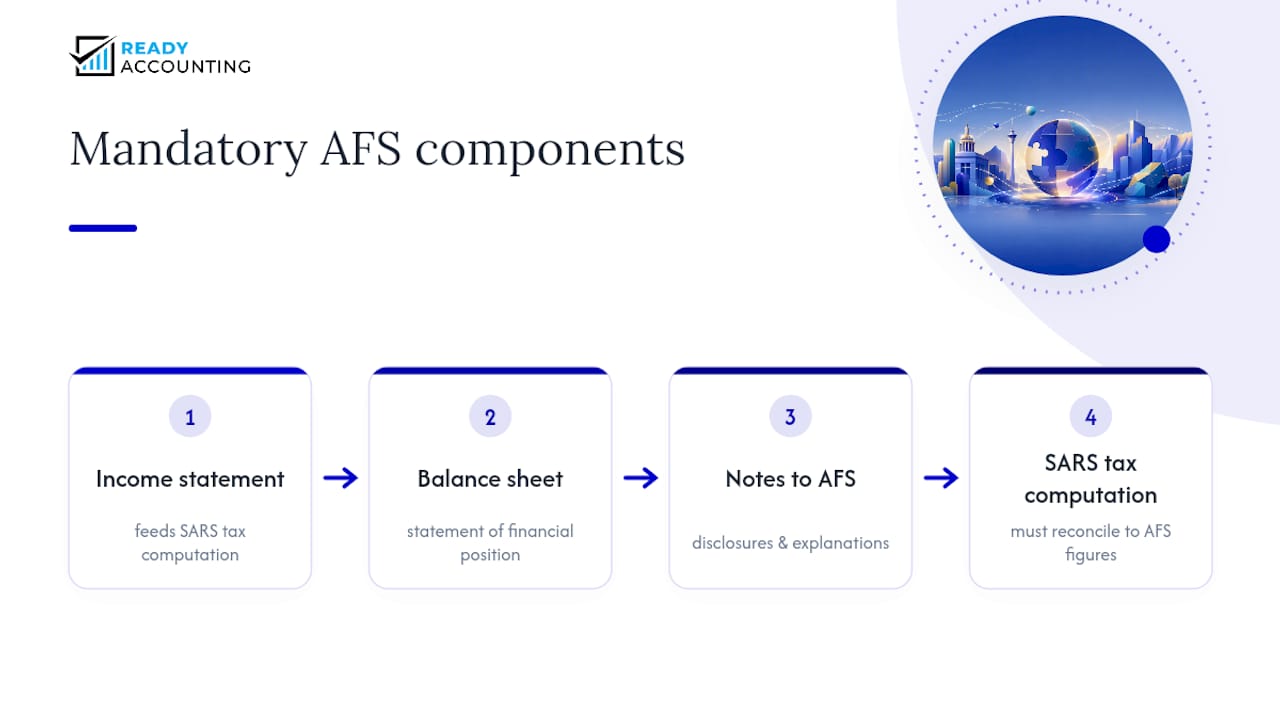
The legal minimum for a compliant AFS is an income statement, a balance sheet (statement of financial position), and notes to the financial statements. SARS adds a tax computation to that list for ITR14 purposes, and the computation must reconcile to the figures in the AFS.
Which standard applies? The Companies Act draws a clear line. Public companies and state-owned companies must use full IFRS. Private companies generally qualify for IFRS for SMEs, which is less disclosure-intensive and more practical for most South African startups and owner-managed businesses. Your MOI or a shareholder agreement can override this and require full IFRS, so check those documents before you start.
The income statement is where SARS focuses first. Revenue recognition policy, gross margin, and operating expenses all feed directly into the tax computation. Errors here create mismatches between your AFS and ITR14 that trigger SARS queries.
Pro Tip: Label every draft AFS clearly as “DRAFT — NOT FOR SUBMISSION.” The version you attach to your ITR14 must be final, signed by the company’s public officer or authorised representative. Filing a draft is one of the most common and costly mistakes South African SMEs make.
Which companies must file AFS with CIPC and SARS?
SARS requires signed AFS attached to the ITR14 for Small Business and Medium-to-Large Business classifications. Micro companies and dormant companies may submit AFS optionally. The SARS external guide IT-GEN-04-G01 sets out the numeric thresholds for each classification.
On the CIPC side, the PIS thresholds drive everything:
- PIS below 100: No audit or independent review required; FAS is acceptable for CIPC annual return filing
- PIS 100–349: Independent review required; audited AFS must be filed in iXBRL if the company is audited voluntarily
- PIS 350 and above: Mandatory audit; AFS must be filed in iXBRL format via the CIPC eServices portal
Statistic callout: The Companies Act gives every company six months from financial year-end to prepare compliant AFS. Miss that window and you risk CIPC compliance consequences, including investigation or fines.
PIS is calculated from four factors: number of employees (one point each), third-party liabilities in millions of rand (one point per R1 million), turnover in millions of rand (one point per R1 million), and whether the company is a public entity. CIPC’s FAQ guidance confirms the calculation method and filing consequences.
Pro Tip: PIS creeps up quietly. A new funding round that increases your liabilities, or a headcount jump, can push you from PIS 80 to PIS 120 overnight. Recalculate every year before you engage your accountant, not after.
Audited, independently reviewed, or internally compiled: what’s the difference?
The CIPC guidance on financial statements is explicit about when a full audit is non-negotiable for private companies:
- PIS of 350 or above
- Fiduciary assets held above a prescribed threshold
- MOI or shareholder resolution requiring an audit
- Public companies (always audited)
An independent review under ISRE 2400 is the middle ground. It provides limited assurance rather than reasonable assurance, costs less than a full audit, and satisfies CIPC requirements for companies with PIS between 100 and 349. For most VC-backed seed-stage startups, an independent review is both legally sufficient and practically credible with early-stage investors.
Internally compiled AFS carry no external assurance. SARS accepts them for Micro companies, but banks and VCs rarely do. If you are raising capital or applying for a business loan, compiled-only statements will slow the process considerably.

Many SMEs underestimate the value of an independent review even when it is not legally required. A reviewed set of financials signals governance maturity to investors and removes a common objection in due diligence.
Pro Tip: If you are planning a funding round within 12 months, commission an independent review now even if your PIS sits below 100. The cost is a fraction of the delay a VC’s due diligence team will cause if they have to wait for reviewed financials.
Types of financial statements explained covers the practical differences in more detail.
Step-by-step checklist from closed books to filed AFS
Follow this sequence. The timeline ranges assume a company with clean bookkeeping; add two to four weeks if your books need reconciliation work.
- Close the books (Week 1): Post all year-end journals, accrue outstanding invoices, and reconcile VAT returns to the general ledger.
- Bank and balance sheet reconciliations (Week 1–2): Reconcile every bank account, debtor and creditor balance. Cap table reconciliation belongs here too.
- Tax adjustments and computation (Week 2–3): Calculate wear-and-tear, assessed losses, and provisional tax credits. The tax computation must tie to the AFS figures.
- Draft AFS preparation (Week 3–4): Prepare income statement, balance sheet, and notes. Label clearly as DRAFT.
- Independent review or audit (Week 4–7): Engage your SAICA- or SAIPA-registered reviewer or auditor. Provide a complete trial balance and supporting schedules upfront to avoid back-and-forth delays.
- Final sign-off (Week 7–8): The public officer or authorised representative signs the final AFS. No signatures, no ITR14 submission.
- SARS ITR14 submission (Week 8): Upload signed AFS via SARS eFiling. Confirm the AFS figures match the ITR14 exactly.
- CIPC iXBRL conversion and upload (Week 8–9): If your PIS requires iXBRL, engage a CIPC-listed Software Service Provider (SSP) to convert your AFS. Upload the instance document and supporting PDFs via the CIPC eServices portal and review the validation summary for errors.
- FAS submission (Week 8, if applicable): Companies not required to file audited AFS complete the Financial Accountability Supplement on the CIPC portal instead.
The CIPC step-by-step guide walks through the portal steps in detail.
Pro Tip: Start your SSP engagement at Week 4, not Week 8. iXBRL conversion takes longer than most finance teams expect, and portal validation errors can send you back to the accountant for corrections. Running conversion in parallel with the review saves two to three weeks.
Common mistakes that delay filings or put off investors
These are the errors that show up repeatedly in SARS queries and CIPC portal rejections:
- Unsigned AFS attached to ITR14. SARS requires a signed document. A draft or unsigned AFS triggers a query that can delay your assessment by months.
- Figures that don’t match between AFS and tax computation. Even a R1 rounding difference creates a reconciliation problem that SARS will flag.
- Unreconciled bank accounts. If your closing bank balance in the AFS doesn’t match your bank statement, your AFS is wrong. Full stop.
- Cap table mismatches. Share capital and premium in the AFS must reconcile to your cap table. VCs check this on day one of due diligence.
- iXBRL validation errors. The CIPC portal’s validation summary will list every tagging error. Common failures include incorrect SIC codes, missing mandatory elements, and instance documents that don’t match the supporting PDF.
- Missing or thin notes. Revenue recognition policy, related-party transactions, and contingent liabilities are the three areas investors and SARS both scrutinise. Sparse notes raise questions.
Avoiding common bookkeeping mistakes before year-end is the single most effective way to shorten your AFS preparation timeline.
Pro Tip: Run a pre-submission checklist: confirm signatures, cross-check AFS totals to ITR14, verify the iXBRL instance document passes portal validation in a test run before final submission. Ten minutes of checking prevents weeks of back-and-forth.
What investors and banks expect alongside your AFS
A compliant AFS gets you through the regulatory gate. An investor-ready package gets you funded. Here is what VCs and banks typically request beyond the core statements:
- Signed, final AFS (income statement, balance sheet, notes)
- Detailed tax computation reconciling to the AFS
- Bank reconciliations for all accounts at year-end
- Debtor ageing report and creditor ageing report
- Fixed asset register with depreciation schedule
- Cap table (fully reconciled to share capital in the AFS)
- Board minutes approving the AFS
- Management accounts for the current period (if AFS is more than three months old)
- Funding reconciliation showing how capital raised was deployed
For SaaS startups, VCs will also want monthly recurring revenue (MRR) movement, churn rate, and cash runway calculated from the AFS closing cash position. Use your burn rate calculator to present runway figures in a format investors recognise.
Tools like QuoteLock help SMEs keep invoicing and VAT records clean throughout the year, which makes the debtor ageing and revenue reconciliation steps significantly faster at year-end.
Why investor-readiness and compliance belong in the same conversation
Most South African SMEs treat compliance and fundraising as separate tracks. That is a mistake. The AFS you prepare for SARS and CIPC is the same document a VC’s due diligence team will read. If it is thin on disclosures, inconsistent with your management accounts, or missing a reconciled cap table, it creates doubt at exactly the wrong moment.
The companies that raise fastest are the ones whose finance function runs on a short close cycle, clean reconciliations, and a reviewed set of financials that is ready before the investor asks. Compliance is not a cost centre when it removes friction from your fundraising process.
Readyaccounting gets your AFS compliant and investor-ready
Readyaccounting’s outsourced accounting and Fractional CFO service covers the full AFS cycle: bookkeeping clean-up, tax computation, independent review coordination, iXBRL conversion with a CIPC-listed SSP, and signed ITR14 support. You get a finance team that knows the SARS algorithmic triggers and the CIPC portal validation requirements, without the overhead of a full-time CFO. Automation speeds your close and shortens the gap between year-end and filed AFS. Book a PIS check and AFS readiness review with Readyaccounting to find out exactly where you stand before your filing deadline arrives.
Sources
Use these official sources to verify PIS thresholds, filing deadlines, and portal requirements:
- Companies Act 2008 – section on annual financial statements
- Guide to complete the Income Tax Return ITR14 for Companies
- FAQ_Annual_Returns_v2_0.pdf
Cross-reference your PIS calculation against the CIPC portal result before engaging an auditor or reviewer. Filing deadlines and portal requirements do change; always verify against the current CIPC and SARS guidance before submission.
This article is general information, not a substitute for advice from a qualified financial advisor. Consult a qualified financial professional about your own circumstances before acting on anything here.