

Accounting for a digital marketing agency: a South African playbook
Accounting for a digital marketing agency: a South African playbook
The single best approach for accounting for a digital marketing agency is cloud-based double-entry bookkeeping, revenue tracked by client and project, and a rolling 13-week cash forecast updated weekly. Start this week with three moves: build an agency-specific chart of accounts, connect your bank feeds and automate invoicing, and draft your first cash forecast. If you’re South African, layer in SARS registration, VAT thresholds, and CIPC filings early, because compliance gaps compound fast once you’re juggling client budgets and media spend.
Executive Summary
- Agencies should implement double-entry bookkeeping and separate revenue categories, especially for media pass-through, to maintain accurate financial insights.
- Building a weekly cash forecast with scenarios helps identify timing issues early, particularly if large clients delay payments beyond 15 days.
- Complying with SARS, VAT, and CIPC regulations early prevents costly penalties and ensures smooth annual filings, especially for agencies with international payments or media spend.
- Project-level profit and loss tracking reveals true client profitability and guides better pricing, utilization, and margin management.
- Automating bank feeds, invoicing, ad-spend ingestion, and time-tracking creates real-time financial visibility critical for decision-making and avoiding cash flow crises.
Table of Contents
- Bookkeeping systems for accounting for a digital marketing agency
- Revenue tracking, invoicing and month-end close for agencies
- How do you forecast cash flow for a marketing agency?
- What tax and compliance rules apply to marketing agencies?
- Financial reporting and KPIs every agency owner should track
- Which accounting software and automations fit an agency?
- When should you hire a bookkeeper, accountant or fractional CFO?
- Common bookkeeping mistakes agencies make and how to fix them
- How Ready Accounting supports agency finance functions
- Accounting for agency intangible assets
- Budgeting and variance analysis for marketing campaigns
- Handling multi-channel and cross-platform billing
- Refunds, rebates and credits in agency accounting
- What the conventional advice on agency accounting gets wrong
- Get compliant, automated agency accounting with Readyaccounting
- Sources
Bookkeeping systems for accounting for a digital marketing agency
Most agencies start with a spreadsheet and a prayer. That works for about six months, until you can’t tell whether last month’s profit came from client fees or from money you’re holding for Google Ads spend. Double-entry bookkeeping is the reliable baseline here, and there’s no serious argument for single-entry once you have more than one client and one vendor.
Single-entry tracks cash in and cash out. It doesn’t give you an audit trail, it can’t reconcile against a bank statement properly, and it makes it almost impossible to produce a balance sheet a bank or investor would trust. Double-entry records every transaction on both sides, debit and credit, so your books self-check. If something doesn’t balance, you know immediately something’s wrong, rather than finding out three months later when SARS asks questions.
Cash basis versus accrual is a separate decision, and this is where agencies genuinely differ from, say, a retail shop.
- Cash basis works fine for very small agencies with simple, short-cycle billing and no real inventory or work-in-progress to track.
- Accrual basis is required in practice once you run retainers, multi-month projects, or media pass-through billing, because you need to recognise revenue when it’s earned, not just when cash lands.
- Accrual accounting also gives you a cleaner month-end picture of what you’ve actually delivered versus what you’ve invoiced, which matters enormously for project profitability.
Your accounting basis also affects VAT. Once VAT-registered, you’ll typically account for VAT on either an invoice basis or a payments basis depending on your registration category, and mixing that up with your bookkeeping basis creates reconciliation headaches at month-end. Accrual-based books make VAT adjustments far more transparent because your revenue and your VAT output tax move together, tied to the invoice date rather than a scattered cash receipt.
If you’re switching from single to double-entry, or from cash to accrual, follow this sequence:
- Pick your accounting period start date, usually the beginning of a financial year or tax period, not mid-month.
- Build an opening balance sheet, listing every asset, liability, and equity balance as it stands today.
- Migrate historical transactions into the new system, at minimum the last 12 months, so trend reporting works.
- Reconcile every bank and card account against opening balances before you go live.
- Lock the prior period once reconciled, so nobody accidentally edits closed months.
Getting this foundation right before you worry about KPIs or software integrations saves you from rebuilding your entire chart of accounts eighteen months in.
Revenue tracking, invoicing and month-end close for agencies
Agencies bill in ways almost no other business does: retainers, one-off projects, performance fees tied to results, and media spend that passes through your books but isn’t really your revenue. Lumping all of that into one “Sales” account in your ledger is the single biggest reason agency financials become unreadable.
Split your chart of accounts into at least four revenue categories:
- Retainer revenue — recognised monthly, evenly, regardless of hours actually worked.
- Project revenue — recognised on milestones or percentage of completion, not on invoice date.
- Performance/success fees — recognised when the performance condition is met and measurable, not when you invoice.
- Media pass-through — booked separately from agency fee revenue, ideally through a clearing account rather than as top-line income.
That last one trips up more agencies than any other line item. If a client gives you $50,000 to spend on ad platforms and you take a 15% management fee, only that fee is your revenue. The $50,000 moving through your bank account is a liability until spent and an asset (media inventory) in between. Booking the full amount as revenue inflates your top line and distorts every margin calculation you run afterward.
Invoicing rules that keep cash moving:
- Invoice retainers on a fixed date each month, ideally the first, not “whenever we get to it.”
- Invoice project milestones the day work is delivered and approved, not at project end.
- Invoice media spend in advance where possible, or require a deposit before you commit client funds to ad platforms.
- Set payment terms at 14 to 30 days and automate a reminder sequence at 7 days, on the due date, and at 7 days overdue.
Pro Tip: Never let media budgets sit in your general operating account. Open a separate bank account for client ad spend, even if your accounting software can track it virtually. One bounced payment to a media vendor because of a mixed-up account is a client relationship you don’t get back.
On the expense side, tag every campaign cost to a client and project code at the point of entry, not retroactively. Reconcile accounts payable weekly against vendor statements, not just at month-end, because ad platform invoicing often runs on different cycles than your own billing.
A workable month-end close checklist for an agency looks like this:
- Reconcile all bank and card accounts.
- Match every media pass-through transaction to its client clearing account.
- Confirm all retainer invoices for the month have been raised.
- Review work-in-progress on active projects against percentage of completion.
- Run a project-level profit and loss for every active client.
- Review accounts receivable ageing and flag anything over 30 days.
Do this monthly, and your year-end financial statements practically write themselves, because you’ve already reconciled the hard parts twelve times over.
How do you forecast cash flow for a marketing agency?
Build a rolling 13-week cash forecast, refreshed every week, not a static annual budget you check quarterly. Thirteen weeks is the sweet spot for agencies because it covers a full quarter of billing cycles while staying granular enough to catch a client payment delay before it becomes a payroll problem.
Your forecast needs five inputs, minimum: accounts receivable ageing (who owes you what and when it’s realistically expected), vendor and media spend timing (when you must pay ad platforms and freelancers), payroll dates, tax liability due dates (VAT, PAYE), and any loan or overdraft facility movements.
Model at least two scenarios inside the same forecast. The base case assumes clients pay on stated terms. The stress case assumes your three largest clients pay 15 to 30 days late, which is realistic because large clients often run their own AP cycles regardless of your invoice terms. If the stress case shows a negative cash position within eight weeks, you have a runway problem, not a revenue problem, and the fix is different: it’s about timing, not sales.
Tactical moves that actually shift the forecast:
- Move retainer invoice dates to the 1st or 25th of the month, ahead of your own payroll run.
- Require a 50% deposit on new project work and media budgets before work begins.
- Negotiate 30 to 45 day terms with media vendors and freelancers where you currently pay on 14 days.
- Set a hard rule: no new client campaign launches until deposit funds clear.
Retainers help smooth agency cash flow because they’re predictable, but seasonality still bites. Many agencies see a client budget pullback in January and a scramble around financial year-end, so build that pattern into your forecast rather than treating it as a surprise every year.
Runway snapshot: what your numbers are telling you
| Runway signal | What it means | Action trigger |
|---|---|---|
| Cash covers several weeks of stress-case outflow | Comfortable | Continue normal operations, review monthly |
| Cash covers several weeks | Tightening | Freeze non-essential hiring, tighten AR follow-up |
| Cash covers under 4 weeks | Critical | Negotiate vendor terms immediately, consider a bridge facility |
The value of a weekly forecast isn’t the spreadsheet itself. It’s the two-week lead time it buys you to fix a problem before it becomes a missed payroll run.
What tax and compliance rules apply to marketing agencies?
South African agencies carry the same compliance load as any registered business, plus a few wrinkles specific to handling client media budgets and, increasingly, crypto payments. Get the registrations right early, because retrofitting compliance under audit pressure is far more expensive than doing it upfront.
SARS registration. You must register as a taxpayer within 21 business days of starting business activities. If you employ staff, that same registration window triggers your PAYE, SDL, and UIF obligations, so don’t wait until your first payroll run to sort this out.
VAT registration thresholds. From 1 April 2026, the compulsory VAT registration threshold increased to R2.3 million in annual taxable turnover, up from the previous R1 million. That’s a meaningful planning opportunity for early-stage agencies: if your billable revenue (excluding media pass-through, which typically isn’t your turnover) sits below that threshold, you can delay compulsory VAT registration and the administrative load that comes with it. Voluntary registration is still available below the threshold if it suits your client mix, particularly if most clients are VAT-registered businesses that reclaim input VAT anyway.
CIPC annual returns. Every registered company must file its annual return within a month of its incorporation anniversary. Miss it and you risk deregistration, which strips your ability to hold a business bank account or bid for tenders. Since mid-2024, CIPC also requires a Beneficial Ownership Declaration before it will accept your annual return filing at all, a step several agencies still get caught out by according to Ready Accounting’s own guidance on agency compliance. CIPC’s step-by-step filing guide walks through the declaration and payment steps in order, which is worth bookmarking before your filing window opens.
Payroll: PAYE, SDL, UIF. Once you have even one employee, PAYE deductions, Skills Development Levy, and UIF contributions become monthly obligations with their own filing deadlines. Our payroll tax guide for South African businesses breaks down the rates and deadlines in detail. If you’re spending more than a few hours a month wrestling with payroll admin, that’s your signal to outsource it. Tools like SimplePay can automate much of the calculation and filing burden for a small monthly fee.
Crypto and digital payments. The Crypto-Asset Reporting Framework took effect in South Africa in March 2026, expanding SARS’s reporting requirements for crypto-asset service providers. If any client pays you in crypto, or you route crypto payments on a client’s behalf, document every transaction flow and instruction carefully. This is no longer a grey area SARS ignores.
Quick reference:
| Requirement | Deadline / trigger | Risk if missed |
|---|---|---|
| SARS taxpayer registration | Within 21 business days of starting activities | Penalties, backdated PAYE liability |
| VAT registration | Compulsory above R2.3 million turnover (from 1 April 2026) | Penalties, interest on unpaid VAT |
| CIPC annual return | Within 30 business days of incorporation anniversary | Deregistration |
| Beneficial Ownership Declaration | Before annual return can be filed | Blocked filing, deregistration risk |
Financial reporting and KPIs every agency owner should track
A consolidated profit and loss statement tells you whether the agency as a whole made money. It tells you nothing about which clients are profitable and which are quietly draining your team’s time. That’s why project-level P&L matters more for agencies than for almost any other business type: it’s the only report that connects hours worked, media managed, and fees earned back to a specific account.
Set up project-level P&L by allocating direct costs (staff time at cost rate, freelancer fees, tools specific to that account) against that client’s revenue every month. You’ll usually find one or two “prestige” clients are barely breaking even once true time cost is allocated properly.
Track these KPIs monthly, not annually:
- Billable utilisation — the percentage of paid staff hours actually billed to clients; anything consistently under 65 to 70% signals overstaffing or scope creep.
- Gross margin by client — revenue minus direct delivery cost, per account, per month.
- Days Sales Outstanding (DSO) — how long, on average, it takes to collect payment after invoicing; rising DSO is often the earliest warning sign of a cash problem.
- Effective hourly rate — actual revenue divided by actual hours delivered, which is almost always lower than your quoted rate card.
Your accounting profit and your taxable income will differ, sometimes by a wide margin, and that’s normal rather than a red flag. SARS’s small business tax guide walks through the adjustments, things like disallowed expenses, capital allowances, and timing differences, that reconcile the two figures. Review that reconciliation with your accountant at least at year-end, not just once at filing time.
A one-page monthly management pack covering the consolidated P&L, a summary of project margins by client, DSO, and cash position gives owners a five-minute read that catches problems weeks before the annual financials would. Our guide on preparing financial statements for South African businesses covers the annual reporting side in more depth.
Which accounting software and automations fit an agency?
Four automations deliver most of the value, in this order: bank feed connections, automated invoice generation for retainers, ad-platform cost ingestion, and time-tracking sync into your billing system. Get those four working before you chase anything more elaborate.

The integration pattern that works well for agencies links your accounting platform, CRM, time-tracking tool, and ad-spend reporting so a single change (a new client, a logged hour, an ad platform invoice) flows through automatically rather than requiring three separate manual entries. Project-level accounting software with real-time P&L reporting is worth prioritising specifically because it improves margin visibility without extra manual work, and that visibility is what actually changes pricing decisions.
Off-the-shelf connectors handle the common cases well: standard CRM to accounting syncs, common time-tracking integrations, and most mainstream ad platform reporting exports. Custom API bridging earns its cost when you’re running multiple entities, need real-time dashboards blending data from systems that don’t talk to each other natively, or manage client media budgets across five or more ad platforms where manual reconciliation eats real staff hours every week.
Pro Tip: Before signing up for another point solution, map out every system you already use that touches money, your CRM, time tracker, ad platforms, payroll tool, and bank. Half the “automation gap” agencies complain about is really an integration gap between tools they already own.
When selecting accounting software for an agency, check for:
- Native project or job costing, not just a generic tags feature bolted onto invoices.
- Multi-entity support if you run separate legal entities for different service lines.
- Real-time dashboards rather than reports you have to manually export and rebuild.
- Solid bank feed and reconciliation tools for South African banks specifically.
This comparison of accounting software options for agency-type businesses is a useful starting point if you’re evaluating platforms from scratch.
When should you hire a bookkeeper, accountant or fractional CFO?
Missed month-end closes, no cash forecast in sight, or an inability to say confidently which clients are actually profitable are the three clearest signals you need outside help, and they usually show up together.
- A bookkeeper handles day-to-day transaction entry, bank reconciliation, and basic reporting.
- An accountant prepares financial statements, handles tax filings, and reviews your compliance position.
- A payroll provider manages PAYE, SDL, UIF calculations and filings so you’re not chasing deadlines manually.
- A fractional CFO builds the cash forecast, prices your services against margin data, and sits with you on funding or growth decisions.
Outsourcing costs vary by scope, but the return typically shows up fastest in reduced late-payment penalties and better pricing decisions once project-level margin data exists. Our guide on when to hire a bookkeeper and our overview of accounting service types for SMEs both walk through onboarding: hand over bank access, twelve months of historical data, your current KPI list, and a two-week transition timeline.
Common bookkeeping mistakes agencies make and how to fix them
The same five mistakes show up in nearly every agency’s books at some point: mixing personal and business bank accounts, booking media pass-through as agency revenue, unreconciled bank accounts sitting for months, unmanaged accounts receivable with no ageing review, and no project-level cost allocation at all.
Fix them in this order:
- Reconcile every bank and card account first, going back at least twelve months if needed.
- Clean up accounts receivable, chase every overdue invoice, and write off anything genuinely uncollectible.
- Correct revenue recognition, separating agency fee revenue from client media pass-through in the ledger.
- Retrofit project-level P&L for your active clients using the corrected data.
- Reconcile owner drawings and personal expenses out of the business accounts entirely, going forward.
The quickest win is usually step one. A common bookkeeping mistakes review can flag the specific errors sitting in your ledger right now, before they compound into a bigger cleanup project.
How Ready Accounting supports agency finance functions
Agencies rarely fail because of bad creative or weak client relationships. They fail because nobody can say, with confidence, what the cash position looks like eight weeks out. Readyaccounting builds cloud infrastructure and API bridging specifically to close that gap, connecting your bank feeds, CRM, and ad-spend data into a single real-time runway dashboard rather than a monthly spreadsheet reconstruction.
The agencies that scale cleanly are the ones that treat their finance function as infrastructure, not admin. A fractional CFO who can see project margins in real time makes better pricing calls than one reviewing last quarter’s numbers.
Faster month-end closes, compliant VAT and PAYE filings, and visible client-level profitability are the practical outcomes agencies see once that infrastructure is in place.
Accounting for agency intangible assets
Digital marketing agencies increasingly build things that aren’t campaigns: proprietary reporting dashboards, custom automation scripts, internal tools, and creative asset libraries that get reused across clients. These sit oddly in standard accounting frameworks because most small business bookkeeping was never designed with software development in mind.
Internally developed software generally gets treated differently depending on its stage. Costs during the research phase, exploring what to build, are typically expensed as incurred. Once you move into development with a clear path to a working product, those costs can often be capitalised as an intangible asset and amortised over its useful life, rather than expensed immediately. That distinction affects your profit and loss significantly if you’re investing real developer or contractor hours into an internal tool.
Creative assets are trickier still. A campaign template or brand asset library built for one client and reused across ten others has real value, but most agencies don’t formally capitalise it, they just absorb the original build cost against that first client’s project margin. If you’re building a genuinely reusable asset library as a business investment rather than a client deliverable, track its development cost separately from project costs so you can see the true return on that investment over time, rather than burying it inside one client’s numbers.
Budgeting and variance analysis for marketing campaigns
Campaign budgets move fast, and a static annual budget is close to useless for managing them. Build campaign-level budgets that break down into media spend, creative production cost, agency fee, and a contingency buffer, then compare actuals against that budget weekly, not monthly, while the campaign is live.
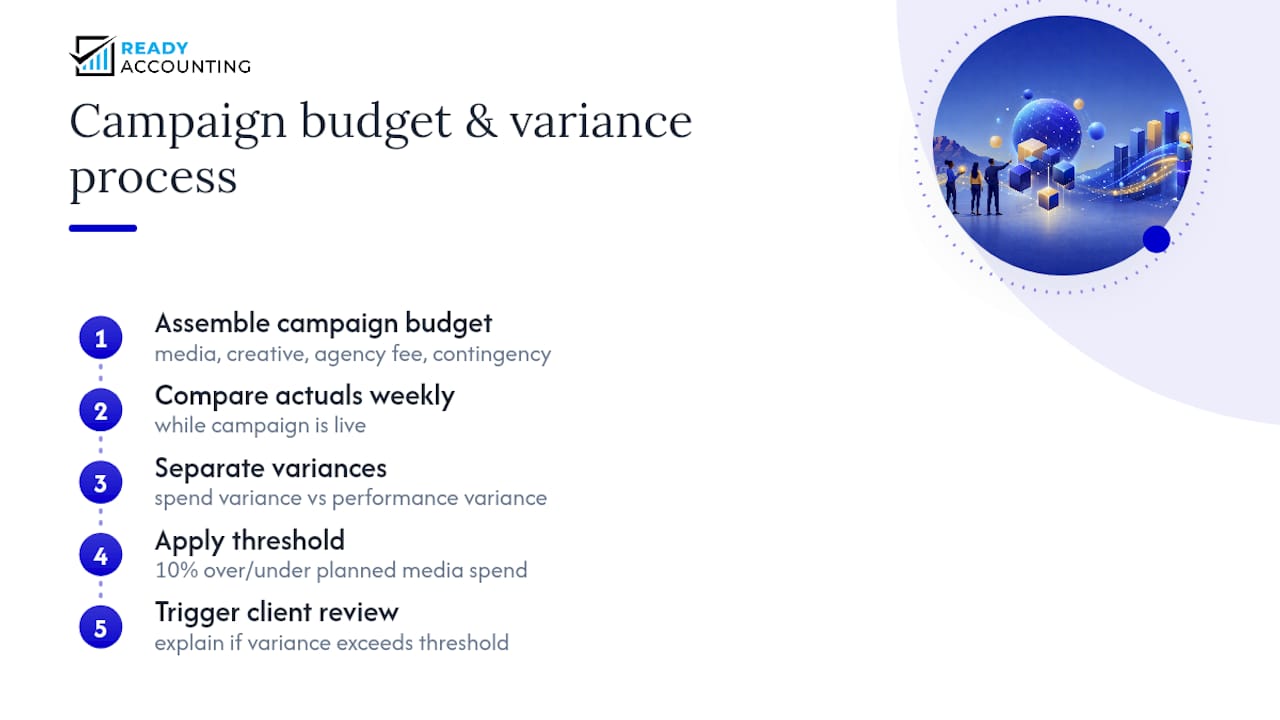
Variance analysis for agencies works best when you separate two very different kinds of variance: spend variance (did we spend what we planned to spend on media) and performance variance (did that spend deliver the results we forecast). A campaign can be perfectly on budget and still be a failure if performance targets were missed, and conflating the two in one report hides which problem you actually have.
Set a variance threshold that triggers a client conversation automatically, commonly 10% over or under planned media spend within any given week. Below that threshold, minor drift is normal. Above it, someone needs to explain why before the client’s finance team asks first. Build this into your month-end close process so budget-to-actual reporting is a standing agenda item, not a fire drill that only happens when a client complains about an invoice.
Handling multi-channel and cross-platform billing
Running campaigns across five or six ad platforms simultaneously creates a billing reconciliation problem most accounting systems weren’t built to handle out of the box. Each platform invoices on its own cycle, in its own format, sometimes in different currencies, and your client expects one consolidated invoice from you regardless.
The cleanest approach is a client-level clearing account structure, where every platform’s spend flows into that client’s clearing ledger as it’s incurred, and you invoice the client against the consolidated total on your own billing cycle rather than trying to match their invoice date to each platform’s date. This also protects your margin visibility, because your management fee sits cleanly on top of verified spend rather than getting blended into platform costs.
Currency exposure deserves separate attention if you manage international ad platforms billing in US dollars or euros while invoicing local clients in rand. Decide upfront whether you absorb exchange rate movement or pass it through to the client explicitly in your contract, and book any foreign exchange gain or loss as its own line item rather than letting it distort your reported media cost. Reconciling six platforms against one consolidated client invoice monthly, rather than quarterly, keeps the gap between what you’ve billed and what you’ve actually spent from growing unnoticed.
Refunds, rebates and credits in agency accounting
Client refunds happen for real reasons in this business: a campaign underdelivers against a contracted guarantee, a media platform issues a rebate for an ad-serving error, or a client cancels a retainer mid-cycle and is owed a prorated amount. How you book these determines whether your revenue figures stay trustworthy.
Never net a refund against current-month revenue as if it never happened. Book it as a credit note against the original invoice, reducing recognised revenue for that specific period and client, so your historical reporting stays accurate if anyone reviews it later. Media platform rebates, credits issued back to you rather than to the client, should flow through your media pass-through clearing account, not your agency fee revenue, because that money was never yours to begin with.
Set a clear internal policy for who can authorise a refund or credit above a certain amount, and require it to be documented against the original invoice number every time. Agencies that skip this step often end up with credit notes floating disconnected from any invoice, which makes both your accounts receivable ageing and your VAT reporting harder to trust at year-end.
What the conventional advice on agency accounting gets wrong
Most advice aimed at small businesses treats media pass-through as a footnote. For agencies, it’s the single biggest distortion risk in the entire ledger, and getting it wrong inflates revenue, understates margin, and can trigger unnecessary early VAT registration if you’re counting client media spend inside your own turnover.
The bigger gap is priorities. Owners chase software features and dashboard aesthetics before they’ve fixed the basics: a proper chart of accounts, weekly bank reconciliation, and project-level cost allocation. None of the automation in the world fixes a ledger where retainer revenue, project revenue, and pass-through spend are all lumped into one “Sales” line.
If you do one thing after reading this, split your revenue categories and separate client media spend into a clearing account this month. Everything else, the forecast, the KPIs, the software integrations, gets meaningfully easier once that foundation is actually clean.
— Johan
Get compliant, automated agency accounting with Readyaccounting
Readyaccounting replaces the spreadsheet-and-guesswork approach with real cloud infrastructure built for how agencies actually bill: retainers, project milestones, performance fees, and media pass-through all tracked separately, reconciled weekly, and visible on a live dashboard rather than reconstructed at month-end. That’s the concrete difference for an agency owner who’s currently finding out their cash position a month after it mattered.
We handle Annual Financial Statement preparation, VAT registration and SARS compliance, CIPC annual returns, payroll, and forensic bookkeeping cleanup, acting as your fractional CFO rather than a once-a-year tax filer. See exactly how the automation improves cash flow visibility for agencies like yours, then reach out to Readyaccounting to book a consultation and get your books, and your runway, under control.
This article is general information, not a substitute for advice from a qualified financial advisor. Consult a qualified financial professional about your own circumstances before acting on anything here.
Sources
Recommended
- Accounting for marketing agencies: streamline, comply, grow | Ready Accounting
- Digital marketing basics for South African SMEs: 2026 guide | Ready Accounting
- Accountants for advertising agencies: why generalists fall short | Ready Accounting
- How to Outsource Accounting for Small South African Businesses - Ready Accounting