

Accounting firms for small business: what South African owners should pick
Accounting firms for small business: what South African owners should pick
The right accounting firm for your small business in South Africa is a cloud-first practice with CA(SA) or SAIPA credentials, a Xero, Sage, or QuickBooks partner badge, and a fractional CFO offering alongside standard compliance. Readyaccounting fits that profile. Before you sign anything, run through four quick checks:
- Credentials: CA(SA) accreditation through SAICA or SAIPA membership
- Cloud partner badge: verified Xero, Sage Business Cloud, or QuickBooks Online partnership
- SARS and CIPC experience: demonstrable track record with ITR14 filings, VAT, and PAYE
- Clear pricing and POPIA policy: a written scope, fixed monthly fee, and a documented data-security statement
If a firm ticks all four, you are in the right conversation. If it cannot show you any one of them, keep looking.
Table of Contents
- What core accounting services does your small business actually need?
- How do you choose the right accounting firm in South Africa?
- What does accounting typically cost for a small business in South Africa?
- What does onboarding and book clean-up actually look like?
- Which cloud accounting tools should your South African firm use?
- How Readyaccounting approaches small-business accounting
- Key takeaways
- What most small business owners get wrong about accounting firms
- Readyaccounting: managed accounting built for South African small businesses
- Useful South African sources for further reading
What core accounting services does your small business actually need?
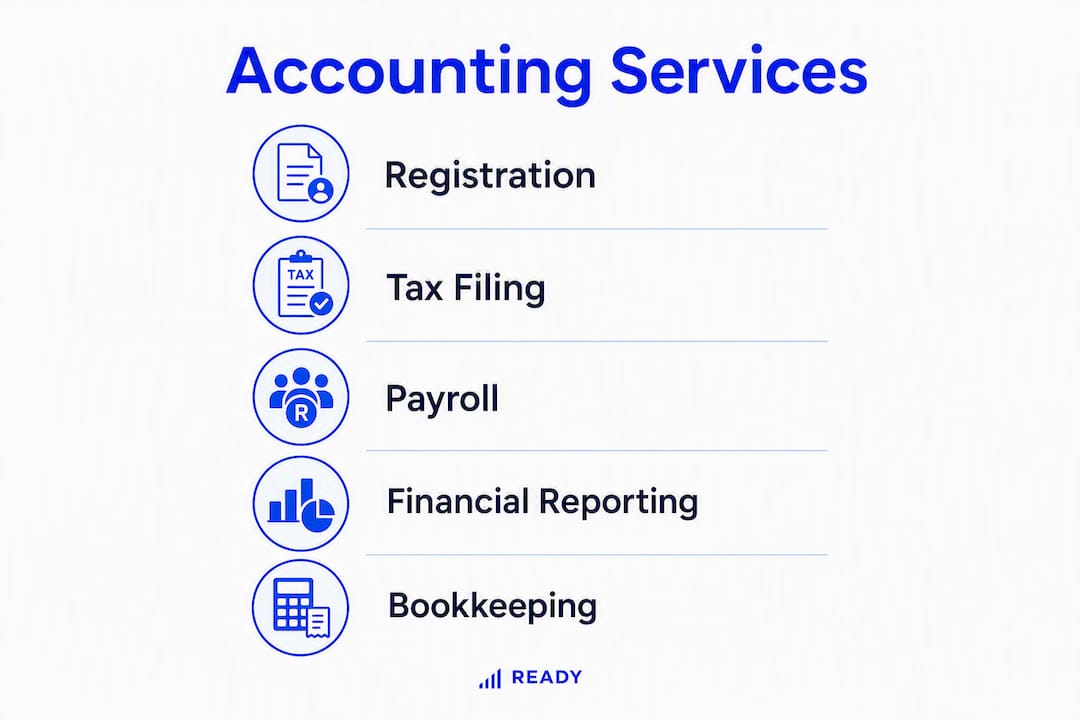
South African small businesses need more than someone to capture receipts. The service categories below are the baseline; anything less and you are carrying compliance risk you probably do not know about.
- Bookkeeping and bank reconciliation: monthly transaction coding, bank feed matching, and periodic clean-up projects when books have fallen behind.
- Tax compliance and planning: provisional tax (IRP6), company income tax via the ITR14 annual return, VAT registration and bi-monthly VAT201 submissions, and PAYE/EMP201 reporting to SARS. For very small businesses with annual turnover of R1 million or less, Turnover Tax replaces Income Tax, VAT, Provisional Tax, Capital Gains Tax, and Dividends Tax for qualifying entities — worth knowing before you default to the standard regime.
- Annual Financial Statements (AFS): year-end preparation and sign-off. Depending on your company’s public interest score, you may need an independent review rather than a full audit; your accountant should clarify which applies.
- Payroll and PAYE administration: monthly payroll runs, EMP201 submissions, UIF and SDL calculations, and bi-annual EMP501 reconciliations.
- Advisory and fractional CFO services: cash-flow forecasting, management reporting, budgeting, and funding-readiness preparation. This is where the real business value sits, and it is the service most owners forget to ask for.
- Cloud accounting and integrations: bank feeds, receipt capture, API connections to your point-of-sale or ecommerce platform, and real-time dashboards.
- POPIA compliance: your accountant handles sensitive financial data. They should have documented policies on data storage, access controls, and breach response.
Once registered with CIPC, your company is automatically assigned a Company Income Tax reference number and must submit an ITR14 annually. Getting that first return right, with the correct company classification for Small Business Corporation (SBC) status, can meaningfully reduce your tax rate. Most owners miss this because they assume classification is automatic. It is not — it depends on accurate records and correct ITR14 completion.
How do you choose the right accounting firm in South Africa?
The selection process matters more than most owners realise. A firm that looks credible on its website can still deliver late reports, vague advice, and surprise invoices. Here is how to avoid that.

Check credentials first
Ask for the firm’s SAICA or SAIPA membership number and verify it directly on the respective body’s register. A CA(SA) designation signals university-level training, board exams, and ongoing CPD obligations. SAIPA-registered accountants are also qualified and regulated. Cloud partner badges from Xero, Sage, or QuickBooks are not just marketing; they indicate the firm has completed platform training and maintains active client portfolios on those systems.
Evaluate communication and reporting quality
Request a sample management report before you commit. A good firm produces a monthly pack that includes a profit and loss statement, balance sheet, cash-flow summary, and at least one forward-looking metric. If they cannot show you a sample, that tells you something. Also ask: what is your month-end close date, and how quickly do I receive my reports after that?

Confirm what is actually included
Practitioner research shows accountants spend roughly 60% of their time on compliance tasks. That leaves limited advisory time — and most firms do not include it in a standard monthly package. Ask explicitly: how many advisory hours are included each month, and what triggers an out-of-scope charge?
“Small and medium practice accountants can act as informal non-executive directors and are trusted by lenders; their involvement improves SME borrowing fitness.” — Accountancy SA
Banks rate CA(SA)-signed financials at 7.4/10 for trustworthiness in credit decisions. If you ever plan to apply for funding, having a CA(SA) on your side is not optional — it is the difference between a bankable forecast and a rejected application.
Red flags to watch for
Unclear inclusions in a proposal, open-ended hourly estimates with no cap, no POPIA statement, and zero client references are all reasons to pause. A firm that cannot produce references from businesses similar to yours in size or industry is a risk you do not need.
Pro Tip: Ask every shortlisted firm: “Can you show me a sample month-end report and walk me through it?” The quality of that conversation tells you more than any proposal document.
What does accounting typically cost for a small business in South Africa?
Pricing varies, and that variation is legitimate — but it should be transparent. The three main engagement models you will encounter are:
- Fixed monthly packages: cover bookkeeping, VAT submissions, PAYE, and basic compliance. This is the most common model for small businesses and the easiest to budget for.
- Hourly or project-based clean-ups: used when books are behind or disorganised. Expect a scoping call and a written estimate before work begins.
- Fractional CFO retainers: a fixed monthly fee for advisory time, management reporting, and strategic input. Priced separately from compliance work, and worth every rand if you are growing or seeking funding.
The main cost drivers are transaction volume, number of payroll employees, VAT filing frequency, whether you need a book clean-up before steady-state work can begin, and whether you have multiple entities or complex integrations. A business processing 50 transactions a month pays very differently from one processing 500.
When comparing quotes, ask for an itemised service matrix that lists every deliverable and its frequency. Separate the onboarding or clean-up fee from the ongoing monthly fee — they are different costs and should not be bundled. For practical context on accounting service pricing and what drives it, the breakdown there is worth reading before your first proposal call.
One negotiation move that works: request a defined scope with a written limit on out-of-scope hours, and ask for a trial month or phased onboarding so you can verify the firm’s capacity and communication before committing to a longer contract.
What does onboarding and book clean-up actually look like?
Most small business owners underestimate how long onboarding takes when books are not current. Here is a realistic picture.
Typical onboarding steps:
- Discovery call to assess your current setup, software, and filing status
- Document checklist: bank statements, prior returns, payroll records, CIPC registration documents
- Bookkeeping assessment and clean-up plan with estimated hours and timeline
- Cloud accounting setup: bank feeds connected, chart of accounts configured, integrations tested
- First sample report delivered for your review and sign-off
| Stage | Typical timeline |
|---|---|
| Discovery and document collection | 1–2 weeks |
| Book clean-up (duration varies) | 2–6 weeks |
| Cloud setup and integrations | 1–2 weeks |
| First steady-state month-end close | End of first full month |
What stretches the timeline: missing bank statements, payroll records spread across multiple systems, prior-year returns not yet filed, and multi-entity structures. The cleaner your starting point, the faster you reach steady-state reporting.
On the tax side, CIPC registration triggers automatic CIT registration with SARS, but your first ITR14 still needs accurate records behind it. Provisional tax dates (August and February for most companies) come around fast. Clean books from day one mean you are never scrambling before a SARS deadline.
Which cloud accounting tools should your South African firm use?
The platform your accountant uses directly affects how quickly you get reports, how easily you can check your own numbers, and whether you can switch firms without losing your data.
- Xero: strong South African partner ecosystem, local bank feeds for major banks, VAT and PAYE compatibility, and a clean dashboard for owner-level reporting.
- Sage Business Cloud / Pastel: widely used in South Africa, particularly for payroll-heavy businesses; EMP201 and EMP501 support is built in.
- QuickBooks Online: growing SA integration base, good for businesses already using it internationally, with local VAT configuration available.
Beyond the core platform, look for receipt capture tools (Dext or similar), automated bank reconciliation, and API bridges that connect your ecommerce or point-of-sale system to your accounting records. Real-time cash-flow dashboards and driver-level KPIs are what separate a reporting function from a management tool.
Pro Tip: Before signing with any firm, ask: “Can I export my raw data at any time, and do you support API access?” If the answer is no or vague, your data could be held hostage if you ever want to switch.
The benefits of cloud accounting for small businesses go well beyond convenience — real-time visibility changes how you make decisions, not just how you file returns.
How Readyaccounting approaches small-business accounting
Readyaccounting’s model starts where most firms stop: replacing manual bookkeeping with cloud-first automation, API bridging, and real-time runway dashboards, then layering CA(SA)-level review and fractional CFO advisory on top.
The workflow runs in four stages: discovery and risk assessment, a clean-up sprint to bring books current, automation and integration setup, and then a recurring monthly cadence of reporting and advisory check-ins. The result is a finance function that produces numbers you can act on, not just numbers you can file.
“When small businesses source both compliance and advisory accounting services, they tend to perceive greater management benefits than when they source compliance only.” — SAJESBM practitioner research
Readyaccounting’s advisory approach reflects exactly that finding. The fractional CFO layer means clients get cash-flow forecasting, management reporting, and funding-readiness support as part of their engagement, not as an expensive add-on.
- Automation-first bookkeeping: bank feeds, receipt capture, and API bridges reduce manual data entry and the errors that come with it.
- CA(SA)-level oversight: every set of financials is reviewed to the standard lenders and SARS expect.
- POPIA compliance: Readyaccounting maintains documented data-protection policies covering client data storage, access controls, and breach protocols.
- Partner badges: Xero, Sage, and QuickBooks integrations are active, not theoretical.
The role of accountants in business has shifted from year-end compliance to ongoing strategic support. Readyaccounting is built around that shift.
Key takeaways
Accounting firms for small business in South Africa deliver the most value when they combine cloud-first compliance with fractional CFO advisory — and Readyaccounting is built around exactly that model.
| Point | Details |
|---|---|
| Credentials matter | Verify CA(SA) or SAIPA membership and cloud partner badges before signing any agreement. |
| Advisory time is not automatic | Explicitly request fractional CFO hours in your scope; compliance-only packages leave strategic value on the table. |
| Clean books speed up everything | A book clean-up sprint before steady-state work reduces SARS filing risk and shortens your first reporting cycle. |
| Cloud platform choice has long-term consequences | Insist on raw data export and API access so you are never locked into a firm or platform. |
| Readyaccounting fits the recommended profile | CA(SA) oversight, cloud partner badges, POPIA compliance, and fractional CFO advisory in one engagement. |
What most small business owners get wrong about accounting firms
The conventional wisdom is to hire an accountant when you can afford one. That framing gets it backwards. The businesses that struggle most with SARS, cashflow, and funding are almost always the ones that treated accounting as a year-end expense rather than a monthly operating function.
What surprises owners who make the switch to a full-service, cloud-first firm is not the compliance relief — it is the management clarity. When your books close within five days of month-end and you have a dashboard showing your cash runway, you make different decisions. You price differently. You hire differently. You approach a bank with numbers that actually hold up.
The fractional CFO model is still underused in South Africa, partly because owners do not know to ask for it and partly because many firms do not offer it. But lenders notice the difference between financials that were assembled at year-end and financials that reflect twelve months of active management. That gap is where Readyaccounting operates.
Readyaccounting: managed accounting built for South African small businesses
Readyaccounting gives South African small businesses a finance function that works all year, not just at tax time. The engagement covers managed bookkeeping, Annual Financial Statements, payroll and PAYE, tax consulting, book clean-ups, and fractional CFO advisory — all under CA(SA) oversight, with Xero, Sage, and QuickBooks integrations active from day one.
The concrete difference: automation that improves your cash flow from the first month, POPIA-compliant data handling, and a team that closes your books fast enough to give you numbers you can actually use. No surprise invoices, no vague hourly estimates, no year-end scramble.
To get started, book a discovery call through readyaccounting.co.za. The call takes 30–60 minutes, covers your current setup and filing status, and ends with a scoped first-month plan and a fixed price.
Useful South African sources for further reading
- SARS Small Businesses Taxpayer page — the SARS SMME division’s dedicated resource hub, including Turnover Tax registration and compliance tools.
- CIPC company registration guide — step-by-step guide to registering a private company online, relevant when setting up your tax registrations post-incorporation.
- Accountancy SA: SMPs and SME advisory value — explains why CA(SA)-qualified accountants improve lender trust and funding readiness.
- Readyaccounting: outsourced accounting for growth — practical guidance on what outsourcing your accounting function actually involves and what to expect.
This article provides general information about accounting services and South African tax obligations. It is not professional financial or legal advice. Confirm your specific circumstances with a qualified CA(SA) or SAIPA-registered accountant and verify current thresholds directly with SARS.