

Accountants for advertising agencies: why generalists fall short
Accountants for advertising agencies: why generalists fall short
If your agency is bleeding cash between paying media owners and waiting on client invoices, the fix is hiring accountants for advertising agencies who specialise in exactly this problem, not a general SARS-compliant bookkeeper who’s never seen a retainer contract. Advertising and marketing agencies run on media buys, project billing, and retainer cycles that don’t behave like normal business revenue, and a generalist accountant simply won’t build the reporting your business needs to survive them.
Specialist agency accounting fixes three things fast:
- Protects cash flow by modelling the gap between when clients pay and when media owners demand payment
- Restores margins through proper project accounting and cost allocation instead of guesswork billing
- Enables outcome-based pricing with the financial metrics (VAT-clean books, an accurate Annual Financial Statement, cloud accounting dashboards) that hybrid fee models require
The agencies that survive margin compression aren’t the ones cutting costs. They’re the ones who can finally see, in real time, which clients and campaigns are actually profitable.
Key Takeaways
Specialist agency accounting works because it treats retainer billing, media reconciliation, and cash-flow timing as core financial infrastructure, not optional add-ons.
| Point | Details |
|---|---|
| Cash-flow float is the core risk | Client terms of up to 150 days against 45-day media terms can create a 105-day funding gap. |
| Margins are already compressed | Industry estimates put agency margin loss at 30% to 50%, from outdated pricing and inefficiency. |
| Reporting must be client-level | Monthly management accounts broken down by client and campaign, not just total revenue, reveal real profitability. |
| Automation shortens cash conversion | API bridges between accounting, time-tracking, and media platforms cut manual reconciliation and speed up invoicing. |
| Readyaccounting builds for this exact problem | Its cloud automation, API integration, and fractional CFO advisory are structured specifically around agency billing and cash-flow patterns. |
Table of Contents
- What do specialised accountants for advertising agencies actually do?
- Why do advertising agencies face unique accounting challenges?
- What services and roles should an accounting partner offer?
- What technology should agency accounting run on?
- What’s the business case for outsourcing agency accounting?
- How do you choose the right accountant for your agency?
- How does Ready Accounting approach agency accounting in practice?
- How do you handle multi-jurisdiction tax if your agency operates across regions?
- Ready to fix your agency’s cash flow and reporting?
- Sources
What do specialised accountants for advertising agencies actually do?
A generalist bookkeeper reconciles a bank statement once a month and calls it done. An accountant for a marketing agency does something closer to running your finance department, because agency money moves in ways ordinary retail or services businesses never encounter.
The core operational work looks like this:
- Client billing and retainer management: tracking which retainers are flat-fee, which are hourly, and which convert to project billing mid-month
- Media cost reconciliation: matching what you paid media owners against what you invoiced clients, including markup and pass-through costs
- Project accounting: allocating staff time, production costs, and overhead to individual campaigns so profitability isn’t a guess
- VAT and payroll: filing on time and structuring invoices so input VAT on media spend gets claimed correctly
- Monthly management accounts: a proper profit-and-loss statement broken down by client, not just a total revenue number
Recurring deliverables should include aged debt reports so you know exactly who owes what and for how long, cash-flow forecasts built around media payment cycles rather than generic 30-day assumptions, profitability breakdowns by client and campaign, and a dashboard you can actually check on a Monday morning without calling your accountant to interpret it. This kind of finance-grade reporting is also what lets an agency finance function demonstrate marketing value to clients who increasingly demand proof of return.
Pro Tip: The single biggest time-sink in agency bookkeeping is manually reconciling media invoices against client billing. An API-driven feed from your media platforms into your accounting system removes hours of manual reconciliation every month and catches billing errors before they become client disputes.

Why do advertising agencies face unique accounting challenges?
Agencies operate with a cash-flow structure that would make a retail business owner’s head spin. Clients often try to push payment terms out to 90 or 150 days, while media owners typically expect payment within 45 days, creating a float of up to 105 days that agencies have to fund out of their own working capital. Smaller agencies and start-ups feel this hardest. They don’t have deep cash reserves to absorb an extended payment cycle, so a single slow-paying client can freeze payroll or delay a media payment that damages a supplier relationship.
Margin compression compounds the problem, making it essential to understand how to price AI services in your agency to align pricing models with value delivered. Industry estimates suggest creative agencies have lost between 30% and 50% of their margins in recent years, driven by process inefficiencies and pricing models that no longer match how agencies actually deliver value.
Agencies are floating client debt for a significant payment float while losing a substantial portion of their margin to pricing models built for a different era.
Beyond the big two, day-to-day operational friction eats away at profitability in smaller, less visible ways:
- Project misbilling when scope creeps but the invoice doesn’t
- Poor time capture that makes it impossible to know if a retainer is actually profitable
- VAT timing errors on media spend that trigger unnecessary cash outlays
- Staff costs allocated to the wrong campaigns, masking which accounts are actually worth keeping
What services and roles should an accounting partner offer?
The right partner covers both the operational grind and the strategic layer, and you need to know which is which before you sign anything.
On the operational side, expect bookkeeping, payroll, VAT filing, monthly management accounts, tax returns, and annual financial statement preparation. If your books are already a mess from years of ad hoc handling, forensic clean-up work should be on the table too. This isn’t a nice-to-have. SARS obligations around registration, record-keeping, VAT, and PAYE apply regardless of how chaotic your internal systems are, and the SARS Tax Guide for Small Businesses lays out exactly what’s required.
On the advisory side, look for access to a fractional CFO who can model cash flow and pricing strategy, a financial controller who owns the monthly close, a dedicated bookkeeper who understands agency workflows specifically, and an accounts receivable function that actively chases aged debt instead of just reporting it.
These roles need to talk to your account managers, not sit in a silo. Insist on a monthly profit-and-loss statement broken out by client, and a rolling cash-flow model that accounts for media payment timing. Providers who specialise in this space, like the tax consultants covered in this overview of agency-focused tax advisors, tend to build these deliverables into the retainer by default rather than charging extra for basic visibility.
What technology should agency accounting run on?
Cloud accounting is table stakes now, but the real value comes from what connects to it. Your stack needs five pieces working together: cloud accounting as the system of record, time-tracking that feeds project costs directly into that system, API bridges to your media vendors so spend reconciles automatically, payment and collections automation to chase aged debt without manual follow-up, and dashboards that surface client-level profitability without a spreadsheet marathon.
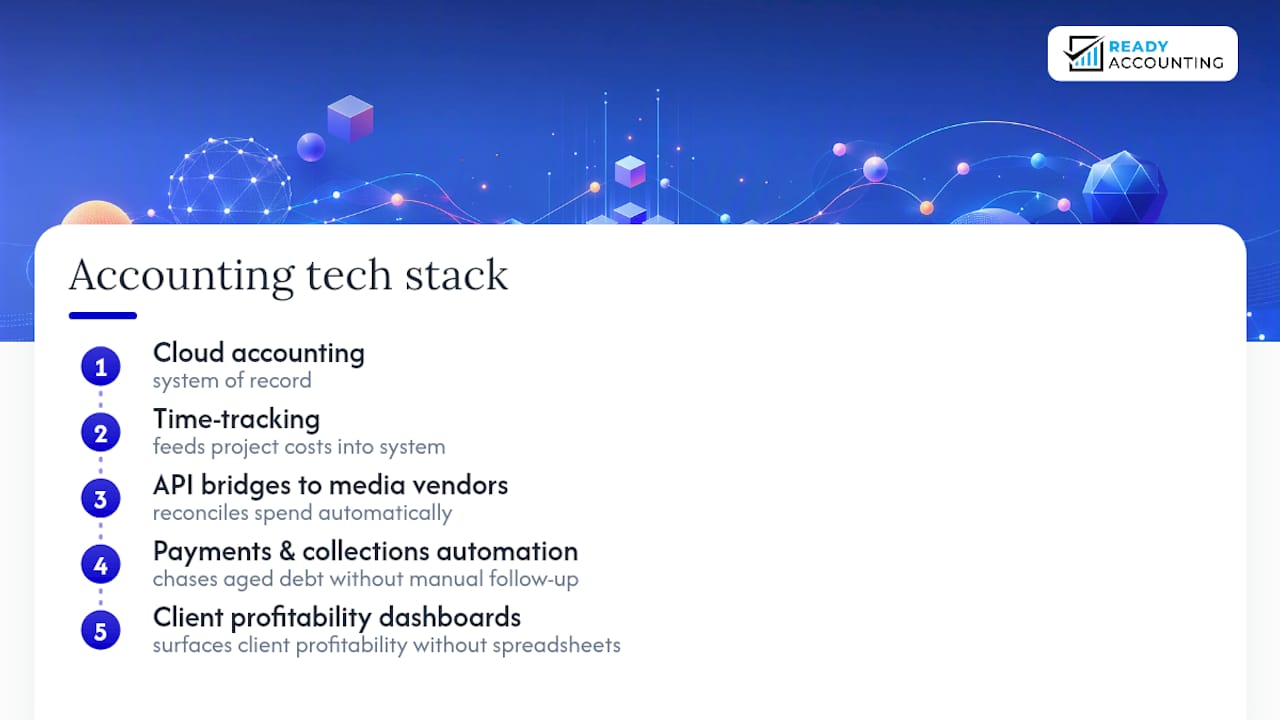
In practice, this means your accounting platform pulls data from time-tracking and media-buying tools through middleware rather than someone re-typing numbers between systems every month. Digital capability like this is one of the critical success factors identified for agency sustainability in a competitive, digitally disrupted market.
Pro Tip: If you can only automate one thing this year, automate retainer invoicing tied to campaign milestones. It shortens your cash conversion cycle faster than any other single change, because invoices go out the moment work is delivered instead of waiting for someone to remember to bill.
What’s the business case for outsourcing agency accounting?
Outsourcing to a specialist beats hiring a generalist in-house for one simple reason: speed to useful reporting. A specialist arrives already knowing how media reconciliation and retainer billing work, so you skip months of the learning curve a generalist hire would need.
The commercial payoff shows up in a few concrete places:
- Cash flow becomes predictable instead of a monthly scramble
- VAT and SARS compliance stops being a source of anxiety
- Client and campaign margins become visible instead of assumed
- Financial close happens faster, with fewer year-end surprises
- Fractional CFO input becomes affordable instead of a full-time salary line
Bank-and investor-ready reporting is a real byproduct here too. If you’re raising capital or negotiating a credit line, clean monthly management accounts and a proper annual financial statement carry weight that a shoebox of invoices never will.
How do you choose the right accountant for your agency?
Run this as a structured evaluation, not a gut-feel decision based on who you liked best over coffee.
- Check technical capability first. Can they produce a sample management account broken down by client, not just a total revenue figure?
- Confirm agency experience. Ask for references from other advertising or marketing clients specifically, not general small business clients.
- Test their automation fluency. Do they already use API integrations with media platforms and time-tracking tools, or is everything manual?
- Review actual reporting samples. A generic template tells you nothing. Ask to see anonymised real output.
- Understand the fee model upfront. Flat retainer, hourly, or hybrid, and what’s included versus billed as extras.
When you interview shortlisted providers, ask direct questions: How do you handle the timing gap between client payments and media-owner terms? What KPIs do you deliver monthly, and can I see an example? Have you built a fractional CFO model for an agency before, and what did it change? How do you handle VAT on pass-through media costs? What’s your process when a client disputes an invoice? Can you show me a cash-flow forecast template you’ve built for a similar-sized agency?
Red flags are easy to spot once you know what to look for: no agency references, no evidence of automation beyond a spreadsheet, vague answers about cash-flow strategy, or sample reports that look like they were built for a retail business. Score each proposal against the same five criteria above in a simple matrix, because comparing notes from memory after three separate conversations never works as well as you think it will.
For agencies weighing outsourced versus in-house, this breakdown of monthly bookkeeping packages is a useful benchmark for what a fair retainer actually includes.
How does Ready Accounting approach agency accounting in practice?
Readyaccounting’s engagement with agency clients typically follows four stages. First, a discovery phase maps your existing billing structure, retainer terms, and media vendor relationships. Second, a books clean-up resolves historical misallocations and VAT errors before anything new gets built on top. Third, automation and API bridging connect your accounting platform to media vendors and time-tracking tools so reconciliation stops being a monthly fire drill. Fourth, ongoing monthly reporting and fractional CFO advisory give you the cash-flow visibility and pricing insight to negotiate confidently with clients.
Agencies going through this process can expect a few concrete shifts: real-time visibility into which clients and campaigns are actually profitable, automated media reconciliation instead of manual matching, and a monthly dashboard that replaces the end-of-quarter scramble to figure out where the money went. Readyaccounting’s focus on cloud automation and API integration is built specifically around removing that administrative drag for growing businesses.
How do you handle multi-jurisdiction tax if your agency operates across regions?
Agencies serving clients in multiple provinces or countries face a layer of complexity a single-location business never encounters. VAT registration thresholds, filing obligations, and payroll tax rules can differ depending on where staff are employed and where services are rendered, and getting this wrong tends to surface at the worst possible moment, usually during a SARS audit or a client’s own compliance review.
The starting point is always the same: know exactly where your agency has a tax obligation, which is often called nexus in accounting terms, before you start billing across a new region. Within South Africa, VAT and PAYE obligations are governed by SARS rules regardless of where in the country a client sits, but agencies serving international clients need to consider whether services rendered abroad trigger foreign tax registration or withholding requirements in that client’s jurisdiction.
Currency exposure adds another wrinkle. If you’re invoicing international clients in US dollars or euros while paying local media owners and staff in rand, exchange rate movements can quietly erode a margin that looked healthy on the invoice date. A specialist accountant builds this into cash-flow forecasting rather than treating it as a surprise at month-end.
The safest approach is documenting where each client relationship sits, which jurisdiction’s rules apply, and reviewing that map annually as your client base shifts. Agencies expanding into new markets should get a tax opinion before signing a contract, not after the first invoice goes out.
A note from Johan
I’ve watched too many agencies treat accounting as a compliance chore instead of the tool that could actually save their margins. Readyaccounting builds around agency cash-flow patterns specifically because generic bookkeeping simply can’t catch what’s draining your profitability.
Ready to fix your agency’s cash flow and reporting?
The agencies that recover from margin compression aren’t cutting staff or slashing rates. They’re the ones who finally know which clients pay for themselves and which don’t, because their books are automated enough to tell them in real time instead of three months late. That’s the gap Readyaccounting closes for advertising and marketing agencies: cloud accounting infrastructure, API bridges to your media and time-tracking platforms, and fractional CFO input that turns your finance function from a monthly headache into a decision-making tool.
If your biggest pain point right now is the gap between client payments and media-owner deadlines, start with this breakdown of how automation improves cash flow. From there, book a consultation through Readyaccounting’s outsourced accounting and fractional CFO service page, and bring your last three months of client invoices and media statements. That’s usually enough for a first, useful read on where your margin is actually leaking.
Sources
- Small and start-up media agencies pay the cost for payment terms - The Media Online
- Advertising industry’s storyboard needs sharper pencils - Business Day
- A framework for the sustainability of advertising agencies in an emerging economy: the case of South Africa
- SARS Tax Guide for Small Businesses
Recommended
- Accounting for marketing agencies: streamline, comply, grow | Ready Accounting
- Top 3 Accounting Firm for High Net Worth Individuals Agencies 2026 | Ready Accounting
- Small accounting firms: how South African SMEs choose right | Ready Accounting
- Top 6 Venture Capital Accounting Experts Agencies 2026 | Ready Accounting